
 Shelby Cobra
Specs, engines and history
Updated Published Sources (2) Report an error
By Sarah Whitmore, Senior Automotive Writer Reviewed by Oleksandr Hnatiuk

- Built
- 1962–1967
- Top power
- 317 kW (431 PS)
Which Shelby Cobra to choose: our verdict
Our verdict · Sarah Whitmore
- Original 289 (Mk I or Mk II): the purest Cobra, light and well balanced. The choice for collectors who want the car that started it all.
- Original 427 (Mk III): the most powerful and the most valuable; demanding to drive fast. Check documented history carefully, because only about 343 coil-spring cars were made and authenticity questions are common.
- Shelby continuation car (CSX4000 and later): the closest to an original that you can drive regularly, with factory documentation.
- AC Mk IV or later AC: a British-built, more refined way to own the shape.
- Replica or kit car: the most affordable route to the look, but not a collector's Cobra.
Records show how valuable originals are: the 1966 Super Snake, chassis CSX3015, set an auction record for an American-built car in January 2007. All AC models are listed on our AC Cars brand page.
The Shelby Cobra is a two-seat sports car Carroll Shelby created by fitting a Ford V8 into the AC Ace roadster from England. AC Cars built the bodies and chassis in Thames Ditton, England, and Shelby American finished the cars in Los Angeles from 1962 to 1967. About 998 were made: 655 with leaf springs (260 and 289 engines) and 343 coil-spring 427s with up to 317 kW (425 hp).
In short
- Built 1962–1967 in three main versions: Mk I (260 and 289 V8), Mk II (289, rack-and-pinion steering) and Mk III (427 V8, coil springs).
- The first car, chassis CSX2000, was completed in January 1962; the first 75 cars had the 4.3-litre 260 V8.
- The 427 delivered 317 kW (425 hp) and 651 Nm in standard form, 362 kW (485 hp) as the S/C, with a top speed of up to 298 km/h.
- Cobras and the Daytona Coupé won the 1965 International Championship for GT Manufacturers for Shelby and Ford.

Specs by version
Verified Manufacturer and type-approval data from our catalog · Sources and methodology
Shelby Cobra at a glance
| Fact | Value |
|---|---|
| Makers | AC Cars (UK) and Shelby American (US) |
| Production | 1962–1967 (AC 289 in Europe until 1969) |
| Total built | about 998 (655 leaf-spring, 343 coil-spring) |
| Body | Two-seat open roadster, aluminium body |
| Chassis | Steel tube ladder frame |
| Engines | Ford V8: 260, 289, 427 (and 428) cu in |
| Top version | 427 S/C, 362 kW (485 hp) |
| Successor line | AC Mk IV and Shelby continuation cars |
The AC Ace, built from 1953, had a light tubular chassis and a hand-built aluminium body but only small six-cylinder engines. Shelby's idea was to give it American V8 power. The maker's own story is told in the history of AC Cars, and the wider family of Shelby cars in our Shelby history.

From AC Ace to Cobra: how it began
In September 1961 Ford gave Shelby two of its new small-block V8 engines, and one went to AC in England. In January 1962 AC's Thames Ditton works completed the prototype, chassis CSX2000, with a stronger Salisbury rear differential and inboard rear brakes of the type used on the Jaguar E-Type. It was flown to Los Angeles on 2 February 1962, and Shelby's team fitted the engine in less than eight hours.

Cars were then shipped from England without engines and completed in California, while AC built finished European-specification cars from late 1963. The arrangement was costly, and Ford and Shelby stopped importing Cobras from England in 1967.
Versions: Mk I, Mk II and the 427 Mk III
| Version | Years | Engine | Chassis and suspension | Built |
|---|---|---|---|---|
| Mk I (260) | 1962 | 260 cu in (4.3 L) V8 | 3-inch tube frame, transverse leaf springs | 75 incl. prototype |
| Mk I (289) | 1962–1963 | 289 cu in (4.7 L) V8 | As above | 51 |
| Mk II | 1963–1965 | 289 cu in (4.7 L) V8 | Rack-and-pinion steering, leaf springs | about 528 |
| Mk III (427) | 1965–1967 | 427 cu in (7.0 L) FE V8; some 428 | 4-inch tube frame, coil springs all round, wider body | 343 coil-spring cars, about 260 street cars |
| Daytona Coupé | 1964–1965 | 289 cu in V8 | Closed aerodynamic body by Pete Brock | 6 |
The Mk II's steering rack came from the MGB and the column from the Volkswagen Beetle. The Mk III was a far bigger change: Ford engineers designed a new chassis with 4-inch main tubes and coil-spring independent suspension, with wide wheel arches and a larger radiator opening. The aim was FIA homologation as a race car, but only 56 of the 100 required competition cars were built, so the remaining cars were sold as road-going "Semi-Competition" (S/C) and street models.

Ford V8 engines: from the 260 to the 427
| Engine | Displacement | Power | Torque | Notes |
|---|---|---|---|---|
| Ford Windsor 260 V8 | 4.3 L (260 cu in) | about 194 kW (260 hp gross), old 1cars text | – | First 75 cars |
| Ford Windsor 289 V8 | 4.7 L (289 cu in) | more than the 260 | – | Mk I late and Mk II |
| Ford FE 427 side-oiler V8 | 7.0 L (427 cu in) | 317 kW (425 hp) at 6,000 rpm | 651 Nm (480 lb-ft) at 3,700 rpm | Single four-barrel carburettor |
| 427 S/C | 7.0 L | 362 kW (485 hp) | – | Competition tune, 298 km/h |
| Ford FE 428 V8 | 7.0 L (428 cu in) | about 268 kW (360 hp) | – | Used in some 1966–1967 cars |
All original Cobras drive the rear wheels through a four-speed manual gearbox. The standard 427 had a top speed of 264 km/h (164 mph) and the S/C reached 298 km/h (185 mph). In a November 1965 test, Car and Driver reported that a 427 Cobra could accelerate from rest to 100 mph and brake to a stop again in about 14.5 seconds; Ken Miles did it in 13.8.

The 427 stops on discs at all four corners and has a limited-slip differential. The 427's reputation comes from its power-to-weight ratio, extreme for the 1960s and delivered without any electronic aids. You can work out the ratio for any car, classic or modern, with our power-to-weight calculator.
Racing: the Daytona Coupé and the 1965 GT title
The Cobra was built to win races, and Shelby's team raced it from its first season in 1962. Its closed sister, the Daytona Coupé designed by Pete Brock, won the GT class at Le Mans in 1964 and finished fourth overall, reaching more than 315 km/h (196 mph) on the Mulsanne Straight. In 1965 Shelby clinched the International Championship for GT Manufacturers at the 12 Hours of Reims on 3–4 July, ending Ferrari's run in the GT category. In November 1965 a Daytona Coupé set 25 world speed records at Bonneville.

Special versions included the Dragon Snake drag-racing package, of which the factory built six 289s and one 427, and the 1966 "Super Snake", a road-legal 427 with twin Paxton superchargers.
After 1967: AC Mk IV, continuation cars and replicas
The Cobra name and shape lived on long after original production:
- AC 289 and AC 428: AC kept building a coil-spring 289 roadster for Europe until late 1969, and the Frua-bodied AC 428 until 1973.
- Autokraft and AC Mk IV (1986–1996): about 480 cars with a 4.9-litre Ford V8 of around 186 kW (250 hp); a 1990 Lightweight version had 276 kW (370 hp). The Mk IV reached 215 km/h and 100 km/h in 5.2 seconds.
- Shelby continuation cars: from the late 1980s Shelby built new cars numbered in the CSX4000 series (427 style), CSX6000 (coil-over), CSX7000 (leaf-spring FIA type), CSX8000 (289 street) and CSX9000 (Daytona Coupé).
- Later AC models: the Mk V of 2004–2007 with a 5.0-litre Ford V8 and, from 2009, the Mk VI built in Germany with a 6.2-litre Chevrolet V8.

The old 1cars text's figure of 0–100 km/h in 3.3 seconds refers to one of these modern cars, not to a 1960s original. Countless replicas and kit cars also copy the 427 shape; they are a separate market from genuine CSX or COB chassis.
Rivals: how the Cobra compared in the 1960s
The Cobra's main American rival was the Chevrolet Corvette C2 Sting Ray; according to the old 1cars text, the Cobra took the racing honours from the Corvette soon after its debut. In Europe it took on Ferrari's GT cars, and on the road it was compared with the Jaguar E-Type. Compared with the Corvette, the Cobra was smaller, lighter and far more basic, an open roadster with little more than the essentials. Other American icons of the decade, including the Shelby Mustang GT500, are in our list of the best classic cars of the 1960s.

Rivals
Compare with…
Compare Shelby Cobra with
- Mercedes-Benz 300SL quick spec comparison

Shelby Cobra in our rankings
- No. 26 of 90 · Most powerful convertibles and roadsters (317 kW · top 29%)
- No. 318 of 1133 · Most powerful cars (317 kW · top 29%)
- No. 61 of 127 · Most powerful British cars (317 kW · top 49%)
- No. 173 of 202 · Most powerful V8 cars (191 kW · top 86%)
More powerful than 71% of ranked convertibles and roadsters in the 1CARS catalog (No. 26 of 90).
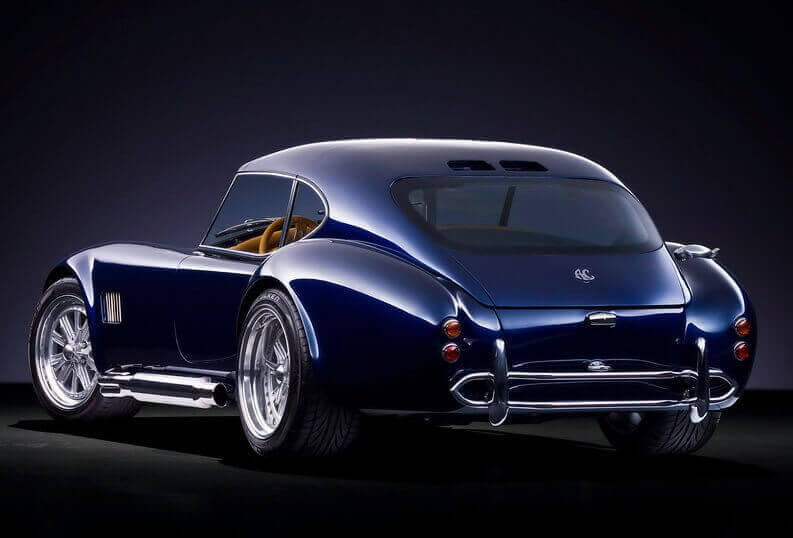
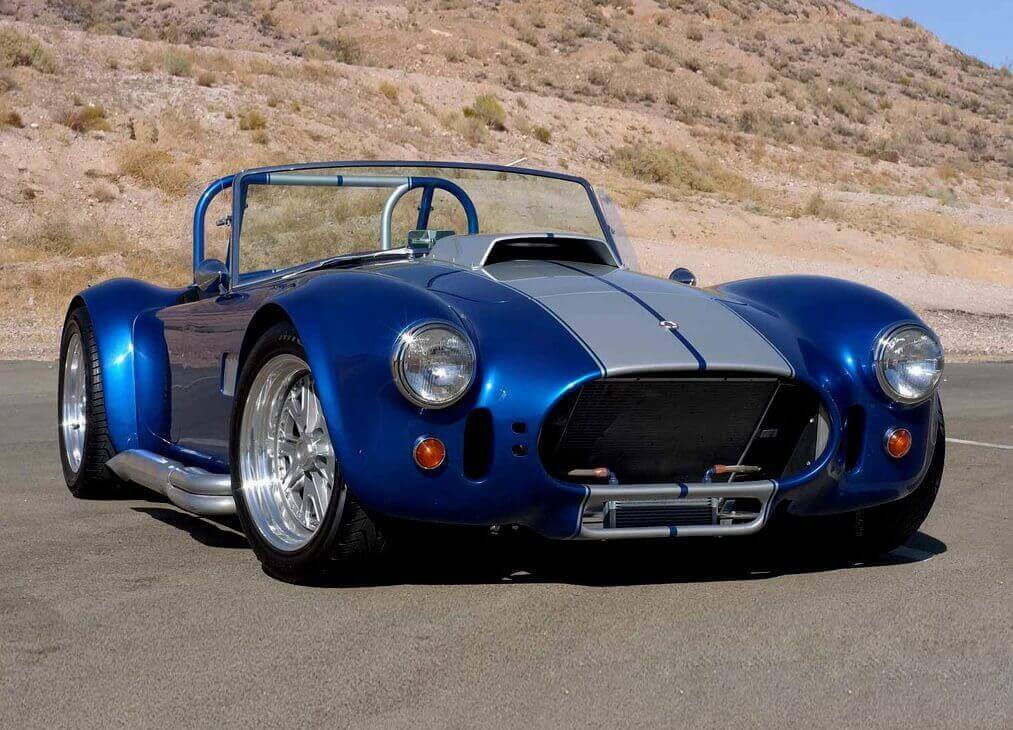
Shelby Cobra photos 15




Shelby Cobra videos 3

Shelby Cobra video 1

Test drive

Video overview
FAQ
How many original Shelby Cobras were built?
About 998 original Cobras were built from 1962 to 1967: 655 leaf-spring cars with the 260 and 289 V8s and 343 coil-spring 427 cars. Later continuation cars, AC-built models and replicas are not included in that total.
What engine is in a Shelby Cobra?
Original Cobras use Ford V8 engines: the 4.3-litre 260 in the first 75 cars, the 4.7-litre 289 in the Mk I and Mk II, and the 7.0-litre 427 FE in the Mk III. The standard 427 gives 317 kW (425 hp) and 651 Nm.
How fast is a Shelby Cobra 427?
A standard 427 Cobra could reach 264 km/h, while the 427 S/C with 362 kW (485 hp) reached about 298 km/h (185 mph). In 1965 Car and Driver measured 0–100–0 mph in about 14.5 seconds.
Is the Shelby Cobra British or American?
Both. The chassis and aluminium body came from AC Cars in Thames Ditton, England, based on the AC Ace. Carroll Shelby's company in Los Angeles installed the Ford V8 engines and gearboxes and sold most cars in the United States.
What is a Shelby Cobra continuation car?
It is a new Cobra built by Shelby since the late 1980s with an official chassis number in a continuation series, such as CSX4000 for 427-style cars and CSX8000 for 289 street cars. They follow the original design but are not period cars.
Data sources
Data checked by an editor against the sources below.
- The text of this article (1cars archive)
- Wikipedia - AC Cobra


