
A Completely Different Zaporozhets: The Prototypes Behind ZAZ
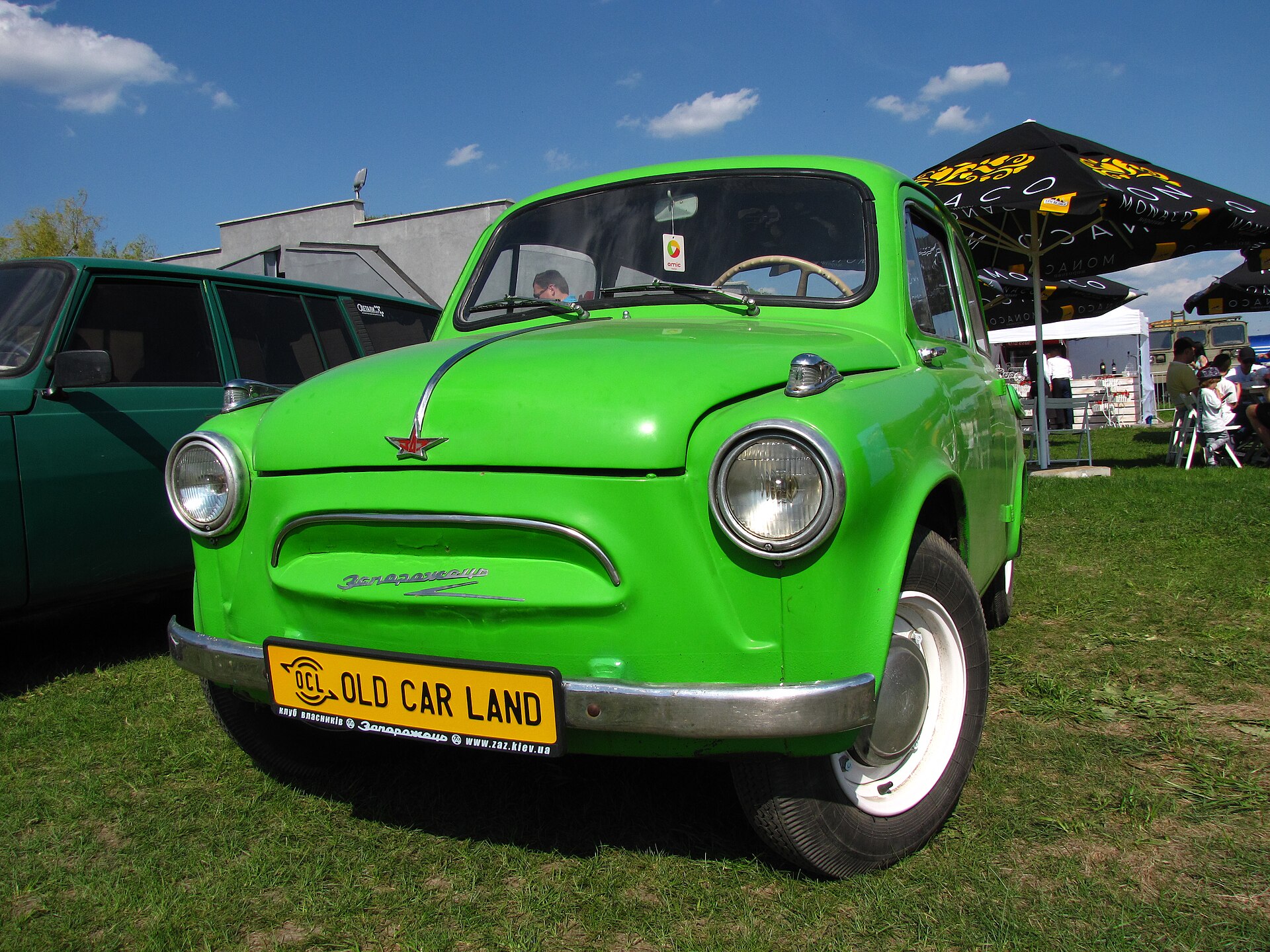
The Zaporozhets was the small rear-engined car built by ZAZ in Zaporizhzhia, Ukraine, from 1960 to 1994, with 3,422,444 made. Behind the production cars stood a second, almost forgotten Zaporozhets: prototypes of a larger saloon, vans, pickups and futuristic taxis, most of which never left the experimental workshop.
Key takeaways
- The ZAZ-965 entered production on 25 October 1960; its roots go back to the Moskvich-444 prototype of 1957 and the Fiat 600.
- A prototype of the larger ZAZ-966 appeared as early as 1961, but series production only began in 1966–1967.
- Van, pickup and minibus versions for rural buyers were built as prototypes and dropped.
- Yuri Dolmatovsky's VNIITE taxis of 1963–1964 showed a one-box layout two decades before the European MPV boom.

Background: why a rear engine
In the 1950s small rear-engined cars were the fashion across Europe. They were cheap to build, light and roomy for their size, as the Fiat 600 and the Volkswagen Beetle showed. Soviet engineers had studied the layout since the early 1950s; the old 1cars text dates the first experimental designs to 1951 and credits the rear-engined concept work to the designer Yuri Dolmatovsky.

Design of the future Zaporozhets began in 1956 as a simple economy car to partly replace the Moskvich 401. The Fiat 600 was the reference. MZMA, the Moskvich factory, built the first prototype, the Moskvich-444, in October 1957. It first used an MD-65 flat-twin motorcycle engine, which proved unsuitable. The ministry preferred the NAMI-G, a 746 cc air-cooled V4 with a magnesium-alloy block that had been developed for the LuAZ off-roader.
Development and launch of the ZAZ-965
On 28 November 1958 the authorities approved production of the car at the former Kommunar plant in Zaporizhzhia. The Kommunar factory traced its history to the farm-machinery works that Abram Koop founded in 1863 and had built combine harvesters since 1929. It was renamed the Zaporizhzhia Automobile Plant, ZAZ, and engines came from the Melitopol Motor Plant (MeMZ), which started supplying them in 1960.

| Year | Event |
|---|---|
| 1956 | Design of a small economy car begins, with the Fiat 600 as reference |
| 1957 | MZMA builds the Moskvich-444 prototype (October) |
| 1958 | Production approved at the Kommunar plant, Zaporizhzhia (28 November) |
| 1960 | ZAZ-965 approved on 25 July; series production starts on 25 October |
| 1961 | First prototype of the larger ZAZ-966 |
| 1962 | ZAZ-965A with the 887 cc engine (November) |
| 1963–1964 | VNIITE taxi and minivan prototypes by Yuri Dolmatovsky |
| 1966–1967 | ZAZ-966 enters production |
| 1969 | ZAZ-965A production ends (May) |
| 1979 | ZAZ-968M introduced |
| 1994 | Last Zaporozhets built (1 June) |
The old 1cars text gives 20 November 1960 as the day the first car left the line; Wikipedia gives 25 October 1960 as the start of series production.
The 1961 ZAZ-966 prototype
The ZAZ-965, nicknamed "the hunchback" for its rounded shape, had barely reached buyers when young engineers at the plant began work on a successor. In 1961 they showed the first prototype of the ZAZ-966, a larger car with the proportions of a conventional saloon. Its flat waistline and wraparound roof reminded observers of the NSU Prinz 4, which appeared in Germany the same year, and of the Chevrolet Corvair.

The likeness was not a coincidence of taste alone. According to the old 1cars account, a Corvair was studied at the NAMI research institute while engineers fought the overheating of the air-cooled ZAZ engine. The ZAZ-966 then took six years to reach production. When it did, in late 1966, it still used the 887 cc engine with 22 kW (30 PS), and only from 1968 did it get the 1,197 cc MeMZ-968 V4 with 29 kW (40 PS). Its big side air intakes earned it the nickname "the eared one".
Vans, pickups and a car for villages
Alongside the saloon, the designers planned a whole family on Zaporozhets mechanicals with a 22 kW (30 hp) engine: a pickup, a van and a minibus, often referred to as the ZAZ-970 family. The idea was to complete the range with a simplified open body and a tarpaulin roof. The main customers were meant to be rural buyers who needed a cheap utility vehicle.

The plant could not supply such a range alongside the saloons. With the ZAZ-966 about to enter production, the utility prototypes were abandoned. The open-car idea survived elsewhere: the LuAZ-969, built in Lutsk, used Zaporozhets engines in a light four-wheel-drive vehicle.
Dolmatovsky's VNIITE taxis
The boldest "other Zaporozhets" came from VNIITE, the institute of technical aesthetics founded around 1962 with advice from Raymond Loewy. Yuri Dolmatovsky, its designer and later director, produced two taxi concepts in 1963–1964.

| Prototype | Year | Base and engine | Key features |
|---|---|---|---|
| VNIITE "Maxi" / taxi | 1963–1964 | ZAZ-965 platform, rear air-cooled V4 | Glass-fibre one-box body, sliding doors on both sides, five seats, swivelling front seats, 11 cm wider than the base car |
| VNIITE-PT | 1964 | Moskvich-408 engine, about 37 kW (50 hp) | Steel frame with plastic panels, low floor, sliding door, three-seat sofa plus a folding seat, partition and a taximeter facing passengers |
The ZAZ-based car raised the front suspension and steering linkage to just below the windscreen to free space for the occupants, a solution that was also said to help in a frontal collision. The VNIITE-PT went into trial operation, and journalists dubbed it the "modern taxi". Only one was built. Its packaging is often compared with the 1984 Renault Espace, though there is no known link between the two. The old 1cars text adds that a later Dolmatovsky concept weighed 650 kg and had a 22 kW (30 hp) ZAZ engine at the back.
Technical highlights
| Parameter | ZAZ-965 (1960) | ZAZ-965A (1962) | ZAZ-968 (1971) |
|---|---|---|---|
| Engine | NAMI-G / MeMZ air-cooled V4, rear | MeMZ-965 V4, 887 cc | MeMZ-968 V4, 1,197 cc |
| Displacement | 746 cc | 887 cc | 1,197 cc |
| Power | – | 20 kW (27 PS); 22 kW (30 PS) from late 1966 | 29 kW (40 PS) |
| Suspension | Independent on all wheels, front torsion bars | Same | Same |
Compared with the first 746 cc unit, the 1,197 cc MeMZ-968 had 60% more displacement and roughly 50% more power than the 887 cc engine of 1962. The engine's magnesium-alloy block and air cooling kept weight low but made overheating a recurring issue. The Zaporozhets family kept independent suspension on all four wheels, which helped on poor roads.

Why the other Zaporozhets vanished
By the late 1960s the industry's priorities had changed. The money went into a huge new plant for front-engined, Fiat-based cars and into raising output, not into experimental designs. ZAZ itself moved on to front-wheel drive with the ZAZ-1102 Tavria, which entered production in 1987–1988. The rear-engined era, and with it the romantic prototypes, came to an end. The full story of the plant, up to the Lanos and the ZAZ Chance, is in the history of ZAZ.
Legacy: collecting a Zaporozhets today
The production Zaporozhets is now a cult car with clubs across Ukraine and beyond, and well-kept 965 "hunchbacks" are the most sought-after. The prototypes are a different matter: most were scrapped, and the few that survive belong to museums. For collectors of 1960s Eastern European cars, see the Soviet-era classics section and the 1960s classics section; the ZAZ catalogue lists the production models, and the 1cars specifications section holds their data. One modern tribute even used a Porsche Boxster to build a Zaporozhets-style car.

FAQ
When was the first Zaporozhets made?
Series production of the ZAZ-965 started on 25 October 1960 at the Zaporizhzhia Automobile Plant, after approval on 25 July 1960. The old 1cars text dates the first car off the line to 20 November 1960.
How many Zaporozhets cars were produced?
ZAZ built 3,422,444 Zaporozhets cars from 1960 to 1994 across the 965, 966, 968 and 968M families. The first-generation ZAZ-965 accounted for about 322,000 of them.
Was the Zaporozhets a copy of the Fiat 600?
No. Its designers used the Fiat 600 as a reference for size and layout, and the cars look alike, but the Zaporozhets was its own design, with an air-cooled V4 engine and torsion-bar front suspension.
What were the VNIITE taxi prototypes?
They were 1963–1964 concepts by Yuri Dolmatovsky: a glass-fibre one-box taxi on the ZAZ-965 platform and the VNIITE-PT with a Moskvich-408 engine and a sliding door. Neither reached production.
Why were the Zaporozhets vans and pickups never built?
The plant lacked the capacity to build them alongside the saloons, and the new ZAZ-966 was about to enter production. The prototypes were dropped, and the industry's investment went to new front-engined cars.


