
 Dodge Charger SRT Hellcat
Specs, engines and history
Updated Published Sources (5) Report an error
By Felix Hartmann, Automotive Technology & EV Contributor Reviewed by Oleksandr Hnatiuk

- Built
- 2014–2023
- Top power
- 602 kW (818 PS)
Which Hellcat sedan to choose
Our verdict · Felix Hartmann
- For value: an early 2015–2019 narrow-body car, usually the least expensive version on the used market.
- For grip and stance: a 2020 or later Widebody with the wider tyres.
- For maximum power: a 2021 Redeye or a 2022–2023 Jailbreak with up to 807 hp.
- For collectors: the 2023 King Daytona, one of 300 cars, or the 2020 Daytona 50th Anniversary, one of 501.
Before buying, check the service history, tyre and brake wear, the condition of the supercharger belt and any signs of drag-strip use. Running costs are high: the gas-guzzler tax already showed how much fuel the Hellcat uses, and our fuel cost calculator puts a yearly figure on it. More Dodge models are in our Dodge catalogue, and the brand's story is in our history of Dodge.
The Dodge Charger SRT Hellcat is the supercharged top version of the seventh-generation (LD) Charger sedan, built in Brampton, Canada, for the 2015 to 2023 model years. Dodge unveiled it on 13 August 2014 with a 6.2-litre Hemi V8 of 527 kW (707 hp) and 881 Nm, and claimed 204 mph (328 km/h). Later versions reached 602 kW (807 hp).
In short
- Engine: supercharged 6.2-litre Hemi V8, 527 kW (707 hp) at launch, 535 kW (717 hp) from the 2021 model year.
- Strongest versions: Redeye with 594 kW (797 hp) in 2021; Jailbreak and all 2023 Redeyes with 602 kW (807 hp).
- Performance: 11.0 s on the quarter mile at launch, 10.6 s for the Redeye; top speed 204 mph (328 km/h).
- Price: 63,995 US dollars in 2014 including the gas-guzzler tax, about €50,000 at the time.

Specs by version
Engines
| Version | Engine | Power | Torque | Gearbox | Drive | Production years |
|---|---|---|---|---|---|---|
| SRT Hellcat 6.2 V8 (707 hp) | 6.2 l · 8 cyl · Petrol 6,166 cc | 527 kW 717 PS707 hp | 881 Nm650 lb-ft | 8-sp Automatic | Rear-wheel drive | 2015 |
| SRT Hellcat Redeye Widebody (797 hp) | 6.2 l · 8 cyl · Petrol 6,166 cc | 594 kW 808 PS797 hp | 959 Nm707 lb-ft | 8-sp Automatic | Rear-wheel drive | 2021–2023 |
Performance
Show all 1 versions
| Version | Top speed | CO₂ |
|---|---|---|
| SRT Hellcat 6.2 V8 (707 hp) | 328 km/h204 mph | 402 g/km |
Dimensions and weight
Show all 1 versions
| Version | Kerb weight | Boot |
|---|---|---|
| SRT Hellcat 6.2 V8 (707 hp) | 2,155 kg4,751 lb | 467 l16.5 cu ft |
Verified Manufacturer and type-approval data from our catalog · Sources and methodology
Charger SRT Hellcat key specifications (2015)
| Parameter | Metric | Imperial |
|---|---|---|
| Engine | 6,166 cc supercharged Hemi V8 | 376 cu in |
| Power | 527 kW (717 PS) | 707 hp |
| Torque | 881 Nm | 650 lb-ft |
| Gearbox | 8-speed automatic (TorqueFlite 8HP90) | - |
| Drive | rear-wheel | - |
| Top speed | 328 km/h (Dodge figure) | 204 mph |
| Quarter mile | 11.0 s (NHRA-certified) | - |
| Front brakes | 390 mm two-piece discs, six-piston Brembo calipers | 15.4 in |
| Wheels | 20-inch forged | - |
| Boot | 467 l | 16.5 cu ft |
| Plant | Brampton, Ontario, Canada | - |
How the Hellcat sedan was born
The seventh-generation Charger appeared in 2011 on the LD platform, a development of the LX of 2006 shared with the Chrysler 300. For the 2015 model year Dodge gave it a facelift with new LED headlights, a 7-inch digital instrument display and electric power steering, and every engine got the eight-speed automatic. The two-door Challenger SRT Hellcat received the same supercharged engine for 2015.

Dodge revealed the Charger SRT Hellcat on 13 August 2014 at the Vinsetta Garage on Woodward Avenue in Berkley, Michigan, before the Woodward Dream Cruise. The company verified its 204 mph top speed at the Chelsea Proving Grounds and claimed the title of the fastest and most powerful production sedan. In Car and Driver's test the car covered the quarter mile in 11.03 seconds at 126.61 mph, after 3.4 seconds to 60 mph. The earlier chapters of the nameplate, from the 1966 fastback to the 1969 Charger Daytona, are covered elsewhere on our site.
The supercharged Hemi and the two keys
The Hellcat V8 is a supercharged 6.2-litre version of Chrysler's Hemi. In the Charger it produces 527 kW and 881 Nm, which by our calculation is about 85 kW per litre. The only gearbox is the ZF-based TorqueFlite 8HP90 eight-speed automatic with paddles; the Hellcat was the only Charger to use this heavy-duty version.

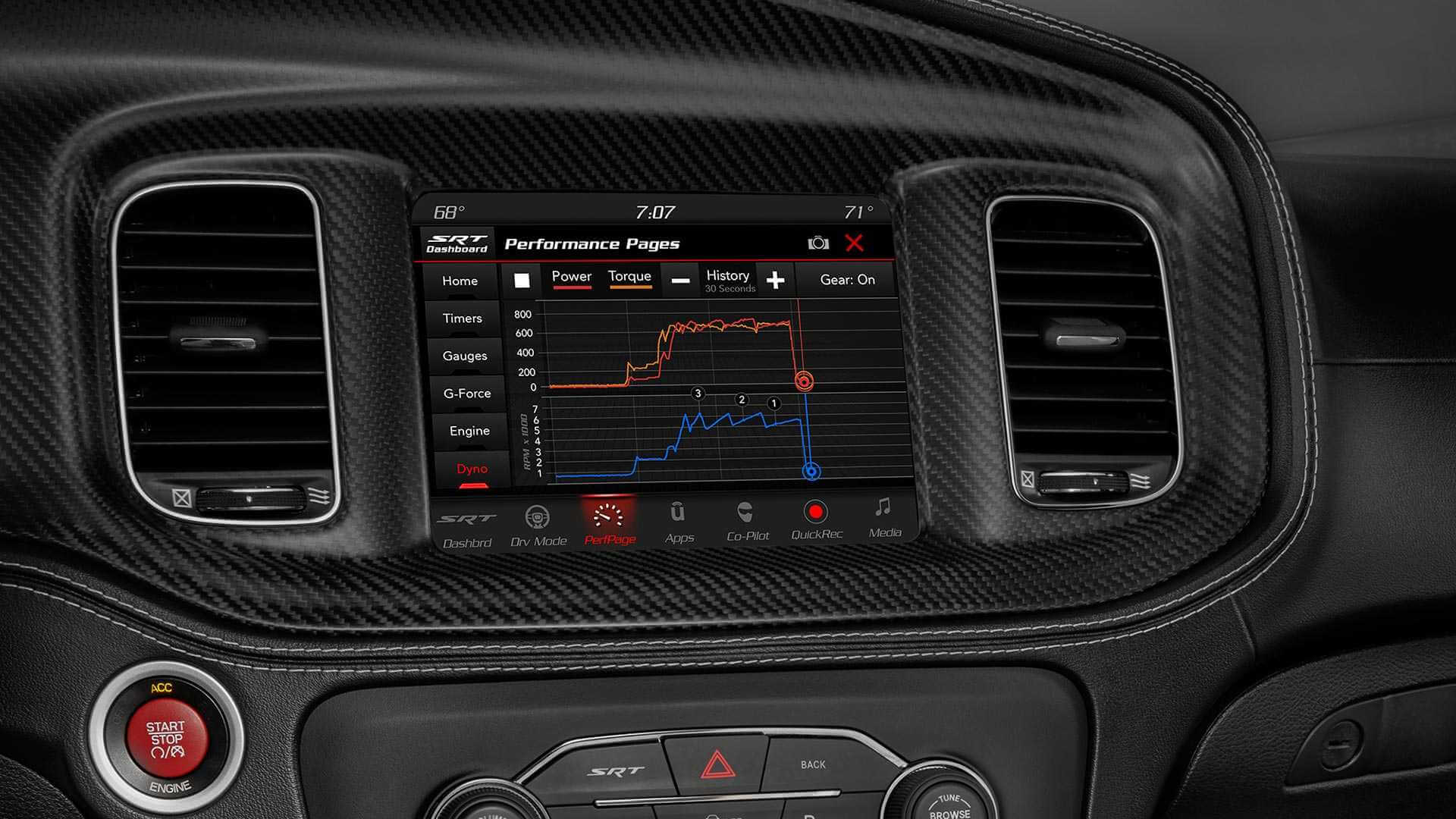
Owners received two key fobs. The red key unlocks the full 707 hp; the black key limits the engine to 500 hp (373 kW), which Dodge intended for valet parking or for lending the car to someone less experienced. The SRT Performance Pages on the Uconnect screen display timers and engine data, and the speedometer reads to 200 mph. Buyers also got a day at the SRT Driving Experience. Our power converter turns all the hp figures into kW and PS.
Chassis, brakes and cabin
The Hellcat keeps the Charger's double-wishbone front and multi-link rear suspension, with adaptive dampers and selectable drive modes, including a custom mode that lets the driver combine settings for engine, gearbox, steering and suspension. Brembo supplies two-piece front discs of 390 mm with six-piston calipers. The 20-inch Slingshot forged wheels came in matt black or the bronze "Brass Monkey" finish.

Inside, the Hellcat has sports seats trimmed in leather and Alcantara, an 8.4-inch Uconnect touchscreen and room for three in the back, which made it a practical family car with supercar speed. The boot holds 467 litres. A Harman Kardon system with 18 speakers and 900 W was available as an option.
Widebody, Redeye and Jailbreak: the versions by year
| Model year | Version | Power | Notes |
|---|---|---|---|
| 2015–2019 | SRT Hellcat | 527 kW (707 hp) | narrow body, launch version |
| 2020 | SRT Hellcat Widebody | 527 kW (707 hp) | 89 mm wider, 305/35 ZR20 tyres; replaced the narrow car |
| 2020 | Daytona 50th Anniversary | 535 kW (717 hp) | 501 cars |
| 2021 | SRT Hellcat Widebody | 535 kW (717 hp) | standard version |
| 2021 | SRT Hellcat Redeye Widebody | 594 kW (797 hp) | 959 Nm, SRT Power Chiller |
| 2022 | Redeye Jailbreak | 602 kW (807 hp) | free choice of colours and trim |
| 2023 | Final year, King Daytona | 602 kW (807 hp) | 300 King Daytona cars in Go Mango |
The Widebody of 2020 added 3.5 inches (89 mm) of width, 20 × 11-inch wheels and Pirelli P Zero tyres in 305/35 ZR20 at every corner. Dodge quoted 0–60 mph in 3.6 seconds and a quarter mile of 10.96 seconds. The Redeye of 2021 used the 6.2 Hemi Hellcat High Output engine with 797 hp and 707 lb-ft; it ran the quarter mile in 10.6 seconds at 129 mph and reached 203 mph. In 2022 the Jailbreak package raised the Redeye Widebody to 807 hp and let buyers mix colours and trim freely. For 2023 Jailbreak was available on every SRT Charger, all Redeyes had 807 hp, and the King Daytona edition of 300 cars marked the end.

By our calculation the Jailbreak's 602 kW are 14 % more than the 527 kW of the first Hellcat sedan, with the same displacement.
Launch price and the last Hellcat sedans
The launch price in 2014 was 63,995 US dollars, including a gas-guzzler tax of 1,700 US dollars. That was about €50,000 at the exchange rate of the time, and by our calculation about 121 US dollars per kilowatt. Later versions cost more; the old version of this page quoted 67,995 US dollars for a 2020 car without stating which version.
Production of the LD Charger ended in Brampton with the 2023 model year, and with it the supercharged Hemi in the Charger. The eighth-generation Charger, built in Windsor from 2024, began as the electric Charger Daytona and is a liftback rather than a classic sedan.
Rivals and alternatives
The Charger SRT Hellcat had no direct four-door rival with a V8 in its price class. The Ford Mustang and Chevrolet Camaro, mentioned in the old text as sales rivals, are two-door coupés. Closer in power and purpose were the Cadillac CTS-V and European super-saloons such as the BMW M5 and the Mercedes-AMG E 63, all of them more expensive in the United States. Within its own brand the same engine powered the Challenger SRT Hellcat, the two-door that also led to the Challenger SRT Demon.

Dodge Charger SRT Hellcat in our rankings
- No. 1 of 95 · Fastest sedans (328 km/h)
- No. 4 of 83 · Power-to-weight: sedans (245 kW/t)
- No. 4 of 44 · Fastest American cars (328 km/h)
- No. 5 of 105 · Most torque: sedans (959 Nm)
- No. 6 of 213 · Most powerful sedans (602 kW)
- No. 10 of 84 · Heaviest sedans (2,155 kg)
Faster than 98% of ranked sedans in the 1CARS catalog (No. 1 of 95).
Dodge Charger SRT Hellcat photos 22


Dodge Charger SRT Hellcat videos 2

Dodge Charger SRT Hellcat video 1

Dodge Charger SRT Hellcat video 2
FAQ
How much horsepower does the Dodge Charger SRT Hellcat have?
The 2015 car has 527 kW (707 hp) and 881 Nm. From the 2021 model year the standard Hellcat has 535 kW (717 hp), the Redeye 594 kW (797 hp), and the Jailbreak and 2023 Redeyes 602 kW (807 hp).
How fast is the Charger SRT Hellcat?
Dodge verified a top speed of 204 mph (328 km/h) and an NHRA-certified quarter mile of 11.0 seconds. In magazine tests it reached 60 mph in about 3.4 seconds. The Redeye runs the quarter mile in 10.6 seconds.
What does the black key on the Hellcat do?
The black key limits the supercharged V8 to 500 hp (373 kW). The red key unlocks the full output. Dodge gave both keys to every buyer so the car could be lent or parked with less power.
When did the Charger SRT Hellcat end?
The 2023 model year was the last. Production of the seventh-generation Charger ended in Brampton, Canada, and the King Daytona of 300 cars was one of the final editions.
What is the Hellcat Redeye?
The Redeye is the High Output version introduced for the Charger in the 2021 model year. Its 6.2-litre supercharged V8 produces 594 kW (797 hp) and 959 Nm, and it later rose to 602 kW (807 hp).
Data sources
Data checked by an editor against the sources below.
- The text of this article (1cars archive)
- Wikipedia - Dodge Charger (LX)
- Moparinsiders - 10 Years Of The Dodge Charger Srt Hellcat
- Wikipedia - LD)
- EEA CO₂ monitoring (European Environment Agency, CC BY 4.0)


