Taganrog Automobile Plant (TagAZ): From Daewoo Licence to Bankruptcy
The Taganrog Automobile Plant, known as TagAZ, was a car factory in the port city of Taganrog on the Sea of Azov. Built from 1997 with Daewoo technology and money from the Doninvest group, it later assembled Citroën, Hyundai, Chery, BYD and JAC models alongside a few cars of its own. Output peaked at 106,322 vehicles in 2008, and the company was declared bankrupt on 21 January 2014.

Key takeaways
- 1997–2000: built under a Daewoo licence; Daewoo-based Doninvest cars and Citroën Berlingo vans in small numbers.
- 2001–2012: Hyundai contract assembly turned TagAZ into a high-volume plant, peaking above 100,000 vehicles a year.
- 2008–2013: Chinese partners and own-brand models such as the Vega, Tager and Aquila.
- Production collapsed after 2008; bankruptcy proceedings ran from 2012 to 2014.

TagAZ history at a glance: key dates
| Year | Event |
|---|---|
| 1997 | Construction starts with Daewoo licence and Doninvest financing |
| 1998 | Opening ceremony; semi-knocked-down assembly of Daewoo Lanos and Nubira |
| 1999–2003 | Citroën Berlingo built as the Doninvest Orion M |
| 2001 | Hyundai Accent assembly begins |
| 2004–2008 | Hyundai Sonata, Porter, Santa Fe and Elantra added |
| 2008 | Record output of 106,322 vehicles; first Chery-based Vortex model |
| 2009 | Own-brand Vega saloon and Master light truck; output falls to 29,240 |
| 2010–2011 | BYD F3, Vortex Corda and Tingo, JAC-based C10 and C190 |
| 2012 | Hyundai production ends; the company applies for bankruptcy |
| 2014 | Declared bankrupt on 21 January |
Doninvest and the Daewoo plan (1997–1998)
TagAZ grew out of the Doninvest financial and industrial group, founded around Doninvest Bank in 1991 by the businessman Mikhail Paramonov. Doninvest had already assembled Daewoo cars at the Krasny Aksay plant from 1995, starting with the Nexia and Espero. In 1997 that plant built 13,200 vehicles. The next step was a large new factory designed to build Daewoo models under licence.

Construction began in spring 1997, fully financed by Doninvest. The investment exceeded 260 million US dollars, about €230 million at the 1997 rate. According to the old 1cars text, the plant stood on the site of a former combine-harvester factory, and its opening ceremony took place in mid-September 1998.
The plan was to build Daewoo designs under Doninvest names: the Assol, based on the Daewoo Lanos, and the Orion, based on the Nubira. The larger Kondor, a Leganza derivative, was built at the Krasny Aksay plant. Pilot semi-knocked-down assembly of the Lanos and Nubira began in 1998.
A difficult start: the 1998 crisis and Daewoo's collapse
The timing was poor. About a month before the opening, the financial crisis of August 1998 cut demand for new cars and made imported kits far more expensive. The plant was mothballed almost immediately after the ceremony and assembled cars only occasionally and in small batches.

The second blow came from Korea. Daewoo Motors ran into financial trouble in 1999 and went bankrupt in 2000, and the supply of components stopped. In the first nine months of 2000, Doninvest built only 34 cars. Official figures show 586 vehicles for 1999 and 298 for 2000.
Citroën Berlingo as the Orion M
Doninvest signed an agreement with Citroën to assemble the first-generation Citroën Berlingo under the name Orion M. Sources disagree on the dates: Wikipedia gives May 1999 for the agreement and 1999 to 2002 or 2003 for production, while the old 1cars text dates the contract to April 2000. Only about 800 to 1,000 Orion M vans and passenger versions were built before the partnership ended in 2003.

The Berlingo did not save the plant, but it showed that TagAZ could work with a foreign partner on contract assembly. That model became the basis of the company's most successful period.
The Hyundai years (2001–2012)
In 2001 TagAZ began assembling the Hyundai Accent of the LC generation. The Accent was simple, cheap to build and in strong demand, and the plant's output rose quickly. According to the old 1cars text, Hyundai's engineers praised the standard of work, and more models followed:
| Hyundai model | Start of assembly at TagAZ |
|---|---|
| Accent (LC) | 2001 |
| Sonata (EF) | 2004 |
| Porter light truck (third generation) | 2005 |
| Santa Fe (SM) and Elantra (XD) | 2008 |
| County bus and Trago heavy truck | assembled from kits |
At its peak, the factory could build up to 20 different models at once and was designed for 180,000 vehicles a year across six models. It covered 60,000 m² with a body shop, paint shop, four assembly lines, an electroplating shop and a testing department, and employed about 8,500 people.
Hyundai's interest declined after it opened its own factory in 2010. TagAZ stopped building Hyundai models in spring 2012.
Taganrog Automobile Plant output by year
| Year | Vehicles built |
|---|---|
| 1999 | 586 |
| 2000 | 298 |
| 2003 | 3,810 |
| 2004 | 25,602 |
| 2005 | 45,417 |
| 2006 | 55,900 |
| 2007 | 79,620 |
| 2008 | 106,322 |
| 2009 | 29,240 |
By our calculation, output grew almost 28 times between 2003 and 2008, and the 2008 total was 34 % more than in 2007. It then fell by 72.5 % in a single year, as the global financial crisis hit demand and credit for car buyers dried up.

Own models and Chinese partners (2008–2013)
From 2008 TagAZ tried to reduce its dependence on Hyundai. It began semi-knocked-down assembly of the Vortex Estina, a rebadged Chery A5, under its own Vortex brand. In October 2010 it added the BYD F3 saloon, the Vortex Corda based on the Chery Amulet and the Vortex Tingo based on the Chery Tiggo.

Two models based on JAC designs followed: the TagAZ C10, a rebadged JAC Tojoy, from June 2011, and the C190, based on the JAC Rein, from October 2011. According to the old 1cars text, the C10 was adapted for harsh road conditions.
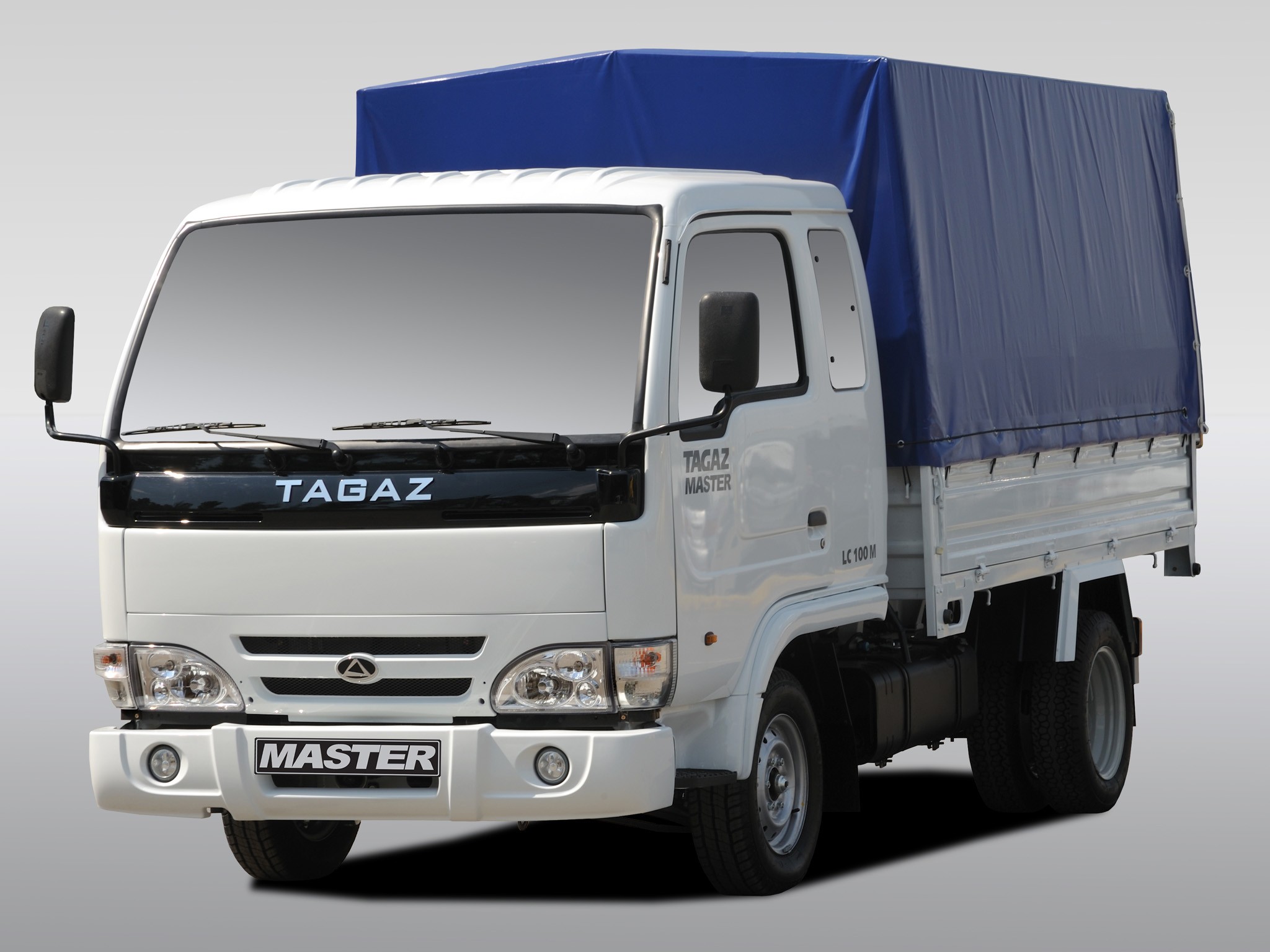
TagAZ also sold cars under its own name. The Vega saloon of 2009 was accused of copying the Chevrolet Lacetti; the dispute cost TagAZ its export rights and ended a joint venture with SsangYong. The Tager and Road Partner were rebadged SsangYong Korando and Musso off-roaders, and the Master was a diesel light truck. The old 1cars text adds a school bus based on the Hyundai County. The last new model, the coupé-styled TagAZ Aquila, went on sale in 2013.
| Model | Type | Origin |
|---|---|---|
| Vega (C100) | saloon | own design, 2009–2012 |
| Tager | off-roader | SsangYong Korando licence |
| Road Partner | off-roader | SsangYong Musso licence |
| Master | light truck | own badge, diesel |
| C10 / C190 | small car / SUV | JAC Tojoy / JAC Rein |
| Aquila | four-door coupé-styled saloon | own design, 2013 |
Debts, bankruptcy and the end of production
The 2008 crisis left TagAZ with heavy debts. In 2010 a lending bank filed a bankruptcy claim against the company; according to the old 1cars text, the claim was later withdrawn. The same text says TagAZ bought land for a third production site that year, with planned investment of more than €24.4 million, but the project did not go ahead.

In spring 2012, with sales falling and staff being cut, TagAZ itself applied to be declared bankrupt. A court declared the company bankrupt on 21 January 2014, and Doninvest Bank collapsed later that year. The old 1cars text reports that a new investor planned to restart the assembly of small trucks, buses and special vehicles for disabled passengers. We found no reliable source confirming that series production resumed.
Our take on the TagAZ story
TagAZ is a typical example of a plant built on contract assembly. It grew fast while a strong partner supplied designs and kits, and it struggled once that partner left. Its own models arrived too late and in too small numbers to replace the Hyundai volume.
To compare the size and data of models the automobile plant assembled, such as the Hyundai Accent and the Vortex Corda, use the 1cars comparison tool. For the wider story of the Korean company behind its first models, read the history of Daewoo, and all TagAZ models are listed on the TagAZ brand page.
FAQ
What is TagAZ?
TagAZ, the Taganrog Automobile Plant, was a car factory in Taganrog on the Sea of Azov. It operated from 1998 to the early 2010s, assembling cars for Daewoo, Citroën, Hyundai, Chery, BYD and JAC, plus a few own-brand models.
Who owned the Taganrog Automobile Plant?
TagAZ was owned by the Doninvest group, led by Mikhail Paramonov, which financed the factory's construction from 1997. About one-fifth of the shares were held by several foreign investment companies.
Which Hyundai models did TagAZ build?
TagAZ assembled the Hyundai Accent from 2001, the Sonata from 2004, the Porter light truck from 2005 and the Santa Fe and Elantra from 2008. It also assembled County buses and Trago trucks from kits.
How many cars did TagAZ build?
The highest annual output, 106,322 vehicles, came in 2008 after fast growth from 3,810 in 2003. In 2009 production fell to 29,240, and volumes never recovered before the company's bankruptcy.
When did TagAZ go bankrupt?
TagAZ applied for bankruptcy in spring 2012, after Hyundai production ended. The bankruptcy ruling followed on 21 January 2014, and Doninvest Bank failed later the same year.