MAN: The German Truck and Bus Maker Behind the Diesel Engine
MAN Truck & Bus is a German maker of trucks, buses and engines, headquartered in Munich and part of the Volkswagen-controlled Traton group. Its parent company, Maschinenfabrik Augsburg-Nürnberg, built the first fully working diesel engine with Rudolf Diesel in 1897 and its first trucks in 1915. In 2023 MAN sold about 116,000 new vehicles.

Key takeaways
- MAN stands for Maschinenfabrik Augsburg-Nürnberg; the company traces its industrial roots to an ironworks founded in Oberhausen in 1758.
- Truck production started in 1915 at Lindau, together with the Swiss firm Saurer; MAN showed a direct-injection diesel truck in 1924.
- Takeovers and partnerships: Büssing (1971), Saviem (1967–1977), Volkswagen light trucks (1979–1993), Steyr, and Neoplan (2001).
- Today's range runs from the TGE van to the TGX tractor and the Lion's City buses, now also as battery-electric versions.

MAN at a glance

| Fact | Value |
|---|---|
| Full name of the founding firm | Maschinenfabrik Augsburg-Nürnberg AG |
| Industrial roots | St. Antony ironworks, Oberhausen (1758) |
| Diesel engine | First fully working engine with Rudolf Diesel, 1897 |
| First trucks | 1915, Lindau (with Saurer) |
| Headquarters | Munich, Germany |
| Owner | Traton SE (Volkswagen Group) |
| Brands | MAN (trucks, buses, vans), Neoplan (coaches) |
| Main plants | Munich, Kraków, Steyr, Vienna, Starachowice, Ankara, Nuremberg (engines) |
| Results 2023 | About 36,000 employees, 116,000 vehicles sold, €14.8 billion revenue |
Ironworks, engineering and the diesel engine (1758–1914)
MAN grew out of several 19th-century engineering firms in Augsburg and Nuremberg, and the group counts the St. Antony ironworks in Oberhausen, founded in 1758, among its roots. The engineering works in Augsburg built printing presses, steam engines and bridges, and in 1908 the merged business took the name Maschinenfabrik Augsburg-Nürnberg, shortened to MAN.

Its most famous early achievement was the diesel engine. Rudolf Diesel developed his engine at the Augsburg works from 1893, and in 1897 MAN presented the first fully functioning self-ignition engine. That invention would later make MAN one of the leading names in heavy-duty engines for ships, power stations and road vehicles.
The first MAN trucks and the diesel truck (1915–1939)
MAN entered the vehicle business during the First World War. In 1915 it formed a joint company with the Swiss truck maker Saurer, and that year 118 trucks left the Lindau plant and five came from Nuremberg. A total of 665 trucks were built from 1915 to 1918, mostly with a payload of around 2.5 tonnes.
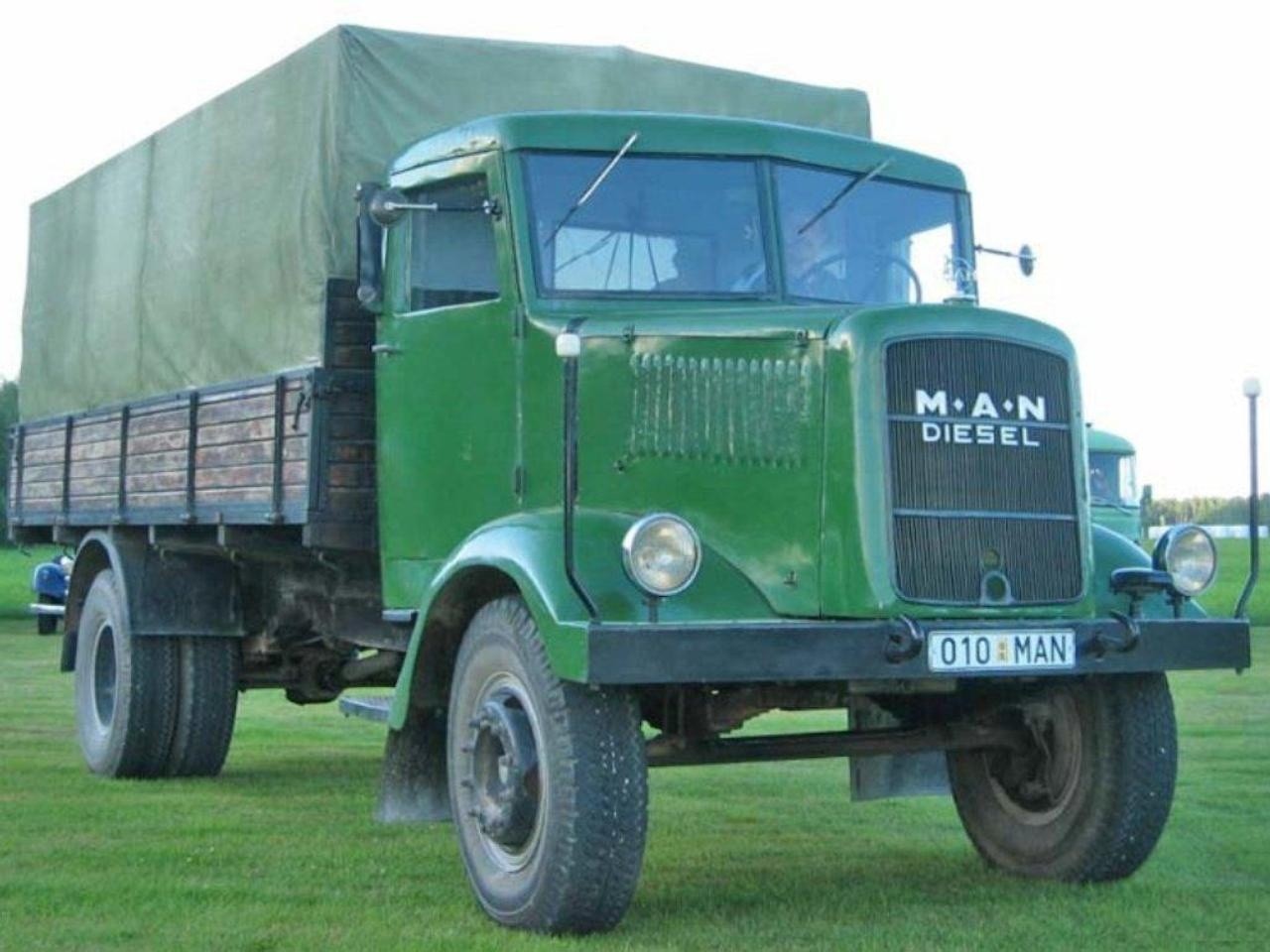
After the war, MAN built special vehicles such as a municipal refuse truck with a hydraulic tipping body and, from 1921, its Ackerdiesel farm tractors, which it made until 1962. In 1924 MAN showed a truck with a direct-injection diesel engine, one of the first of its kind, and from 1925 its new five-tonne truck used a cardan shaft instead of chain drive. By the end of the decade the range covered payloads from 3 to 8 tonnes with diesel or petrol engines. During the Second World War production was turned over to military needs, and the factories were badly damaged by bombing.
Rebuilding and the Munich plant (1945–1966)
Production restarted slowly: 303 trucks were built in 1945 and 1,440 in 1950. The F8 of 1951 was MAN's first heavy truck after the war, and in the early 1950s MAN introduced turbocharged diesel engines with its spherical combustion chamber, known for low fuel use and quiet running. In 1955 work began on a new truck plant at Munich-Allach, which went on to build 100,000 trucks in its first ten years. The rounded "Ponton" bonneted trucks of 1956 and the 30,000th anniversary truck of 1960 belong to this period.

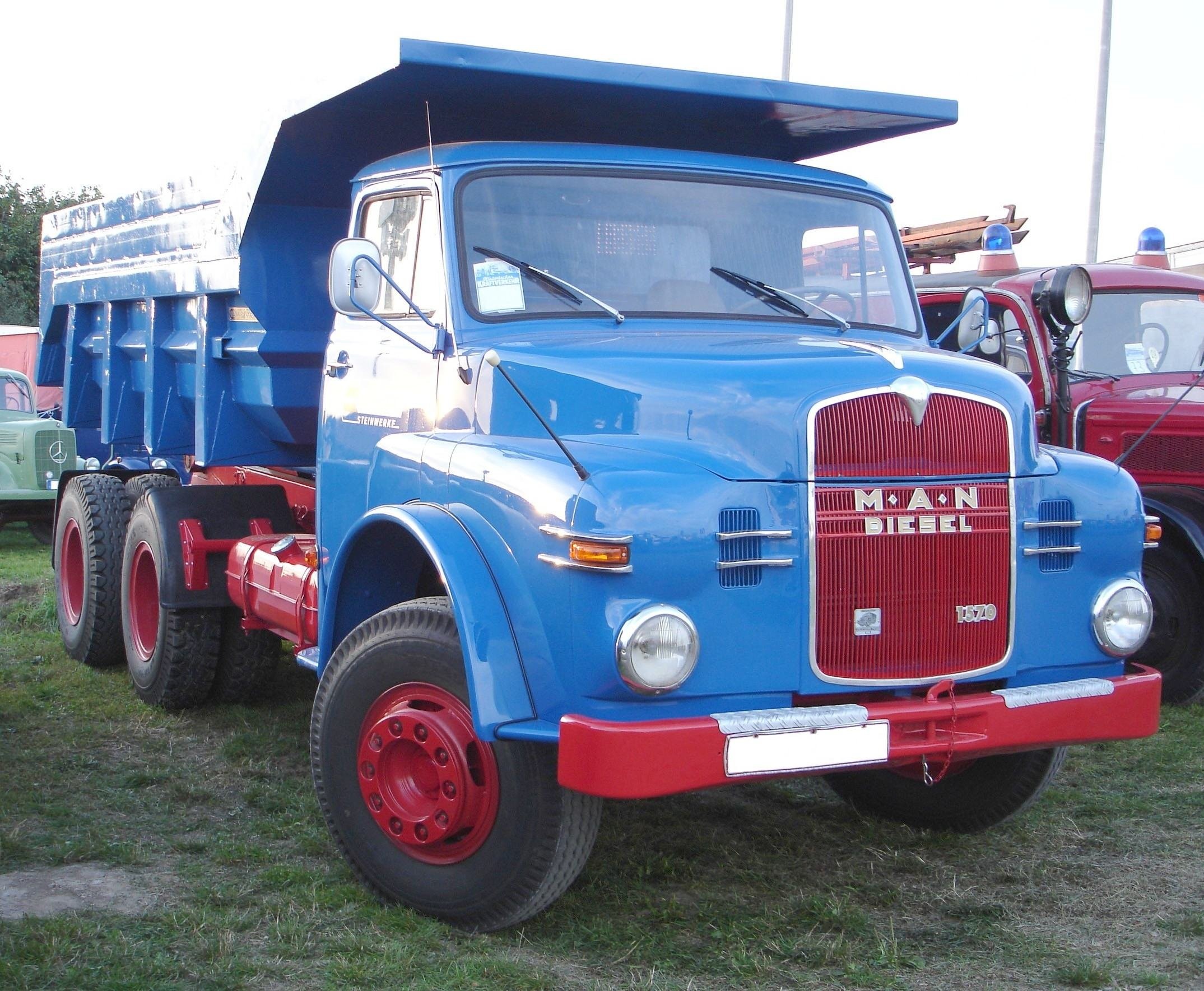
In the 1960s MAN adopted the model naming that is still familiar today: the first number gives the gross vehicle weight in tonnes, the second the engine output. A 19.280, for example, is a 19-tonne truck with about 206 kW (280 PS). Production rose to 13,844 trucks in 1965.
Saviem, Büssing and Volkswagen (1967–1993)
From 1967 to 1977 MAN cooperated with the French maker Saviem, part of the Renault group, and sold Saviem light and medium trucks under its own badge. In 1971 MAN took over Büssing of Braunschweig, a pioneer of German buses and trucks, and adopted the Büssing lion as its emblem. The lion still sits on every MAN grille.

The MAN 19.280 was named International Truck of the Year in 1978, the first of several such titles for the brand. A year later, MAN and Volkswagen launched a jointly developed range of light trucks from 6 to 10 tonnes, the G series, which was built until 1993 with 72,000 units produced. In 1990 MAN bought the truck business of Austria's Steyr, which later became its plant for light and medium trucks.
The TG range, Neoplan and global growth (1994–2017)
In the 1990s MAN replaced its F 90 and M 90 trucks with the F 2000 (1994) and M 2000 (1996). The next big step was the TGA of 2000, the first model of the "Trucknology Generation", with air-operated disc brakes, ABS and traction control, and automated gearboxes. In 2001 MAN bought Neoplan, the coach maker founded by Gottlob Auwärter, and combined it with its own bus business.
The light TGL and medium TGM followed in 2005, and the TGL was named Truck of the Year 2006. In autumn 2007, in Amsterdam, MAN presented the heavy MAN TGX and MAN TGS; the Kraków assembly plant in Poland opened the same year. MAN also won the truck class of the Dakar Rally in 2007. Abroad, MAN took a 25% stake in China's Sinotruk in 2009, and Sinotruk later launched the SITRAK brand using MAN technology. On 1 January 2011 MAN Nutzfahrzeuge was renamed MAN Truck & Bus. The TGE large van, based on the Volkswagen Crafter, arrived in 2017.
Traton, the new TGX and electric trucks (2018–2026)
Volkswagen gradually took control of MAN SE in the 2010s and grouped its truck brands, MAN, Scania, Navistar and Volkswagen Caminhões e Ônibus, under Traton. MAN Truck & Bus became a European company (SE) in March 2019, and MAN SE merged into Traton SE on 1 September 2021.

The latest generation of the TGX and TGS arrived in 2020 with new cabs, digital displays and the 12-speed TipMatic automated gearbox. Electrification began with the eTGM delivery truck and the Lion's City E electric city bus, and in 2024 MAN began series production of battery-electric heavy trucks. In the 1cars catalogue, the MAN TGX with 500 kW (680 PS) is third in the most powerful trucks ranking, behind two rivals of even higher output.
MAN timeline
| Year | Event |
|---|---|
| 1758 | St. Antony ironworks founded in Oberhausen (industrial root) |
| 1897 | First fully working diesel engine, with Rudolf Diesel |
| 1908 | Name Maschinenfabrik Augsburg-Nürnberg (MAN) |
| 1915 | First trucks at Lindau, with Saurer |
| 1924 | Direct-injection diesel truck |
| 1951 | F8, first heavy post-war truck |
| 1955 | Munich-Allach truck plant started |
| 1967–1977 | Cooperation with Saviem |
| 1971 | Büssing takeover; lion emblem |
| 1978 | MAN 19.280 named International Truck of the Year |
| 1979–1993 | MAN-Volkswagen G-series light trucks |
| 2000 | TGA, first of the TG range |
| 2001 | Neoplan acquired |
| 2007 | TGX and TGS; Kraków plant; Dakar win |
| 2011 | Renamed MAN Truck & Bus |
| 2021 | MAN SE merged into Traton SE |
| 2024 | Series production of electric heavy trucks |
Landmark MAN trucks and buses

| Model | Years | Why it matters |
|---|---|---|
| MAN-Saurer trucks | 1915– | MAN's entry into road vehicles |
| F8 | 1951– | First heavy truck after the war |
| 19.280 | 1970s | International Truck of the Year 1978 |
| G series (with VW) | 1979–1993 | Light truck partnership, 72,000 built |
| TGA | 2000–2007 | Start of the "Trucknology Generation" |
| TGX / TGS | 2007– | Heavy long-haul and distribution trucks |
| Lion's City | – | City bus range, now also battery-electric |
| TGE | 2017– | Large van based on the VW Crafter |
Which MAN to choose: verdict
For long-haul work, the TGX is MAN's flagship, with the most powerful engines and the largest cabs; the TGS suits construction and regional haulage, and the TGL and TGM cover city distribution. Used buyers usually prefer later Euro 6 TGX and TGS trucks for their lower fuel use and higher resale value, while the battery-electric models suit fleets with depot charging and fixed routes. To compare trucks and other vehicles side by side, use the 1cars comparison tool, and browse the full range in the MAN catalogue.


FAQ
What does MAN stand for?
MAN stands for Maschinenfabrik Augsburg-Nürnberg, the name taken by the merged engineering works of Augsburg and Nuremberg in 1908. Today the truck and bus business trades as MAN Truck & Bus SE, based in Munich.
Who owns MAN trucks?
MAN Truck & Bus belongs to Traton SE, the commercial-vehicle group of Volkswagen. Traton also owns Scania, Navistar (International) and Volkswagen Caminhões e Ônibus. MAN SE was merged into Traton SE in September 2021.
Did MAN invent the diesel engine?
Rudolf Diesel invented it, but he developed it at MAN's Augsburg works, and in 1897 MAN presented the first fully functioning self-ignition engine. MAN later showed one of the first direct-injection diesel trucks, in 1924.
When did MAN start making trucks?
In 1915, together with the Swiss company Saurer. That year 118 trucks were built at Lindau and five at Nuremberg; by 1918 the total had reached 665 trucks.
Why does MAN use a lion as its logo?
The lion comes from Büssing, the Braunschweig truck and bus maker that MAN took over in 1971. MAN adopted Büssing's lion emblem, and it still appears on the grille of every MAN truck and bus.
Does MAN make electric trucks?
Yes. MAN offers the eTGM, the battery-electric Lion's City E bus and, since 2024, series-produced battery-electric versions of its heavy trucks, aimed at fleets with regular routes and depot charging.
Photos (3)