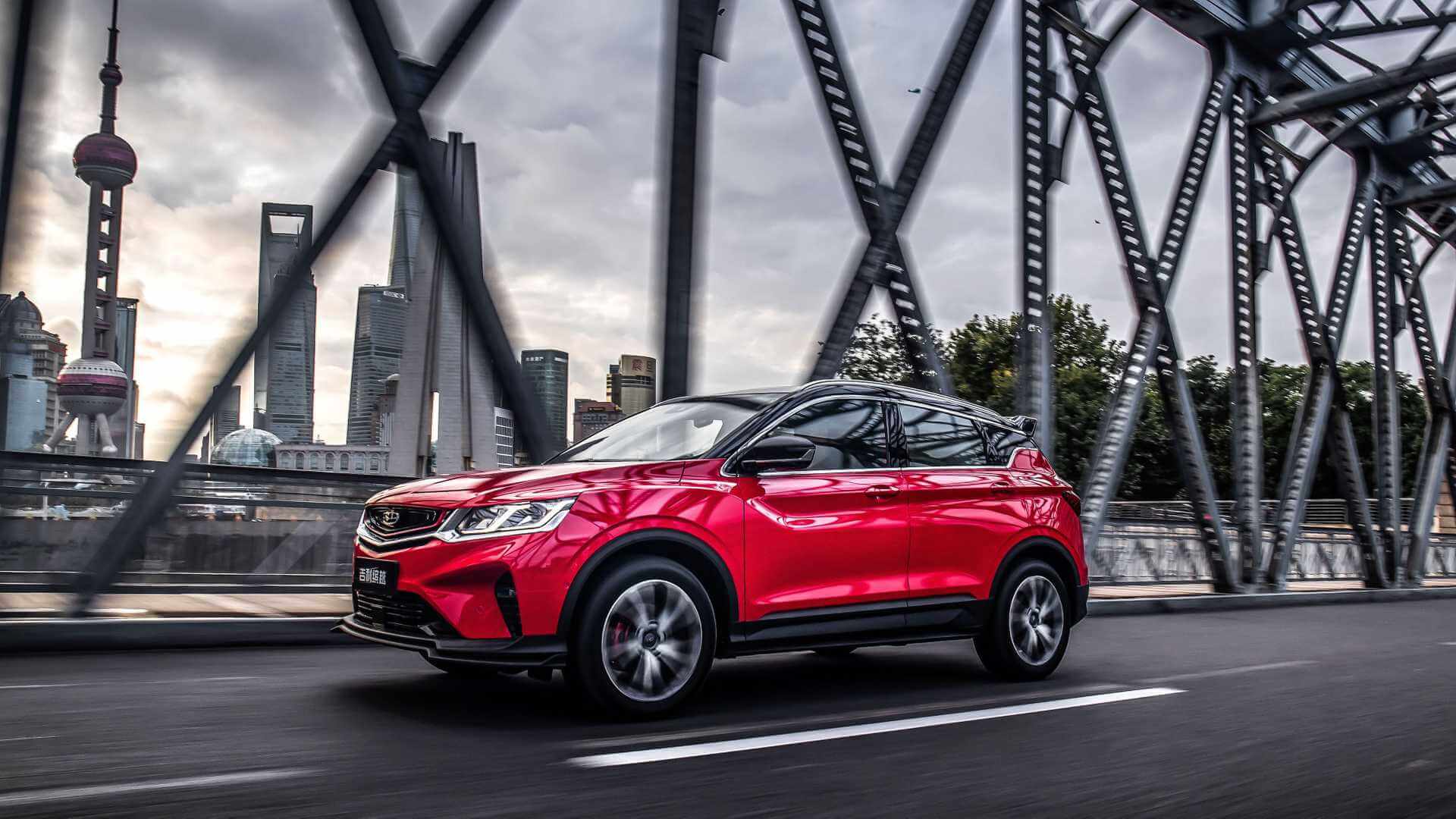
 Geely Emgrand EC7
Specs, engines and history
Updated Published Sources (3) Report an error
By Oleksandr Hnatiuk, Automotive Editor & Used Car Specialist Reviewed by Felix Hartmann

- Built
- 2009–2016
- Top power
- 93 kW (126 PS)
The Geely Emgrand EC7 is a front-wheel-drive compact saloon, also sold as the EC7-RV hatchback, built by Geely in China from 2009 to 2016. It was the first model of Geely's Emgrand sub-brand, used 1.5- and 1.8-litre petrol engines and, in 2011, became the first Chinese-designed car to earn four stars from Euro NCAP.
In short
- Launch: first deliveries in August 2009; the 1.8-litre EC718 was presented at the Hangzhou International Auto Expo on 23 October 2009.
- Engines: 1.5 L and 1.8 L petrol, front-wheel drive only; the 1.8 had 102 kW (139 PS) and 172 Nm at launch.
- Safety: four Euro NCAP stars in 2011 for the European-specification 1.8 saloon, with 75% for adult occupant protection.
- Not to be confused with the larger Emgrand EC8, the Emgrand X7 SUV or the later Emgrand saloons.

Size at a glance
| Dimensions | Geely Emgrand EC7 |
|---|---|
| Length | 4,631 mm182.3 in |
| Width | 1,789 mm70.4 in |
| Height | 1,470 mm57.9 in |
| Wheelbase | 2,650 mm104.3 in |
Specs by version
Engines
Dimensions and weight
Verified Manufacturer and type-approval data from our catalog · Sources and methodology
Geely Emgrand EC7 at a glance
The EC7 is a four-door saloon and five-door hatchback of roughly 4.6 m. Geely launched the Emgrand brand in July 2009 with the EC7 as its first vehicle, describing it as a medium-to-high-end line. At the time the company planned three sub-brands: Gleagle for entry-level cars, Emgrand for the mainstream and Shanghai Englon at the top.
Production was based at Geely's Ningbo plant. According to the Chinese trade press, the first EC7 was delivered in mid-August 2009, two months before the 1.8-litre EC718 appeared at Hangzhou. Geely called it its first independently developed global model, planned for export from the start. Wikipedia lists Siemens (engine electronics), Lear (seats) and Saint-Gobain (glass) among the suppliers.
When Geely dropped the separate Emgrand brand in 2014 and moved to a single Geely badge, the car simply became the Geely Emgrand. For the wider company story, see our history of Geely.
Where the EC7 was built and sold
Besides the Chinese plant, the EC7 was assembled or sold under local names in several countries:
- Egypt: Ghabour Auto (GB Auto) assembled the first-generation EC7 from 2013 to 2019, with more than 150,000 cars reported.
- Taiwan: Yulon sold it from May 2012 as the Tobe M'way saloon and Q'way hatchback.
- Uruguay: Nordex assembled it as the Emgrand 718.
- Iraq, Mozambique (as the Matchedje X3) and Sri Lanka also had local assembly, and South Africa and Namibia received the car in 2013.
Which Emgrand is which
The Emgrand name covers several unrelated cars, so it helps to separate them. This page covers only the original EC7 and EC7-RV.

| Model | Class and body | Years | On 1cars |
|---|---|---|---|
| Emgrand EC7 / EC7-RV | Compact saloon and hatchback | 2009–2016 | This page |
| Emgrand EC8 | Larger saloon | From 2010 | Emgrand EC8 |
| Emgrand X7 | SUV | Later model | Emgrand X7 |
| Emgrand GC9 | Flagship saloon | Concept shown 2015 | Geely GC9 debut |
| EC7-EV, Emgrand EV300/450/500, EC7 PHEV | Electric and plug-in hybrid saloons | 2017–2021 | Not covered |
| Later Emgrand saloons | Compact saloon | 2018 onwards | Not covered |
The electric and plug-in versions are separate models. The rest of the Geely range is in our catalogue.
Engines, transmissions and performance
Every EC7 is front-wheel drive with a four-cylinder petrol engine; there was no all-wheel-drive, diesel or hybrid version of this car. Wikipedia describes the first-generation engines as Mitsubishi-derived 4G15 (1.5 L) and 4G18 (1.8 L) units, while spec databases list Geely codes such as MR479QA for the 1.5.

| Engine | Capacity | Power | Torque | Notes |
|---|---|---|---|---|
| 1.5 L petrol | 1,498 cc (91.4 cu in) | 72 kW (97 bhp) at 6,000 rpm | 126 Nm (93 lb-ft) at 4,000 rpm | Aggregator figure for the manual; later CVT versions quoted up to 80 kW (108 bhp) |
| 1.8 L petrol | 1,792 cc (109.4 cu in) | 102 kW (139 PS) at launch | 172 Nm (127 lb-ft) | Launch figures from the 2009 Hangzhou show and the 2011 Australian plans |
| 1.3 L turbo petrol | - | 133 hp (about 99 kW), reported | 186 Nm (137 lb-ft), reported | Reported in January 2014 for the facelift |
Power figures for the 1.8 vary. The launch output was 102 kW, but later data, partly for the 2016 Emgrand 7, quotes 93 to 95 kW, so a car's papers depend on year and market. The 1.3 turbo comes from a CarNewsChina report ahead of the 2014 Beijing show, not from confirmed catalogue data.
A 5-speed manual was offered throughout, but automatic options depended on the market: the Australian importer planned a 6-speed automatic for the 1.8, the 2011 UK plans mentioned an automatic on the 1.8 only, and spec databases list a CVT for some 1.5 versions. German Wikipedia also mentions a 7-speed dual-clutch unit, so check the exact car rather than assuming.
Performance is modest. The 1.5 manual is quoted at 15.0 seconds from 0 to 100 km/h (0 to 62 mph) and about 166 km/h (103 mph) flat out, while Geely gave the 1.8 EC718 a top speed of 185 km/h (115 mph) at launch.
Dimensions, interior space and boot
At about 4.6 m long with a 2,650 mm wheelbase, the EC7 saloon sits at the large end of the compact class. The figures below are for the saloon; the EC7-RV hatchback is shorter, at about 4,397 mm (173.1 in).

| Parameter | Metric | Imperial |
|---|---|---|
| Length | 4,635 mm | 182.5 in |
| Width | 1,789 mm | 70.4 in |
| Height | 1,470 mm | 57.9 in |
| Wheelbase | 2,650 mm | 104.3 in |
| Track, front / rear | 1,502 / 1,492 mm | 59.1 / 58.7 in |
| Ground clearance | 167 mm | 6.6 in |
| Kerb weight | 1,265–1,355 kg | 2,789–2,987 lb |
| Boot (saloon, one source) | 680 L | 24.0 cu ft |
| Fuel tank | 50 L | 11.0 UK gal |
The main dimensions agree across the 2009 launch data and later spec sheets within a few millimetres. The 680-litre boot figure comes from a single spec database, so treat it as indicative.
The chassis is conventional: MacPherson struts at the front, a semi-independent torsion beam at the rear, and disc brakes all round, ventilated at the front. Tyre sizes listed for the EC7 are 205/65 R15, 205/55 R16 and 215/55 R16.
EC7 fuel economy and running costs
For the 1.5 manual, spec data gives 6.7 L/100 km (42.2 mpg UK) combined, with 8.7 L/100 km (32.5 mpg UK) in town and 5.5 L/100 km (51.4 mpg UK) on the open road. CVT versions are quoted at 5.6 to 5.9 L/100 km (50.3 to 47.9 mpg UK), but those entries seem to belong to later cars, and the test cycle is not stated for any of them.

The 1.5 was rated for Euro IV and 92-octane fuel. Because the EC7 never reached EU showrooms, parts supply in its country of sale matters more to running costs than fuel use.
EC7 trims and equipment
Equipment varied strongly by market. The Australian plans of 2011 listed electronic stability control and side curtain airbags as standard on the 1.8 saloon. Typical equipment lists from other markets show ABS, EBD and two front airbags on all cars, with side airbags, stability control and tyre-pressure monitoring on higher trims. On a used car, check what is actually fitted.

Safety: the Euro NCAP result
Euro NCAP awarded the Geely Emgrand EC7 four stars in its 2011 programme, making it the first Chinese-designed and Chinese-built car to reach that level. The car tested was a European-specification 1.8 saloon, and Euro NCAP looked at it because Geely planned to enter Europe through the UK by the end of 2012.

GoAuto reported 75% for adult occupant protection. The breakdown was mixed:
- In the frontal offset test the driver's footwell deformed and tore in places, and the brake pedal moved 176 mm (6.9 in) into the footwell, which cost points for lower-leg protection.
- The car scored maximum points in the side barrier test.
- Chest protection in the side pole test was rated weak.
Euro NCAP secretary general Michiel van Ratingen called the result "a milestone for the Chinese automotive industry". The Jaguar XF, Fiat Panda and MG6 were among the other four-star cars of 2011. Child and pedestrian percentages were not available to us, and no C-NCAP result for the EC7 was found.
The four stars apply to the 2011 European 1.8 saloon only, not to the 2014 facelift, the hatchback or any later Emgrand.
Rivals and which EC7 to look for
By size the EC7 belongs with compact saloons such as the Toyota Corolla and Hyundai Elantra. Its arguments were a long wheelbase, a large boot and a Euro NCAP result no Chinese car had matched before. Geely's 2011 UK plans promised a five-year, 161,000 km (100,000-mile) warranty, but we found no evidence that UK sales started. You can compare it with other Chinese cars or the full list of saloons.

If you are considering one, the car's market of origin matters more than its year:
- Identify where it was built or sold (China, Egypt, Taiwan, Uruguay or elsewhere), because engine output, gearbox and safety kit differed.
- Check the airbags and ESC actually fitted; the Euro NCAP car was well equipped, not every EC7 is.
- Prefer the 1.8 if you drive mostly on motorways, given the 1.5's 15-second sprint.
- Confirm local parts supply before buying.
Facelifted cars from 2014 reportedly have new headlights, grille, bumpers and rear lights, and a minor 2013 update brought slightly smoked headlights.
What came after the EC7
The Emgrand name continued on newer saloons that are different cars. After the 2014 update (which Wikipedia counts as a second generation on the same platform) came a third generation in 2018, a BMA-platform Emgrand in 2021 that Proton also sells as the S70, and a fifth generation unveiled in October 2025.

Rivals
Compare with…
Compare Geely Emgrand EC7 with
- Lifan Solano quick spec comparison
- Dongfeng S30 quick spec comparison
- TagAZ Aquila quick spec comparison
-
Ended 2015
- Years
- 2008–2015
- Body
- Sedan
- Fuel
- Petrol
- Power
- 70–98 kW (95–133 PS)
-
Ended 2017
- Years
- 2009–2017
- Body
- Sedan
- Fuel
- Petrol
- Power
- 78–86 kW (106–117 PS)
-
Ended 2013
- Years
- 2013
- Body
- Sedan
- Fuel
- Petrol
- Power
- 79–110 kW (107–150 PS)
-
Ended 2022
- Years
- 2001–2022
- Body
- Sedan
- Fuel
- Petrol, LPG / CNG
- Power
- 75–84 kW (102–114 PS)


Geely Emgrand EC7 in our rankings
- No. 195 of 420 · Longest cars (4,631 mm · top 47%)
- No. 245 of 420 · Smallest cars (4,631 mm · top 59%)
- No. 510 of 912 · Longest-running car nameplates (7 years · top 60%)
- No. 299 of 403 · Widest cars (1,789 mm · top 75%)
- No. 428 of 557 · Biggest engines: cars (1,800 cc · top 79%)
- No. 146 of 170 · Most powerful cars of the 2000s (93 kW · top 86%)
Longer than 53% of ranked cars in the 1CARS catalog (No. 195 of 420).
Geely Emgrand EC7 photos 17


Geely Emgrand EC7 videos 2

Geely Emgrand EC7 video 1

Geely Emgrand EC7 video 2
FAQ
What is the fuel consumption of the Geely Emgrand EC7?
Spec data gives 6.7 L/100 km (42.2 mpg UK) combined for the 1.5 manual. CVT versions are quoted at 5.6 to 5.9 L/100 km; the test cycle is not stated.
Is the Geely Emgrand EC7 available with all-wheel drive or as a hybrid?
No. The EC7 is front-wheel drive with petrol engines only. The EC7 PHEV and the electric EC7-EV and Emgrand EV models of 2017 to 2021 are separate cars.
How safe is the Geely Emgrand EC7?
The European-specification 1.8 saloon received four Euro NCAP stars in 2011, with 75% for adult occupant protection. Weak points were footwell intrusion and side pole chest protection.
What is the difference between the Emgrand EC7, EC8 and X7?
The EC7 is a compact saloon and hatchback, the EC8 is a larger saloon introduced in 2010, and the X7 is an SUV. They share the Emgrand name but not the same body or class.
Was the Geely Emgrand EC7 sold in Europe?
Geely announced UK sales for 2012 and had the car tested by Euro NCAP, but we found no confirmation that sales went ahead. It was assembled or sold in Egypt, Taiwan, Uruguay, Iraq and African markets.
Data sources
Data checked by an editor against the sources below.
- The text of this article (1cars archive)
- Wikipedia - Geely Emgrand EC7
- Euro NCAP - Chinese Manufacturers Investing In Safety