
 Geely Emgrand X7
Specs, engines and history
Updated Published Sources (1) Report an error
By Oleksandr Hnatiuk, Automotive Editor & Used Car Specialist Reviewed by Felix Hartmann

- Built
- 2015
- Top power
- 110 kW (150 PS)
Which Geely Emgrand X7 to buy
Our verdict · Oleksandr Hnatiuk
The 2.0 with the six-speed automatic is the best compromise of performance and economy. The 2.4 is quicker but uses about 10 L/100 km. Choose a car with a complete service history, check the bodywork for corrosion and test all electrical equipment, because spare parts and specialist knowledge differ widely by country.
The Geely Emgrand X7 is a compact SUV launched by the Chinese carmaker Geely in 2012 and sold under several names: Gleagle GX7, Englon SX7, Geely GX7 and Emgrand X7. It uses front-engine, front-wheel-drive petrol versions with 1.8, 2.0 and 2.4-litre four-cylinder engines and a 580-litre boot. In China its successors were the Vision X6 (2016) and the Haoyue Pro (2024).
In short
- Launched in 2012 under Geely's Gleagle and Englon sub-brands; renamed Geely GX7 when Gleagle closed in 2015.
- Engines: 1.8 with 92–102 kW (125–139 PS), 2.0 with 102–104 kW (139–141 PS) and 2.4 with 110 kW (150 PS).
- Body: five-door compact SUV with MacPherson front and multi-link rear suspension; boot 580 litres.
- Export markets included Eastern Europe, the Middle East and Africa, with an X7 Sport derivative from 2018.

Running cost
Fuel · Emgrand X7 92 kW (125 PS) SUV
about 2,200 EUR fuel a year at 15,000 km
8.4 l/100 km · petrol at 1.75 EUR/l · change mileage, fuel price or version
Specs by version
Engines
Performance
Show all 1 versions
| Version | Fuel consumption |
|---|---|
| 92 kW (125 PS) SUV | 8.4 l/100 km28.0 mpg US · 33.6 mpg UK |
Dimensions and weight
Show all 3 versions
| Version | Boot |
|---|---|
| 92 kW (125 PS) SUV | 580 l20.5 cu ft |
| 2.0 102 kW (139 PS) SUV | 580 l20.5 cu ft |
| 2.4 110 kW (150 PS) SUV | 580 l20.5 cu ft |
Manufacturer and type-approval data from our catalog · Sources and methodology
Geely Emgrand X7 at a glance
The Emgrand X7 was one of Geely's first SUVs, developed when the company still sold cars through several sub-brands. In China it appeared in 2012 as the Gleagle GX7 and the Shanghai Englon SX7, with an official market launch of the Gleagle version on 3 March 2014. When Geely shut down its sub-brands in 2015, the car became the Geely GX7, while export markets knew it as the Emgrand X7. It was the brand's answer to established compact SUVs such as the Toyota RAV4 and Hyundai Tucson, at a much lower price.

Geely's growth from a fridge maker to the owner of Volvo is told in the history of Geely, and the brand's saloons include the Emgrand EC7 and the larger Emgrand EC8.
| Generation | Name | Years | Body | Engines | Power (kW / PS) |
|---|---|---|---|---|---|
| 1st | Gleagle GX7 / Englon SX7 / Emgrand X7 | 2012–2018 | 5-door SUV | 1.8, 2.0, 2.4 petrol | 92–110 / 125–150 |
| Successor | Vision X6 / Yuanjing X6 (NL-4) | 2016–2023 | 5-door SUV | 1.4 turbo, 1.8 petrol | about 98–104 / 133–141 |
| Successor | Haoyue Pro (NC31) | 2024– | 5-door SUV | petrol | – |
Engines and transmissions
The Emgrand X7 uses naturally aspirated four-cylinder petrol engines with multi-point injection, 16 valves and variable valve timing:
| Engine | Power | Gearbox | Typical consumption |
|---|---|---|---|
| 1.8 petrol | 92–102 kW (125–139 PS) | manual | about 8.4 L/100 km |
| 2.0 petrol | 102–104 kW (139–141 PS) | manual or 6-speed automatic | about 8–9 L/100 km |
| 2.4 petrol | 110 kW (150 PS) | automatic | about 10 L/100 km |

Figures vary by market and year: Chinese specifications list the 1.8 at 98–102 kW (133–139 hp) and the 2.0 at 104 kW (141 hp), while export brochures quoted 139 PS for the 2.0 and 150 PS for the 2.4. The Emgrand X7 was never offered with a diesel, a hybrid or four-wheel drive, so it is a front-wheel-drive soft-roader rather than an off-road vehicle.
Consumption of 8–10 L/100 km (24–29 mpg US) on the combined cycle is high for a compact SUV, mainly because of the older engine technology and the automatic gearboxes.
Design, interior and boot space
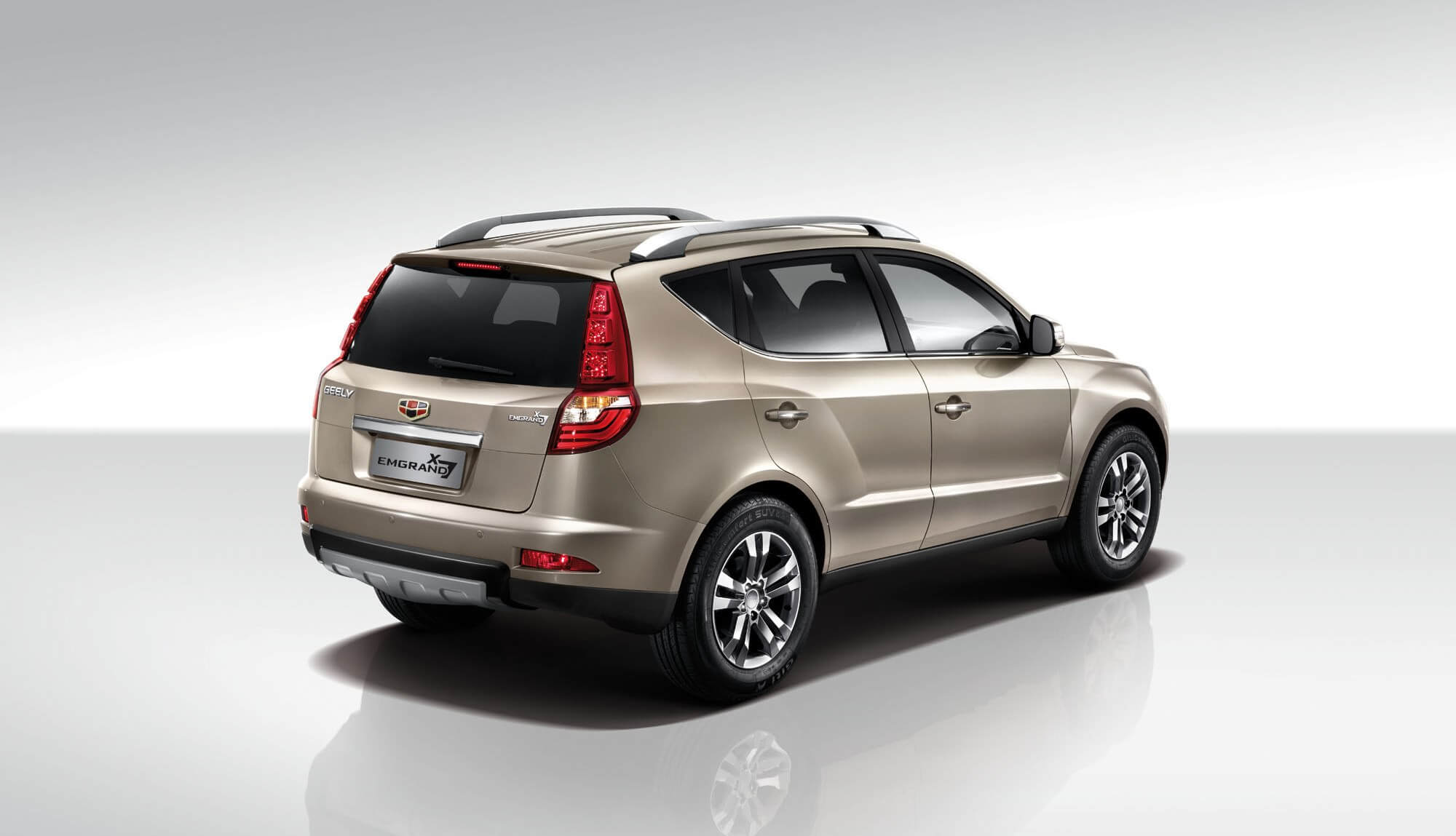
The X7's styling is conservative, with a black plastic grille, slightly rounded headlights, fog lights set into the bumper and tall tail lights that run up the D-pillars. Along the sides, pronounced creases run over the wheel arches and the bottom of the doors, and the rear door glass sweeps up towards the D-pillar to make the Emgrand X7 look less boxy. At the back, rear fog lights sit low in the bumper and a large Geely nameplate fills the centre of the tailgate, which opens high enough for easy loading of the 580-litre boot.

Inside, the cabin uses grey plastics with silver inserts, LED-lit instruments and a large centre console. The driver's seat has six-way adjustment, or eight-way electric adjustment on top versions, and the rear seat backrests can also be adjusted.
Rear passengers get plenty of head and legroom in the Emgrand X7, and the large glass area gives good visibility. The boot holds 580 litres (20.5 cu ft) with the rear seats up, which is generous for the class, and the rear seats fold to extend it. The steering wheel adjusts for height and carries remote buttons for the audio system, and the centre console of later Emgrand X7s has a colour display.
Chassis and safety
The Emgrand X7 uses a monocoque body with MacPherson strut front suspension and a multi-link rear axle, rack-and-pinion steering with hydraulic assistance and disc brakes on all four wheels, ventilated at the front. ABS with brake-force distribution, airbags and three-point belts were fitted to every Emgrand X7, with more driver aids on higher trims. Geely highlighted the X7's top score in the China New Car Assessment Programme (C-NCAP).

Emgrand X7 reliability and known faults
The Emgrand X7 is mechanically simple, but reviews and owners point to a few recurring weaknesses of the Geely:
- Interior trim quality below European and Japanese rivals.
- Noticeable body roll in corners.
- High fuel consumption, especially with the 2.4 automatic, and modest performance from the 1.8.
- Variable dealer and parts support for Geely, depending on the country.

Rivals: how the Emgrand X7 compares
In export markets the X7 competed with the Chery Tiggo, Great Wall Hover and Haval models, and with cheaper versions of the Hyundai Tucson, Kia Sportage and Toyota RAV4. Its strengths were space and equipment for the price; its weaknesses were economy, resale value and dealer coverage. More Chinese models are listed among Chinese cars and in the Geely catalogue.

Rivals
Compare with…
Compare Geely Emgrand X7 with
- Chery Tiggo 5 quick spec comparison
- JAC S5 quick spec comparison
- Haima 7 quick spec comparison
-
Ended 2021
- Years
- 2013–2021
- Body
- SUV
- Fuel
- Petrol
- Power
- 104–113 kW (141–154 PS)
3 generations
- Tiggo 5
- Tiggo 5
- II


Geely Emgrand X7 in our rankings
- No. 37 of 321 · Biggest boot: cars (580 l · top 13%)
- No. 28 of 140 · Biggest boot: SUVs and crossovers (580 l · top 22%)
- No. 73 of 155 · Biggest engines: SUVs and crossovers (2,400 cc · top 51%)
- No. 355 of 627 · Biggest engines: cars (2,400 cc · top 58%)
- No. 170 of 297 · Most economical cars (8.4 l/100 km · top 58%)
- No. 72 of 101 · Most economical SUVs and crossovers (8.4 l/100 km · top 72%)
Bigger boot than 87% of ranked cars in the 1CARS catalog (No. 37 of 321).
Geely Emgrand X7 photos 20




Geely Emgrand X7 videos 3

Geely Emgrand X7 video 1

Geely Emgrand X7 video 2

Geely Emgrand X7 video 3
FAQ
What other names does the Geely Emgrand X7 have?
The Emgrand X7 was also sold as the Gleagle GX7, the Shanghai Englon SX7 and, after Geely closed its sub-brands in 2015, the Geely GX7. A related Emgrand X7 Sport appeared in some export markets from 2018.
What engines does the Geely Emgrand X7 have?
It uses four-cylinder petrol engines of 1.8, 2.0 and 2.4 litres with about 92–110 kW (125–150 PS). There is no diesel, hybrid or four-wheel-drive Emgrand X7.
How big is the Geely Emgrand X7 boot?
The boot holds 580 litres with the rear seats up, which is generous for a compact SUV. Rear passengers also get plenty of head and legroom.
What is the fuel consumption of the Emgrand X7?
Owners report about 8–9 L/100 km for the 2.0 and around 10 L/100 km for the 2.4 automatic on the combined cycle. This is higher than most Japanese and Korean rivals.
What replaced the Geely Emgrand X7?
In China the GX7 was followed by the Vision X6 (Yuanjing X6) in 2016 and the Haoyue Pro in 2024. Geely's later export SUVs, such as the Atlas and Coolray, took over its role in many markets.
Data sources
Data collected automatically from the sources below and not yet checked by an editor.
- The text of this article (1cars archive)


