Archive first published
Tokyo Motor Show 2015: Seven Highlights and What Became of Them
The 44th Tokyo Motor Show ran from 29 October to 8 November 2015 at Tokyo Big Sight. It drew 812,500 visitors to 417 vehicles from 160 exhibitors in 11 countries. Our November 2015 report picked seven standouts, from the 368 kW BMW M4 GTS to Mazda's rotary RX-Vision. Only one became a series car; the others were concepts, and this page explains what each one led to.
Key takeaways
- The show: 29 October – 8 November 2015, Tokyo Big Sight, theme "Your heart will race", 812,500 visitors.
- The only production car of the seven: the BMW M4 GTS, limited to 700 units.
- Concepts with a legacy: the Mitsubishi eX (leading to the Eclipse Cross) and the Mazda RX-Vision (a Gran Turismo racing car).
- The show itself became the Japan Mobility Show in 2023.

How we picked the seven
The original 2015 report gave each car a title, such as "most coveted" or "most futuristic". We kept that selection and those titles, checked each car against manufacturer releases and reference sources, and added what happened in the decade after the show. Figures come from the makers' 2015 announcements unless stated otherwise.

| # | Model | Year shown | Drive | Power | Why it is on the list |
|---|---|---|---|---|---|
| 1 | BMW M4 GTS | 2015 (production) | 3.0 l turbo straight-six, water injection | 368 kW (500 PS) | most coveted |
| 2 | Toyota Kikai | 2015 (concept) | not published | - | most unusual |
| 3 | Nissan Teatro for Dayz | 2015 (concept) | electric, kei-car size | - | most sociable |
| 4 | Daihatsu Tempo and friends | 2015 (concepts) | small kei-class vehicles | - | most practical ideas |
| 5 | Mazda RX-Vision | 2015 (concept) | Skyactiv-R rotary | not published | most unexpected |
| 6 | Mitsubishi eX Concept | 2015 (concept) | two electric motors | 2 × 70 kW | best for export |
| 7 | Mercedes-Benz Vision Tokyo | 2015 (concept) | fuel cell plus battery | not published | most futuristic |
1. BMW M4 GTS (2015–2016): the most coveted
The M4 GTS was the only car of the seven that buyers could actually order. BMW first showed it as a concept at Pebble Beach in August 2015 and presented the production version in Tokyo. It used the M4's 3.0-litre twin-turbo straight-six, here with a water-injection system that sprays water into the intake to cool the charge. Output rose by 51 kW over the standard car.

| Item | BMW M4 GTS |
|---|---|
| Power / torque | 368 kW (500 PS) at 6,250 rpm / 600 Nm |
| Weight | 1,585 kg with the dual-clutch gearbox |
| 0–100 km/h | 3.8 s |
| Top speed | 305 km/h |
| Nürburgring Nordschleife | 7:28 (BMW figure) |
| Production | 700 units |
The Nordschleife time was 24 seconds quicker than that of the standard M4. By our calculation the GTS carried 4.3 kg per kW; you can compare that with other cars in our power-to-weight calculator. BMW followed it with the M4 CS of 2017 (338 kW, 3,000 cars) and the M4 CSL of 2022 (405 kW, 1,000 cars). The current model is covered on our BMW M4 page.
2. Toyota Kikai (2015): the most unusual
Kikai is the Japanese word for a mechanism, and the concept showed exactly that. Toyota turned the usual logic of car design around and exposed the parts that are normally hidden: suspension parts and other mechanicals were visible from outside, like a motorcycle without fairings. Toyota did not publish technical data.

The Kikai never went into production. At the same show Toyota also presented the S-FR, a small rear-wheel-drive sports car concept, and the FCV Plus, a hydrogen fuel-cell concept. Both reflected the same mood of 2015: playful design next to new drive technology.
3. Nissan Teatro for Dayz (2015): the most sociable
Nissan aimed the Teatro for Dayz at what it called "share natives", young people who grew up sharing everything online. It was based on the 660 cc Dayz kei car and used Nissan's electric-vehicle technology. Its cabin was a blank white space onto which content could be projected, so the interior worked as a screen for messages, video and social media.
It stayed a concept, and the projected cabin did not reach a production Nissan. In 2015 Nissan also used the Tokyo show to present the IDS concept, its vision of autonomous driving, and gave an update on the Leaf, which had passed 180,000 sales since 2010.
4. Daihatsu Tempo and the D-base family (2015): practical ideas
Daihatsu brought four concepts, and our 2015 report singled out the Tempo, a tiny catering van that opens up into a mobile kitchen or market stall. The other three were the D-base, a preview of the next Move kei car, and the Hinata, a small minivan that previewed a replacement for the Move Conte. The fourth, the Noriori, was a tiny minivan designed for wheelchair users.

| Daihatsu concept | Idea |
|---|---|
| Tempo | small catering and shop van |
| D-base | preview of the next Move |
| Hinata | small family minivan |
| Noriori | low-floor minivan for wheelchair users |
These concepts showed Japan's kei-car market at its most inventive. Daihatsu's long history in small cars is told in our history of Daihatsu.
5. Mazda RX-Vision (2015): the most unexpected
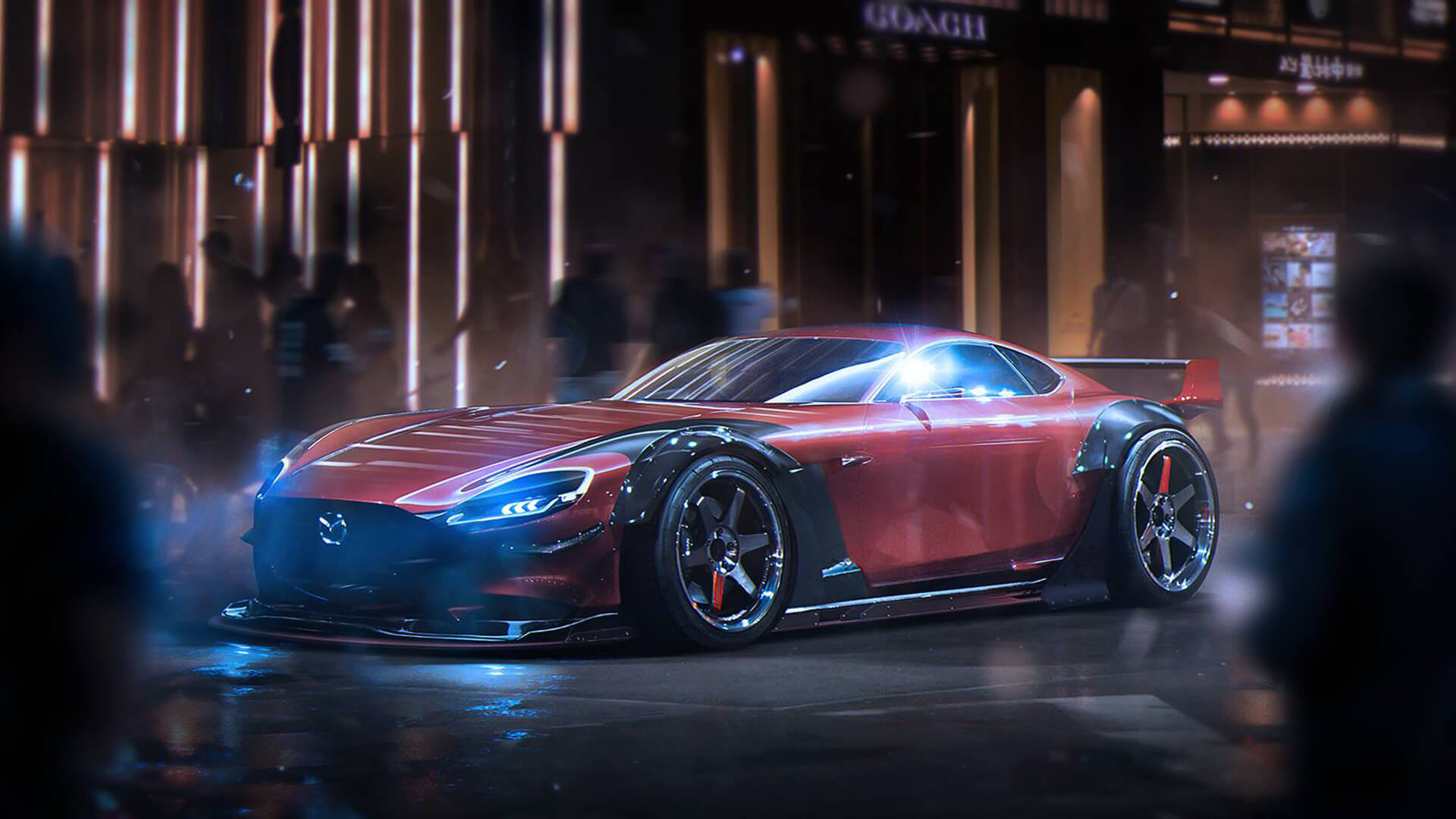
The RX-Vision drew the biggest crowds. It was a long-bonneted front-engined, rear-wheel-drive coupé in Mazda's Kodo design language, and Mazda said it was meant for a next-generation rotary engine called Skyactiv-R. Since the RX-8 had ended production in 2012, it raised hopes of a rotary sports car.

| Dimension | Mazda RX-Vision |
|---|---|
| Length | 4,389 mm |
| Width | 1,925 mm |
| Height | 1,160 mm |
| Wheelbase | 2,700 mm |
In 2016 the RX-Vision was voted the most beautiful concept car at the International Automobile Festival in Paris. It never reached showrooms, but it raced on. Mazda and Polyphony Digital turned it into the RX-Vision GT3 Concept, which arrived in the game Gran Turismo Sport in May 2020 with a four-rotor engine. An updated Evo version was announced in August 2026.
6. Mitsubishi eX Concept (2015): built for export
The eX was a compact electric crossover sized just below the ASX. It had two 70 kW motors, a 45 kWh battery and a claimed range of 400 km on the Japanese test cycle. The original report saw it as the car most clearly aimed at export markets. It was not built as shown, but its role passed to the petrol Eclipse Cross of 2017 and, in 2025, to an electric Eclipse Cross. The full story is on our page about the Mitsubishi eX Concept.
7. Mercedes-Benz Vision Tokyo (2015): the most futuristic
Mercedes called the Vision Tokyo an "automotive lounge" for the megacities of the future and dedicated it to Generation Z. It was a large van-like vehicle with a single door on the left that opened upwards, and inside it had an oval sofa instead of rows of seats. A seat could fold out from the bench for manual driving; otherwise the car was meant to drive itself, with sensors in a fin on the roof.
| Item | Mercedes-Benz Vision Tokyo |
|---|---|
| Length × width × height | 4,803 × 2,100 × 1,600 mm |
| Wheels | 26 inches |
| Drive | fuel-cell plug-in hybrid |
| Range | 980 km (190 km on battery, about 790 km on hydrogen) |
| Seats | up to five, on an oval bench |
The drive system came from the F 015 Luxury in Motion concept: a fuel cell generated electricity, and the battery could be charged by induction. The Vision Tokyo stayed a show car. Mercedes' first electric SUV for customers, the EQC, followed in 2019 with batteries only.
Other debuts at the 2015 show
Fuel cells were a theme of the show. Lexus showed the LF-FC, a 5.3-metre fuel-cell saloon that previewed the next LS, and Honda presented the Clarity Fuel Cell, which it began leasing in Japan in March 2016. Porsche used the show for the world debut of the Macan GTS, and Yamaha showed its Sports Ride concept.
The show took place in a weak market. In January–September 2015 Japanese new-vehicle registrations fell 9.5 % to 3,908,150 units, and among the major brands only Lexus and Mazda grew.
Verdict: which of the seven mattered most
Ten years on, the BMW M4 GTS is the only one of the seven that a collector can buy. With a run of 700 cars, it is the obvious choice for an enthusiast who wants a piece of the 2015 show in the garage. The Mitsubishi eX had the clearest effect on real cars, because its ideas reached customers through the Eclipse Cross. The Mazda RX-Vision kept the rotary dream alive for fans, while the Mercedes Vision Tokyo and the Nissan Teatro predicted how people would use cars more than which cars they would drive.
What happened to the Tokyo Motor Show
| Year | Show | Visitors |
|---|---|---|
| 1954 | First All Japan Motor Show, Hibiya Park | about 547,000 |
| 2015 | 44th Tokyo Motor Show | 812,500 |
| 2017 | 45th Tokyo Motor Show | 771,200 |
| 2019 | 46th Tokyo Motor Show | 1,300,900 |
| 2021 | cancelled because of COVID-19 | - |
| 2023 | renamed Japan Mobility Show | - |
By our calculation, attendance in 2015 was about 49 % higher than at the first show in 1954. The 2021 cancellation was the first time the show had not been held as planned since 1954. Since 2023 it has covered mobility as a whole, not only cars. You can compare the production models from these brands in our car comparison tool.
FAQ
When was the 2015 Tokyo Motor Show held?
The 44th show opened to the public at the end of October 2015 and closed on 8 November, after eleven days. Its theme was "Your heart will race", and 812,500 people visited.
Which cars from the 2015 Tokyo Motor Show went into production?
Of our seven, only the BMW M4 GTS was a production car, built in 700 units. The Mitsubishi eX influenced the later Eclipse Cross, and the Porsche Macan GTS and Honda Clarity Fuel Cell also reached customers.
Was the Mazda RX-Vision ever built?
No. It remained a concept for a rotary-engined sports car. A racing version, the RX-Vision GT3 Concept, exists only in the Gran Turismo video games.
What was the Mercedes-Benz Vision Tokyo?
A five-seat autonomous lounge concept with a fuel-cell plug-in hybrid drive. Mercedes quoted a range of 980 km, 190 km of it on battery power alone.
Does the Tokyo Motor Show still exist?
Under a new name. After the 2021 show was cancelled, the event returned in 2023 as the Japan Mobility Show, held at Tokyo Big Sight from 26 October to 5 November 2023.