
 Haima 7
Specs, engines and history
Updated Published Sources (2) Report an error
By Oleksandr Hnatiuk, Automotive Editor & Used Car Specialist Reviewed by Felix Hartmann

- Built
- 2010–2020
- Top power
- 110 kW (150 PS)
Which Haima 7 to buy: verdict
Our verdict · Oleksandr Hnatiuk
This SUV suits a buyer who wants a roomy, high-riding family car at a low price and accepts modest performance and basic safety. Choose a facelifted S7 from 2013 or later, preferably with the 1.8 turbo, which addresses the main weakness of the 2.0. If safety matters most, compare it with other SUVs in our car finder before deciding.
The Haima 7 is a five-door compact crossover built by the Chinese carmaker Haima from 2010 to 2020; from 2011 it was sold as the Haima S7. It made its debut at the Beijing motor show in 2010 and went on sale in July that year. The launch engine is a 2.0-litre petrol four with 110 kW (150 PS) and 180 Nm, driving the front wheels.
In short
- Built 2010–2020 in Hainan, China, with assembly in Iran; renamed Haima S7 in 2011 and facelifted in 2013, 2015 and 2016.
- Engines: 2.0 petrol, 110 kW (150 PS) and 180 Nm, later joined by a 1.8 turbo petrol.
- Performance of the 2.0: 0–100 km/h in 14.9 s, top speed 165 km/h; front-wheel drive with manual or automatic gearboxes.
- Size: 4,421–4,456 mm long, 1,830 mm wide, 2,619 mm wheelbase, kerb weight 1,435–1,495 kg.
Size at a glance
Brilliance V5
The Haima 7 is 199 mm shorter, 92 mm narrower and 13 mm taller than the Brilliance V5.
| Dimensions | Haima 7 | Brilliance V5 | Difference |
|---|---|---|---|
| Length | 4,421 mm174.1 in | 4,620 mm181.9 in | −199 mm−7.8 in |
| Width | 1,830 mm72.0 in | 1,922 mm75.7 in | −92 mm−3.6 in |
| Height | 1,740 mm68.5 in | 1,727 mm68.0 in | +13 mm+0.5 in |
| Wheelbase | 2,619 mm103.1 in | 2,725 mm107.3 in | −106 mm−4.2 in |
| Boot | - | 430 L15.2 cu ft | - |
Running cost
Fuel · 7 110 kW (150 PS) SUV
about 2,150 EUR fuel a year at 15,000 km
8.1 l/100 km · petrol at 1.75 EUR/l · change mileage, fuel price or version
Specs by version
Performance
Show all 1 versions
| Version | Fuel consumption |
|---|---|
| 110 kW (150 PS) SUV | 8.1 l/100 km29.0 mpg US · 34.9 mpg UK |
Dimensions and weight
Show all 1 versions
| Version | Length | Width | Height | Wheelbase | Kerb weight |
|---|---|---|---|---|---|
| 110 kW (150 PS) SUV | 4,421 mm174.1 in | 1,830 mm72.0 in | 1,740 mm68.5 in | 2,619 mm103.1 in | 1,500 kg3,307 lb |
Verified Manufacturer and type-approval data from our catalog · Sources and methodology
The Haima 7 at a glance: a Chinese SUV with Mazda roots
Haima began in 1992 as a joint venture that built Mazda-based cars, and much of its early range drew on Mazda engineering. The Haima 7 continued that line: the old 1cars text notes how closely it resembles the Mazda Tribute, which served as the starting point of the concept under an official cooperation agreement. The car sat above the later, smaller Haima S5. Haima's story is told in the history of Haima, and all its models are in the Haima catalogue.

| Fact | Value |
|---|---|
| Maker | Haima Automobile, Hainan, China |
| Production | 2010–2020 |
| Names | Haima 7 (2010), Haima S7 (from 2011) |
| Body | Five-door compact SUV |
| Drive | Front-wheel drive |
| Engines | 2.0 petrol 110 kW (150 PS); 1.8 turbo petrol |
| Assembly | Hainan (China); Iran (IKCO Khorasan) |
| Facelifts | April 2013, 2015, October 2016 |
One generation, three facelifts
| Generation | Code | Years | Body styles | Engines | Power (hp / kW) |
|---|---|---|---|---|---|
| Haima 7 / S7 | – | 2010–2020 (facelifts 2013, 2015, 2016) | Five-door SUV | 2.0 petrol, 1.8 turbo petrol | 110 kW (150 PS) for the 2.0 |
The model had one generation with three facelifts. The first, shown at the Shanghai motor show in April 2013, updated the styling and cabin; a second followed in 2015 and a third reached the Chinese market in October 2016. The car stayed in production until 2020.

The 2.0 HM484Q and the 1.8 turbo
The 2.0-litre HM484Q four-cylinder petrol engine produces 110 kW (150 PS) and 180 Nm. In early 2010 it came only with a five-speed manual gearbox, which a Chinese motoring site called a serious weakness for its market; automatic versions followed. Over its life the car was offered with five- and six-speed manual and five- and six-speed automatic gearboxes, and a turbocharged 1.8-litre HM484Q-T joined the range.

| Engine | Power | Torque | 0–100 km/h | Top speed | Gearboxes |
|---|---|---|---|---|---|
| 2.0 HM484Q petrol | 110 kW (150 PS) | 180 Nm | 14.9 s | 165 km/h | 5/6-speed manual, 5/6-speed automatic |
| 1.8 HM484Q-T turbo petrol | – | – | – | – | manual or automatic |
The two-litre car is not quick: a 14.9-second sprint is slow for a 1.4-tonne SUV. Drivers quoted in the old 1cars text found the engine short of pull and the manual clutch long and vague. By our calculation, the 2.0 carries about 13 kg per kW at its lightest kerb weight.
Five seats, a modest boot and high clearance
| Parameter | Metric | Imperial |
|---|---|---|
| Length | 4,421–4,456 mm | 174.1–175.4 in |
| Width | 1,830 mm | 72.0 in |
| Height | 1,740 mm | 68.5 in |
| Wheelbase | 2,619 mm | 103.1 in |
| Kerb weight | 1,435–1,495 kg | 3,164–3,296 lb |
The cabin has room for five, and the rear bench offers good space and a folding centre armrest, with a reclining backrest. The old 1cars text lists the weak points. The driver's seat adjusts only manually, even on top versions, and its height adjuster tilts only the cushion; the rear seats do not fold into a flat floor. The boot is modest for the class and its opening is short, so heavy items must be lifted high. On the plus side, the heated front seats have five heat settings, all seat belts have pretensioners, and the high ground clearance helps on poor roads. Suspension uses MacPherson struts at the front and a multi-link axle at the rear, with disc brakes on all wheels.

Around 8–9 litres per 100 km
The old 1cars text gives combined figures of about 8.1 l/100 km for the manual 2.0 and 8.8 l/100 km for the automatic. Those are high for a car of this size and power, largely because the engine has to work hard. The fuel cost calculator shows what that means over a year of driving.

Base, Deluxe and Navigation versions
In its export version, the old 1cars text describes three trims. The base 2.0 MT has a four-speaker audio system, cloth seats, rear parking sensors, heated electric mirrors, ABS, an alarm and central locking. The Deluxe MT adds air conditioning, a CD/MP3 system, heated front seats, full electric windows and brake assist. The top Navigation AT with an automatic gearbox adds climate control, leather trim, tyre-pressure monitoring, electronic brake-force distribution, fog lamps and two front airbags. None of the versions had keyless entry, a reversing camera or electronic stability control.

Two airbags and no stability control
The car was never crash-tested by Euro NCAP or the IIHS. Its equipment shows its age: two airbags and ABS, but no electronic stability control on the versions described above. Buyers who want modern safety should look at newer SUVs.

Known weak points on used cars
The 2.0 engine and the manual gearbox are simple, but owners mention cheap interior materials, uneven assembly, a slow-reacting climate control fan and a hard-to-read climate display. Check the clutch, the automatic gearbox, the suspension bushes and the electrical equipment on a used example, and confirm that parts are available locally.

Rivals: how the Haima 7 compares
| Model | Engines | Power (hp) | Boot (l) | Price from (EUR) |
|---|---|---|---|---|
| Haima 7 / S7 | 2.0 petrol, 1.8 turbo | 148 (2.0) | – | out of production |
| Haima S5 | 1.5 turbo, 1.6 petrol | – | – | out of production |
| Mazda Tribute (first gen) | 2.0–2.3 I4, 3.0 V6 petrol | – | – | out of production |
Compared with the later Haima S5, the 7 is the larger car, but older in design and less efficient, with its two-litre engine using around 8 to 9 l/100 km. Against Japanese and Korean compact SUVs of its time, it offered a lower price but less power, weaker safety equipment and poorer finish. Within the brand, the Haima M3 saloon shows the same budget approach in a smaller car.

Rivals
Compare with…
Compare Haima 7 with
- Geely Emgrand X7 quick spec comparison
- Chery Tiggo quick spec comparison
- Brilliance V5 quick spec comparison


Popular comparisons
Haima 7 in our rankings
- No. 49 of 156 · Lightest SUVs and crossovers (1,500 kg · top 32%)
- No. 68 of 212 · Smallest SUVs and crossovers (4,421 mm · top 33%)
- No. 241 of 591 · Smallest cars (4,421 mm · top 41%)
- No. 479 of 1175 · Longest-running car nameplates (10 years · top 43%)
- No. 303 of 563 · Widest cars (1,830 mm · top 54%)
- No. 240 of 449 · Lightest cars (1,500 kg · top 54%)
Lighter than 68% of ranked SUVs and crossovers in the 1CARS catalog (No. 49 of 156).
Haima 7 photos 16


Haima 7 videos 2

Test drive
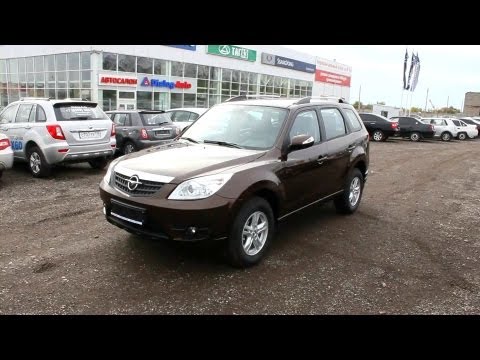
Video overview
FAQ
What engine does the Haima 7 have?
The launch engine is a 2.0-litre HM484Q petrol four with 110 kW (150 PS) and 180 Nm. A turbocharged 1.8-litre HM484Q-T was added later. Both drive the front wheels.
Is the Haima 7 based on the Mazda Tribute?
Haima grew out of a joint venture that built Mazda-based cars, and the old 1cars text notes that the Haima 7 closely resembles the Mazda Tribute, which inspired its concept. The body, interior and engines were developed by Haima.
What is the fuel consumption of the Haima 7?
The old 1cars text gives about 8.1 l/100 km for the 2.0 with a manual gearbox and 8.8 l/100 km with the automatic. Real use is often higher because the engine works hard in a 1.4-tonne car.
Is the Haima 7 available with all-wheel drive?
No. All versions documented at launch are front-wheel drive. The high ground clearance helps on rough roads, but the Haima 7 is not designed for real off-road driving.
What is the difference between the Haima 7 and the Haima S7?
They are the same car. Haima launched it as the Haima 7 in 2010 and renamed it S7 in 2011, then facelifted it in 2013, 2015 and 2016. Production ended in 2020.
Data sources
Data checked by an editor against the sources below.
- The text of this article (1cars archive)
- Wikipedia - Haima 7


