Archive first published
The 5 Most Reliable Modern Petrol Engines
Many modern engines are designed for low fuel use and emissions, which often means turbochargers, direct injection and tightly packaged components. Some simpler naturally aspirated petrol engines have earned a reputation for long life instead. This guide ranks five of them, from Renault's 1.6-litre K-Type units to Nissan's 2.0-litre MR20DE, and explains the design features behind their durability.

Key takeaways
- Best for simplicity: Renault K7M, an 8-valve 1.6 with a cast-iron block.
- Best all-rounder: Renault K4M, the 16-valve version of the same family.
- Durable mid-size options: Opel Z18XER 1.8, Mitsubishi 4B11 2.0 and Nissan MR20DE 2.0.
- All five are naturally aspirated multi-point injection engines; three use a timing belt that must be changed on schedule.

How we picked
The ranking is based on the engines' long service history in mass-market cars and on their design. We looked at five points:
- Simplicity: natural aspiration and multi-point injection, with no turbocharger or high-pressure direct-injection system.
- Block and valvetrain: a cast-iron block or a proven aluminium design, and a timing chain or a well-understood belt system.
- Track record: many years of production in many different models.
- Parts and know-how: wide availability of spare parts and workshops that know the engine.
- Owner experience: the old 1cars text reports owners covering 300,000 km and more with regular maintenance. These mileages are owner reports, not manufacturer figures.

No engine lasts without care. Each of these units needs regular oil changes and, where fitted, timely timing-belt replacement.
Comparison table

| # | Engine | Years | Displacement and layout | Power | Why it is on the list |
|---|---|---|---|---|---|
| 1 | Renault K7M | 1995– | 1.6 L, 8 valves, SOHC, belt | 55–73 kW (75–99 PS) | Cast-iron block, very simple design |
| 2 | Renault K4M | 1998– | 1.6 L, 16 valves, DOHC, belt | 66–99 kW (90–135 PS) | Same robust block with more power |
| 3 | Opel Z18XER | 2005– | 1.8 L, 16 valves, DCVCP, belt | 103 kW (140 PS) | Cast-iron block, natural aspiration |
| 4 | Mitsubishi 4B11 | 2007– | 2.0 L, 16 valves, MIVEC, chain | 110–116 kW (150–158 PS) | Timing chain, used across many brands |
| 5 | Nissan MR20DE | 2005– | 2.0 L, 16 valves, VVT, chain | 98–110 kW (133–150 PS) | Timing chain, used by Nissan and Renault |
1. Renault K7M (1.6 8V, since 1995)
The K7M is the simplest engine in this list. It is a 1,598 cc four-cylinder with a cast-iron block, an aluminium head, a single overhead camshaft and two valves per cylinder, driven by a toothed belt. Bore and stroke are 79.5 × 80.5 mm, and fuel is delivered by multi-point injection. Early versions powered the Renault Mégane, Scénic and Clio II; from 2004 the 64 kW (87 PS) K7M 710 became the main engine of the Dacia Logan and Sandero.

Later versions produce between 60 and 73 kW, including LPG and flex-fuel variants and a 64 kW version for the Lada Largus. According to the old 1cars text, the engine has no hydraulic valve lifters, and owners of Renault Logan and Renault Sandero cars report 300,000 to 400,000 km. The trade-off is modest performance: in its common form it gives 60–64 kW.
2. Renault K4M (1.6 16V, since 1998)
The K4M shares the K7M's cast-iron block, bore, stroke and displacement but has a double-overhead-camshaft head with 16 valves. Outputs range from 66 kW (90 PS) in the Dacia Logan to 94 kW (128 PS) in the Clio GT and 99 kW (135 PS) in the Twingo RS. It has been used in the Mégane, Scénic, Laguna, Kangoo, Fluence and Clio, and in the Renault Duster, whose 4x4 version used the 77 kW K4M 606.
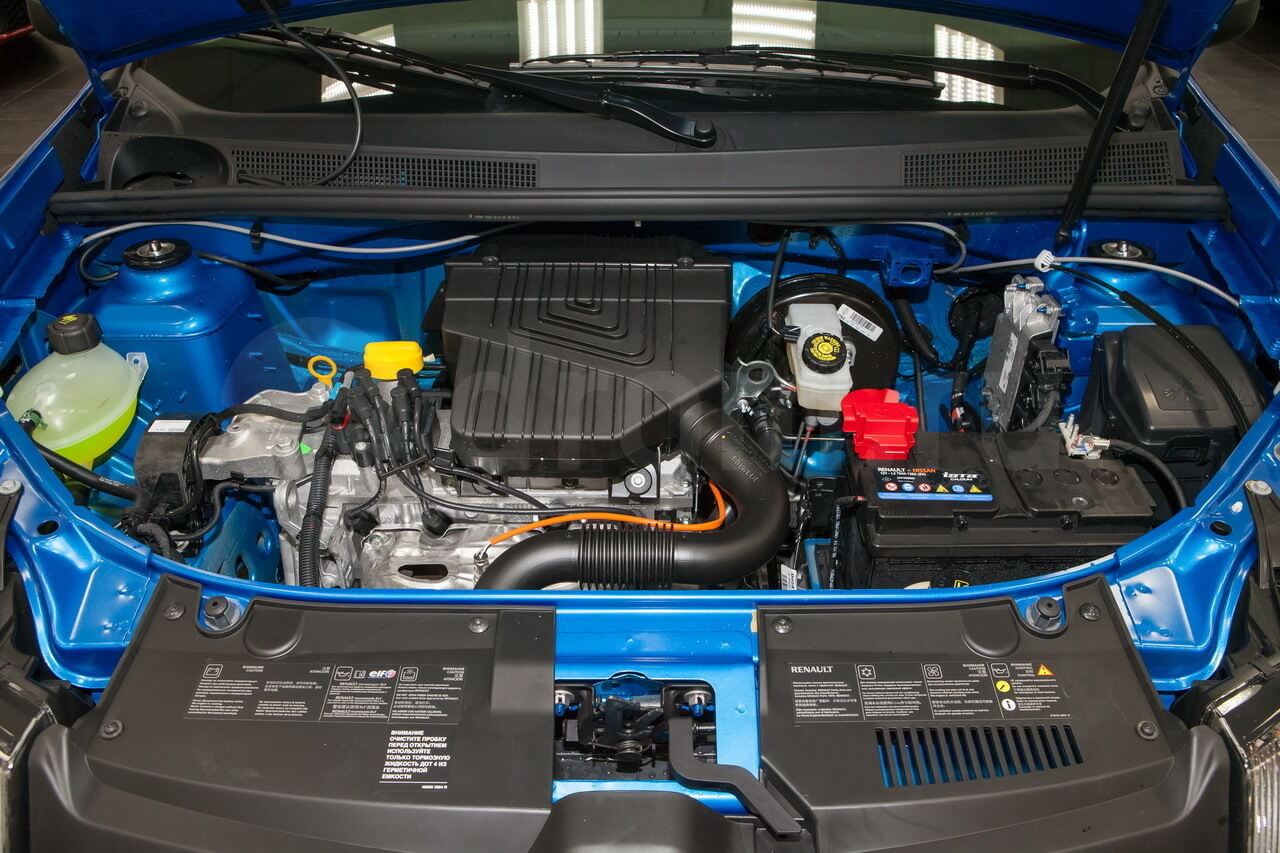
The old 1cars text notes that the K4M has hydraulic valve lifters and, with a timing belt changed at the first signs of wear, serves for 300,000 to 350,000 km. It is a good choice for drivers who want more power than the K7M offers without giving up the proven K-Type layout.
3. Opel Z18XER (1.8 16V, since 2005)
The Z18XER belongs to the third generation of General Motors' Family 1 engines, launched in 2005. This 1,796 cc unit has a lighter cast-iron block, belt-driven camshafts with bucket tappets and Double Continuous Variable Cam Phasing (DCVCP), which adjusts the timing of both camshafts. It produces 103 kW (140 PS) at 6,300 rpm and 175 Nm (129 lb-ft) at 3,800 rpm.
Wikipedia lists the Z18XER in the Opel Vectra (2005–2008) and Signum (2007–2008). 1.8-litre engines of the same generation also powered the Opel Astra, Zafira and Insignia and, as the 2H0 and related codes, the Chevrolet Cruze and Orlando. The old 1cars text highlights the engine's simplicity. As with the Renault engines, the timing belt must be replaced at the intervals the maker sets.
4. Mitsubishi 4B11 (2.0 16V, since 2007)
The 4B11 is a 1,998 cc square engine (86 × 86 mm) built at Mitsubishi's Shiga plant under the Global Engine Manufacturing Alliance with Chrysler and Hyundai. It has a die-cast aluminium block and head, double overhead camshafts, MIVEC variable valve timing on the intake and exhaust sides and a timing chain rather than a belt. It produces 110–116 kW (150–158 PS) at 6,000 rpm and 199 Nm at 4,250 rpm.
It powers the Mitsubishi Lancer and Galant Fortis (2007–2017), the Mitsubishi Outlander, ASX, Eclipse Cross and Delica, as well as the Citroën C4 Aircross, Peugeot 4007 and 4008 and Proton Inspira. A turbocharged 4B11T version powered the Lancer Evolution X. Hyundai and Kia use the related Theta engine from the same alliance, which explains why the old 1cars text linked the 4B11 with Korean models.
5. Nissan MR20DE (2.0 16V, since 2005)
Introduced in early 2005, the MR20DE is a 1,997 cc aluminium four-cylinder with a bore and stroke of 84 × 90.1 mm, double overhead camshafts, variable valve timing and a quiet timing chain. In standard form it produces 108 kW (147 PS) at 5,100 rpm and 199 Nm at 4,800 rpm; detuned versions give 98 kW (133 PS).
Nissan used it in the Nissan Qashqai, Nissan X-Trail (2007–2019), Teana J32, Sentra, Serena and NV200. Renault knows it as the M4R and fitted it to the Clio, Mégane III, Scénic, Laguna, Fluence, Latitude and first-generation Koleos. The old 1cars text credits its durability to a simple design and the chain-driven camshafts.
How to make any engine last longer
Even the most durable engine depends on its owner. The basics are simple:
- Change the oil and filter at the intervals in the service book, using the specified grade; for the K-Type family this is 5W-30.
- On belt-driven engines (K7M, K4M, Z18XER), replace the timing belt and tensioners on time; a broken belt can cause serious engine damage.
- On chain-driven engines (4B11, MR20DE), listen for chain rattle at start-up and keep oil levels correct, because chain tensioners depend on oil pressure.
- Let the engine warm up gently before using high revs, and keep the cooling system in good condition.
FAQ
Which is the most reliable modern petrol engine?
In this ranking the Renault K7M comes first because of its simple 8-valve design and cast-iron block. Owners in the old 1cars text report 300,000 to 400,000 km with regular maintenance.
Are engines with a timing chain more reliable than those with a belt?
A chain usually lasts longer than a belt, but it still needs correct oil levels and healthy tensioners. A belt engine such as the K7M or K4M is durable if the belt is replaced on schedule.
Why are naturally aspirated engines often more durable?
They have fewer highly stressed parts: no turbocharger, lower cylinder pressures and, with multi-point injection, no high-pressure fuel pump. That makes them simpler to maintain and repair.
Which cars use the Renault K4M engine?
The K4M has been used in the Renault Mégane, Scénic, Clio, Laguna, Kangoo, Fluence and Duster, the Dacia Logan and Sandero, and other models, with outputs from 66 to 99 kW.
Is the Mitsubishi 4B11 used by Kia and Hyundai?
No. Kia and Hyundai use the related Theta engine, developed under the same Global Engine Manufacturing Alliance. The 4B11 itself appears in Mitsubishi, Citroën, Peugeot and Proton models.