
 Suzuki Baleno
Specs, engines and history
Updated Published Sources (3) Report an error
By Felix Hartmann, Automotive Technology & EV Contributor Reviewed by Oleksandr Hnatiuk

- Built
- 2015–present
- Top power
- 82 kW (111 PS)
Which Suzuki Baleno to buy
Our verdict · Felix Hartmann
- Best all-rounder: the 1.0 Boosterjet with the manual gearbox, quick and economical.
- For town use and low running costs: the 1.2 Dualjet SHVS mild hybrid.
- For automatic driving: the 1.0 Boosterjet with the six-speed automatic, smoother than the CVT of the 1.2.
Look for a car with the Radar Brake Support pack, which gives the four-star safety rating. The Baleno suits buyers who want maximum space and economy in a compact, light car and do not need a soft-touch interior. Suzuki's background is in the history of Suzuki, and its current models are on the Suzuki brand page.
The Suzuki Baleno of 2015 is a five-door supermini built by Maruti Suzuki in India and sold in Europe from spring 2016 until 2020. It weighs well under a tonne thanks to the HEARTECT platform and has a 355-litre boot. Engines are a 1.0-litre Boosterjet turbo with 82 kW (111 PS) or a 1.2-litre Dualjet with 66 kW (90 PS), optionally as a mild hybrid.
In short
- Previewed by the iK-2 concept at Geneva in March 2015 and unveiled at Frankfurt on 15 September 2015; production began in India that month.
- It revived a name Suzuki had used in Europe in the 1990s, which is why the old 1cars page called it "Baleno 2".
- Euro NCAP 2016: three stars as standard, four stars with the optional Radar Brake Support safety pack.
- Withdrawn from Europe in 2020 because of low sales; in India a second generation followed in February 2022, also sold as the Toyota Glanza.

Size at a glance
| Dimensions | Suzuki Baleno |
|---|---|
| Length | 3,995 mm157.3 in |
| Width | 1,745 mm68.7 in |
| Height | 1,470 mm57.9 in |
| Wheelbase | 2,520 mm99.2 in |
Specs by version
Engines
Dimensions and weight
Verified Manufacturer and type-approval data from our catalog · Sources and methodology
Suzuki Baleno at a glance
| Parameter | Metric | Imperial |
|---|---|---|
| Length | 3,995 mm | 157.3 in |
| Width | 1,745 mm | 68.7 in |
| Height | 1,470 mm | 57.9 in |
| Wheelbase | 2,520 mm | 99.2 in |
| Ground clearance (European cars) | 120 mm | 4.7 in |
| Boot (seats up / folded) | 355 / 756 l | 12.5 / 26.7 cu ft |
| Drag coefficient | 0.299 | |
| Engines (Europe) | 1.0 turbo three-cylinder, 1.2 four-cylinder | |
| Plants | Manesar and Ahmedabad (Gujarat), India |
The earlier Baleno (1995–2002), sold in Europe as a saloon, estate and hatchback, was a different car, based on the Cultus Crescent. The 2015 car is a new design. In Suzuki's European range it sat above the Swift as a roomier family hatchback, and Suzuki styled it with what it called a "Liquid Flow" theme.

Boosterjet, Dualjet and SHVS engines
| Engine | Code | Power | Torque | Gearboxes |
|---|---|---|---|---|
| 1.0 Boosterjet turbo, three-cylinder | K10C | 82 kW (111 PS) | 160 Nm | 5-speed manual, 6-speed automatic |
| 1.2 Dualjet, four-cylinder | K12C | 66 kW (90 PS) | about 120 Nm | 5-speed manual, CVT |
| 1.2 Dualjet SHVS mild hybrid | K12C | 66 kW (90 PS) | about 120 Nm | 5-speed manual |
The Boosterjet is the drivers' choice, with turbocharged torque from low revs in a car that weighs about 900 kg. The Dualjet uses two injectors per cylinder for efficiency, and the SHVS (Smart Hybrid Vehicle by Suzuki) adds an integrated starter-generator and a small lithium-ion battery that assists the engine and allows smoother stop-start. Outside Europe, markets also received a 1.4-litre K14B, and India a 1.2-litre K12M and a Fiat-sourced 1.25-litre diesel.

At 82 kW the 1.0 Boosterjet places the Baleno 20th among the most powerful hatchbacks in the 1cars catalogue (October 2026), unusual for a car of this price class. With 82 kW and about 950 kg, it has roughly 86 kW per tonne by our calculation, compared with about 76 kW per tonne for the 1.2 Dualjet (66 kW, about 870 kg).
HEARTECT platform, body and cabin
The HEARTECT platform, shared with the Swift and Ignis, uses a continuous frame structure and high-strength steel. Suzuki said it made the body about 10% stiffer and about 15% lighter than the previous structure, as the old 1cars text reported. Front brakes are ventilated discs; the rear brakes are drums or discs depending on trim.

Inside, the cabin is plain, with hard plastics, but well built. Higher trims have a 7-inch touchscreen with smartphone connection, navigation and a reversing camera, automatic climate control with a round display, and adaptive cruise control linked to the Radar Brake Support system. The rear bench offers generous legroom for the class, with 805 mm between front and rear seating positions, but the sloping roof and narrow cabin make three adults a squeeze. The rear backrest splits 60:40, and a full-size spare wheel sits under the boot floor in some markets.
Euro NCAP: three or four stars
Euro NCAP tested the Baleno in 2016 and gave two results:
| Version | Stars | Adult | Child | Pedestrian | Safety assist |
|---|---|---|---|---|---|
| standard | 3 | 80% | 73% | 65% | 25% |
| with safety pack (Radar Brake Support) | 4 | 85% | 73% | 65% | 43% |

Six airbags, ESP, ABS with EBD, belt pretensioners and ISOFIX mounts were standard in Europe. The old 1cars article described the test in detail: the chest of the driver was the weak point in the pole impact, and child protection lost points for the ten-year-old dummy on a booster cushion. Outside Europe results differ by specification: a Latin American car with two airbags and no stability control scored zero stars in 2021, while a 2025 version with six airbags scored much better.
Ownership costs and known faults
The Baleno is cheap to run. The light body means small fuel bills and low tyre and brake wear, and Suzuki's K-series engines have a good reputation. On a second-hand Baleno, check:
- on the 1.0 Boosterjet, regular oil changes with the right specification, since the turbo depends on them;
- on CVT cars, smooth take-off and no whining;
- the infotainment touchscreen, which can freeze and need a software update;
- light paint and plastics that scratch easily, and rust on the underside of high-mileage cars from salted roads.

You can estimate yearly fuel spend with the fuel cost calculator.
Rivals: how the Baleno compares
| Model | Engines | Power | Boot |
|---|---|---|---|
| Suzuki Baleno | 1.0 turbo, 1.2 | 66–82 kW | 355 l |
| Suzuki Swift (2017) | 1.0 turbo, 1.2 | 66–82 kW | 265 l |
| Volkswagen Polo (6C) | 1.0–1.4 petrol, 1.4 diesel | 44–141 kW | 280 l |
| Skoda Fabia (2014) | 1.0–1.2 petrol, 1.4 diesel | 44–81 kW | 330 l |
Compared with the Swift, which shares its engines, the Baleno has 90 litres more boot space and much more rear legroom, but it is less fun to drive. Against the Polo and Fabia it offers more space for less money, while the Volkswagen Group cars feel more solid inside and scored five stars in Euro NCAP. Set any of them against the Baleno in the 1cars comparison tool.

Rivals
Compare with…
Compare Suzuki Baleno with
- Lada Kalina quick spec comparison
-
Ended 2018
- Years
- 2013–2018
- Body
- Hatchback, Station wagon
- Fuel
- Petrol
- Power
- 64–78 kW (87–106 PS)

Suzuki Baleno in our rankings
- No. 52 of 531 · Smallest cars (3,995 mm · top 10%)
- No. 35 of 93 · Smallest hatchbacks (3,995 mm · top 38%)
- No. 56 of 91 · Widest hatchbacks (1,745 mm · top 62%)
- No. 63 of 93 · Longest hatchbacks (3,995 mm · top 68%)
- No. 103 of 141 · Most powerful hatchbacks (82 kW · top 74%)
- No. 68 of 91 · Biggest engines: hatchbacks (1,400 cc · top 75%)
Shorter than 90% of ranked cars in the 1CARS catalog (No. 52 of 531).
Suzuki Baleno photos 22


Suzuki Baleno videos 2

Suzuki Baleno video 1
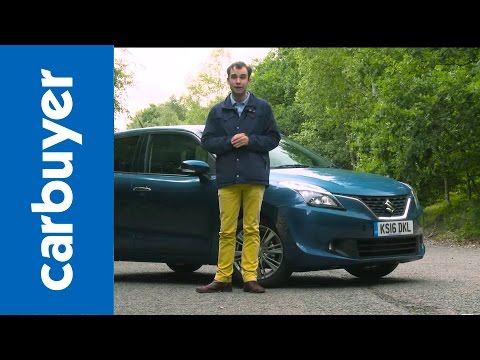
Video overview
FAQ
How many generations of the Suzuki Baleno are there?
The 2015 Baleno is the first of the modern hatchbacks, built in India and sold in Europe from 2016 to 2020. A second generation appeared in India in February 2022. Suzuki had also used the Baleno name in Europe for a different car from 1995 to 2002.
Is the Suzuki Baleno reliable?
It has a good record: the K-series petrol engines and manual gearboxes are simple and durable, and the light body is easy on brakes and tyres. Main points to watch are oil changes on the turbo 1.0, CVT behaviour and infotainment glitches.
What is the fuel consumption of the Suzuki Baleno?
Low, thanks to a weight of about 900 kg. The 1.2 Dualjet SHVS mild hybrid is the most frugal version, and the 1.0 Boosterjet uses only a little more in real driving despite its 82 kW turbo engine.
Is the Suzuki Baleno available with all-wheel drive or as a hybrid?
It has front-wheel drive only. The 1.2 Dualjet was offered with Suzuki's SHVS mild-hybrid system, which uses a starter-generator and a small lithium-ion battery; there was no full hybrid or electric version.
What are the main rivals of the Suzuki Baleno?
In Europe it competed with the Volkswagen Polo, Skoda Fabia and Ford Fiesta, and with its own sister car, the Suzuki Swift. The Baleno offered more interior and boot space than most of them for a lower price.
Data sources
Data checked by an editor against the sources below.
- The text of this article (1cars archive)
- Wikipedia - Suzuki Baleno (2015)
- Motoringresearch - The Safest New Cars Of 2016


