
 Nissan Cefiro
All generations, specs and history
Updated Published Sources (2) Report an error
By Sarah Whitmore, Senior Automotive Writer Reviewed by Oleksandr Hnatiuk

- Built
- 1988–2003
- Generations
- 3 · A31 to A33
- Top power
- 141 kW (192 PS)
Timeline
Cefiro generations
Click a generation for its own page
- Cefiro A31 1988–1994 · Sedan
- Cefiro A32 1994–1998 · Sedan · 103–141 kW (140–192 PS)
- Cefiro A33 1998–2003 · Sedan
Newest first · 3 generations since 1988
-
1998

-
1994

-
1988
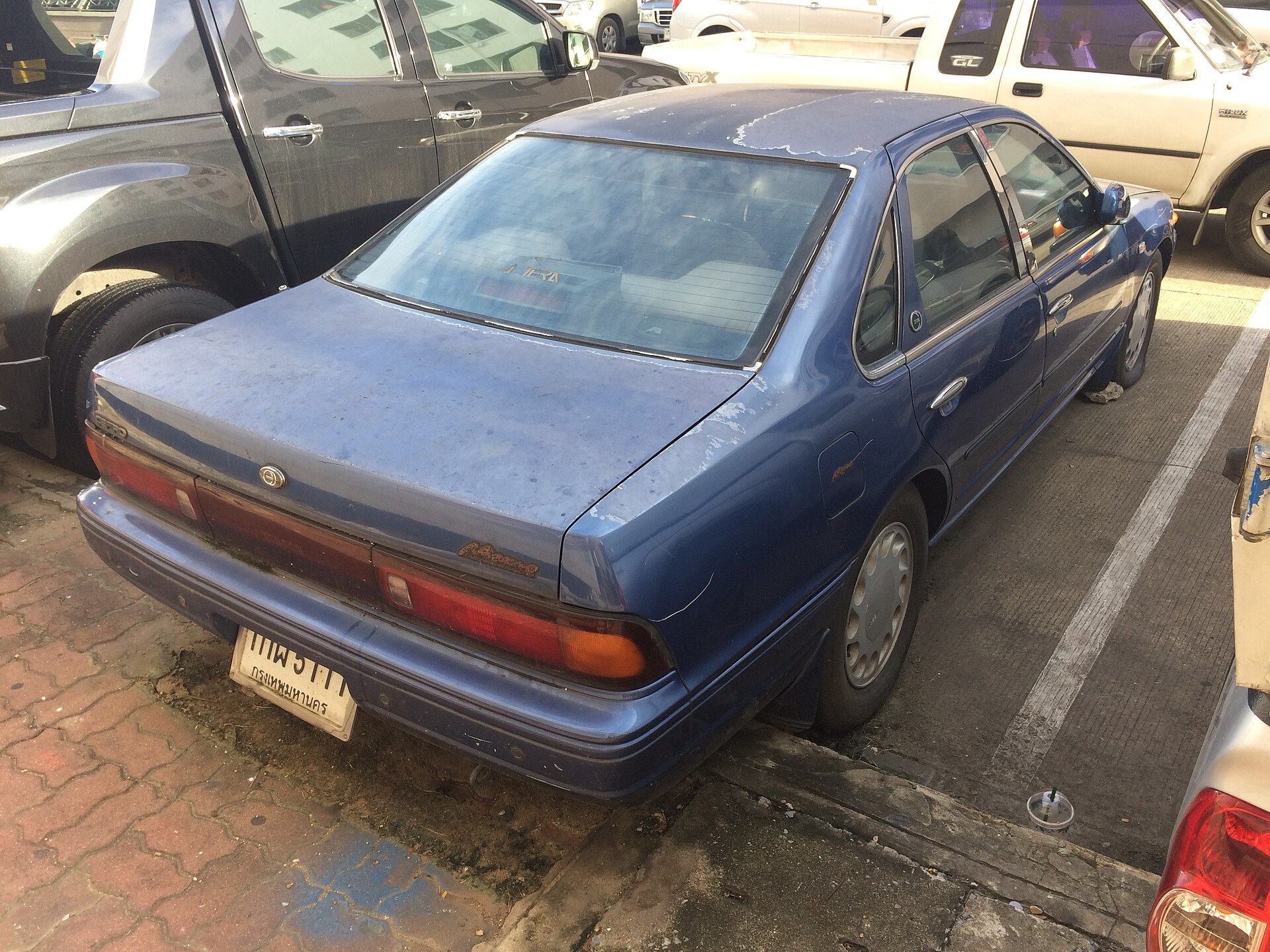


All generations by year: Cefiro A33 (1998–2003) · Cefiro A32 (1994–1998) · Cefiro A31 (1988–1994)
Which one is mine?
Pick the year of first registration to see which generation it is.
Check by VINThe Nissan Cefiro A32 is a mid-size four-door saloon launched in Japan in August 1994, the second Cefiro generation and the first with front-wheel drive. Abroad it was sold as the Nissan Maxima QX in Europe, the Maxima in North America and Australia, and the Infiniti I30. Its VQ V6 engines range from 103 kW (140 PS) to 141 kW (190 hp).
In short
- Years: Japanese saloon from August 1994, facelift in January 1997, replaced by the A33 in late 1998; Cefiro Wagon (WA32) from June 1997 to August 2000.
- Engines: VQ20DE 2.0 V6 with 103 kW (140 PS) in Europe; 2.5 V6 in Japan; VQ30DE 3.0 V6 with 141 kW (190 hp) and 278 Nm.
- Gearboxes: 5-speed manual or 4-speed automatic; front-wheel drive only.
- The VQ30DE was a first-place winner of the Ward's 10 Best Engines list, and the US Maxima was Motor Trend's 1995 Import Car of the Year.

Specs by version
Engines
Dimensions and weight
Show all 1 versions
| Version | Boot |
|---|---|
| A32 · 1994–1998 | |
| A32 · 2.0 103 kW (140 PS) Sedan | 440 l15.5 cu ft |
Verified Manufacturer and type-approval data from our catalog · Sources and methodology
Nissan Cefiro A32 at a glance
The first Cefiro (A31) of 1988 was a rear-wheel-drive saloon related to the Nissan Skyline. For the A32, Nissan changed course: the new car shared its front-wheel-drive platform with the Maxima, and from this generation the Maxima became an export version of the Cefiro. The Maxima name was retired in Japan, while export markets kept it. Nissan's wider story is told in the history of Nissan.

| Generation | Code | Years | Drive | Main engines |
|---|---|---|---|---|
| 1st | A31 | 1988–1994 | rear-wheel drive, optional AWD | RB20 and RB25 straight-six |
| 2nd | A32 | 1994–1998 (wagon to 2000) | front-wheel drive | VQ 2.0, 2.5 and 3.0 V6 |
| 3rd | A33 | 1998–2003 | front-wheel drive | VQ 2.0, 2.5 and 3.0 V6 |
Names around the world
| Market | Name |
|---|---|
| Japan | Nissan Cefiro (some cars with Maxima badges) |
| Europe | Nissan Maxima QX |
| North America | Nissan Maxima, Infiniti I30 (from model year 1996) |
| Australia | Nissan Maxima (from February 1995) |
| Taiwan | Built by Yulon |
| Philippines | Nissan Cefiro (from 1997) |
Engines and gearboxes
The A32 introduced Nissan's VQ V6, an aluminium engine with four valves per cylinder that was praised for its smoothness and response. European cars were offered with a 2.0 V6 for markets where taxation favoured small engines, and with the 3.0 V6.

| Engine | Displacement | Power | Torque | Markets |
|---|---|---|---|---|
| VQ20DE | 2.0 L V6 | 103 kW (140 PS) in Europe; up to 114 kW (155 PS) in Japan | – | Europe, Japan, Southeast Asia |
| VQ25DE | 2.5 L V6 | 140 kW (190 PS) | – | Japan |
| VQ30DE | 3.0 L V6 | 141 kW (190 hp) | 278 Nm (205 lb-ft) | North America, Europe, Australia |
All versions drive the front wheels through a 5-speed manual or a 4-speed automatic. In the US, the 3.0 Maxima reached 60 mph in 6.6 seconds with the manual and 7.6 seconds with the automatic, quick for a family saloon of the mid-1990s. Some early Infiniti I30s with the manual gearbox had a viscous limited-slip differential. The 2.0 has a compression ratio of 9.5:1 and runs on regular petrol.
Chassis and suspension
Front suspension uses MacPherson struts. At the rear, Nissan replaced the independent suspension of the previous Maxima with a lighter multi-link beam axle, a cost-saving choice that many Japanese makers adopted after the early-1990s economic downturn. Critics noted the change, but the A32 still rode comfortably and handled well for its class: Car and Driver put the Maxima SE on its Ten Best list in 1995 and 1996.

Interior and equipment
The cabin offers space for five, leather upholstery on better-equipped versions, electric seat adjustment, climate control and an outside temperature display. The rear seat is about as roomy as in the previous model, and the seating position is higher. Because of the passenger airbag, the glovebox is small, but the storage bin under the centre armrest compensates. The boot holds about 440 litres.
Facelift and the Cefiro Wagon
Nissan facelifted the Cefiro in January 1997 with new multi-reflector headlights and tail lights; ABS and airbags became standard in Japan. A "Brown Selection" special edition with a chrome grille and brown interior followed the same month. Export Maximas received revised bumpers, five-spoke alloy wheels and clear-lens headlights, and optional side airbags were added for 1998.

From June 1997 to August 2000, Japan also had the Cefiro Wagon (WA32), an estate version of the A32. In some markets, European cars can be recognised by the QX badge on the boot lid and horizontal grille slats, while Gulf-market cars have vertical slats.
From A32 to A33
The third and last Cefiro, the A33, arrived in Japan in December 1998 and kept front-wheel drive and the VQ engines, with a 2.0, a 2.5 and a 3.0 V6; in Europe it was again sold as the Maxima QX, with 140 PS and 200 PS versions. Nissan dropped the Cefiro name in Japan in 2003, and the Teana (J31) took its place in some markets. The A32 therefore marks the turning point between the rear-drive, Skyline-related A31 and the later front-drive Nissan executive saloons.

Cefiro A32 in film
A 1990s Nissan Maxima of this generation appeared in the 2001 film The Fast and the Furious, driven by the character Vince (played by Matt Schulze), which raised the model's profile among tuning fans.

Rivals: how the Cefiro A32 compares
In Japan, the Cefiro competed with the Toyota Mark II and Camry and with the Honda Accord. In Europe, the Maxima QX faced executive saloons such as the Ford Scorpio, Opel Omega and Toyota Camry. Its strengths were the V6 engine and the equipment; its weakness was a rear suspension simpler than some rivals'. More cars of the era are listed among Japanese cars and classic cars of the 1990s.

Buying a Nissan Cefiro A32 today
The A32 has a reputation for durability, and simple maintenance keeps running costs reasonable. When inspecting one, check:
- Service history of the automatic gearbox.
- Smooth, quiet running of the V6 and no warning lights on the dashboard.
- Rust on sills, wheel arches and the rear subframe.
- Condition of the electric seats, windows and climate control.
- Originality: many cars were modified by tuning enthusiasts.


Nissan Cefiro evolution in numbers
Did you know?
- The Nissan Cefiro ran for 15 years, from 1988 to 2003, over 3 generations in our catalog.
- The longest-running generation is the Cefiro A31 (1988–1994): 6 years.
Image credits · Photos from Wikimedia Commons under free licences
- Nissan Cefiro A31 · Photo: M.rJirapat / Wikimedia Commons, CC BY-SA 4.0
Rivals
Compare with…
Compare Nissan Cefiro with
- Honda Accord quick spec comparison
- GAZ Volga quick spec comparison
- Opel Vectra quick spec comparison
-
In production
- Years
- 1976–present
- Body
- Sedan, Hatchback
- Fuel
- Petrol, Diesel, Hybrid
- Power
- 50–207 kW (68–281 PS)
11 generations
- VI
- VII
- VIII
- IX
- CV
- XI
- +5 earlier
-
Ended 2009
- Years
- 1997–2009
- Body
- Sedan
- Fuel
- Petrol, Diesel
- Power
- 51–125 kW (69–170 PS)
2 generations
- 3110
- 31105
-
Ended 2008
- Years
- 1988–2008
- Body
- Sedan, Hatchback
- Fuel
- Petrol, Diesel
- Power
- 42–206 kW (57–280 PS)
4 generations
- A
- B
- Vectra
- C


Nissan Cefiro in our rankings
- No. 284 of 1082 · Longest-running car nameplates (15 years · top 28%)
- No. 155 of 321 · Biggest boot: cars (440 l · top 49%)
- No. 61 of 111 · Most powerful cars of the 1990s (141 kW · top 56%)
- No. 101 of 174 · Most powerful sedans (141 kW · top 59%)
- No. 181 of 411 · Cars with the most generations (3 generations · top 64%)
- No. 91 of 143 · Biggest engines: sedans (2,000 cc · top 67%)
In production longer than 72% of ranked nameplates in the 1CARS catalog (No. 284 of 1082).
Nissan Cefiro photos 15


FAQ
Is the Nissan Cefiro A32 the same as the Maxima?
Yes. From the A32 generation, the Maxima became an export version of the Cefiro. It was sold as the Maxima QX in Europe, the Maxima in North America and Australia, and as the Infiniti I30.
When was the Cefiro A32 produced?
The A32 saloon was launched in Japan in August 1994, facelifted in January 1997 and replaced by the A33 in late 1998. The Cefiro Wagon was built from June 1997 to August 2000.
What engine does the Cefiro A32 have?
It uses Nissan's VQ V6 engines: a 2.0 with 103 kW (140 PS) in Europe, a 2.5 in Japan and a 3.0 VQ30DE with 141 kW (190 hp). All drive the front wheels.
Is the Cefiro A32 front-wheel drive?
Yes. The A32 was the first front-wheel-drive Cefiro; the earlier A31 was rear-wheel drive and shared its platform with the Skyline. No four-wheel-drive A32 was offered.
Which car from The Fast and the Furious is a Maxima?
Vince, played by Matt Schulze, drives a 1990s Nissan Maxima of the A32 generation in the 2001 film. The appearance helped make the model popular with tuning enthusiasts.
Data sources
Data checked by an editor against the sources below.
- The text of this article (1cars archive)
- Wikipedia - Nissan Cefiro


