
 Abarth 500C
Specs, engines and history
Updated Published Sources (3) Report an error
By Felix Hartmann, Automotive Technology & EV Contributor Reviewed by Oleksandr Hnatiuk

- Built
- 2010–2024
- Top power
- 132 kW (179 PS)
Which version to buy: 500C, 595C or Competizione
Our verdict · Felix Hartmann
A 595C Turismo with a manual gearbox is the best all-round choice: it has enough power, a more comfortable cabin and fewer modifications than many Competizione cars. The Competizione suits drivers who want the sharpest version and accept a harsh ride. Avoid automated gearboxes if you do a lot of town driving, and check the roof mechanism, drains and seals for leaks.
The early 500C with 99 kW is the cheapest way in, but it is the slowest and its interior is the oldest. Buyers who want an open-top Abarth without a petrol engine should look at the electric 500e on the 1cars electric car pages. Other models are in the Abarth section of the 1cars catalogue.
The Abarth 500C is the open-roof version of the Abarth 500, the performance model based on the 2007 Fiat 500. It arrived in 2010 with a 1.4-litre T-Jet turbo of 99 kW (135 PS) and a full-length electric fabric roof. From 2012 it was sold as the 595C with up to 132 kW (180 PS), and petrol production ended in 2024.
In short
- Body: three-door 500 shell with an electric folding fabric roof; the roof pillars and side windows stay in place.
- Engines: 1.4 T-Jet turbo petrol from 99 kW (135 PS) to 132 kW (180 PS) in the Competizione and 695C models.
- Performance: 0–100 km/h in about 6.7–7.9 seconds, depending on version.
- Successor: the electric Abarth 500e, also offered with a folding roof, launched in 2023.

Specs by version
Performance
Show all 1 versions
| Version | Fuel consumption |
|---|---|
| 1.4 99 kW (135 PS) Convertible | 6.5 l/100 km36.2 mpg US · 43.5 mpg UK |
Verified Manufacturer and type-approval data from our catalog · Sources and methodology
The Abarth 500C at a glance

| Fact | Value |
|---|---|
| Brand | Abarth, a stand-alone performance brand since 2008 |
| Based on | Fiat 500 (2007) and Fiat 500C (2009) |
| Production | 2010–2024 (as 500C, then 595C and 695C) |
| Plant | Tychy, Poland, with the Fiat 500 |
| Body | Three-door, four-seat convertible with fabric roof |
| Engine | 1.4 T-Jet 16V turbo petrol |
| Drive | Front-wheel drive |
From the scorpion badge to the 500C
Carlo Abarth founded his tuning company in 1949 and made his name with fast versions of small Fiats, including the original 500 and 600. Fiat bought the business in 1971, and in early 2008 it relaunched Abarth as a separate performance brand with its own dealers. The Abarth 500 hatchback was shown at the Geneva Motor Show in March 2008 and went on sale that July.

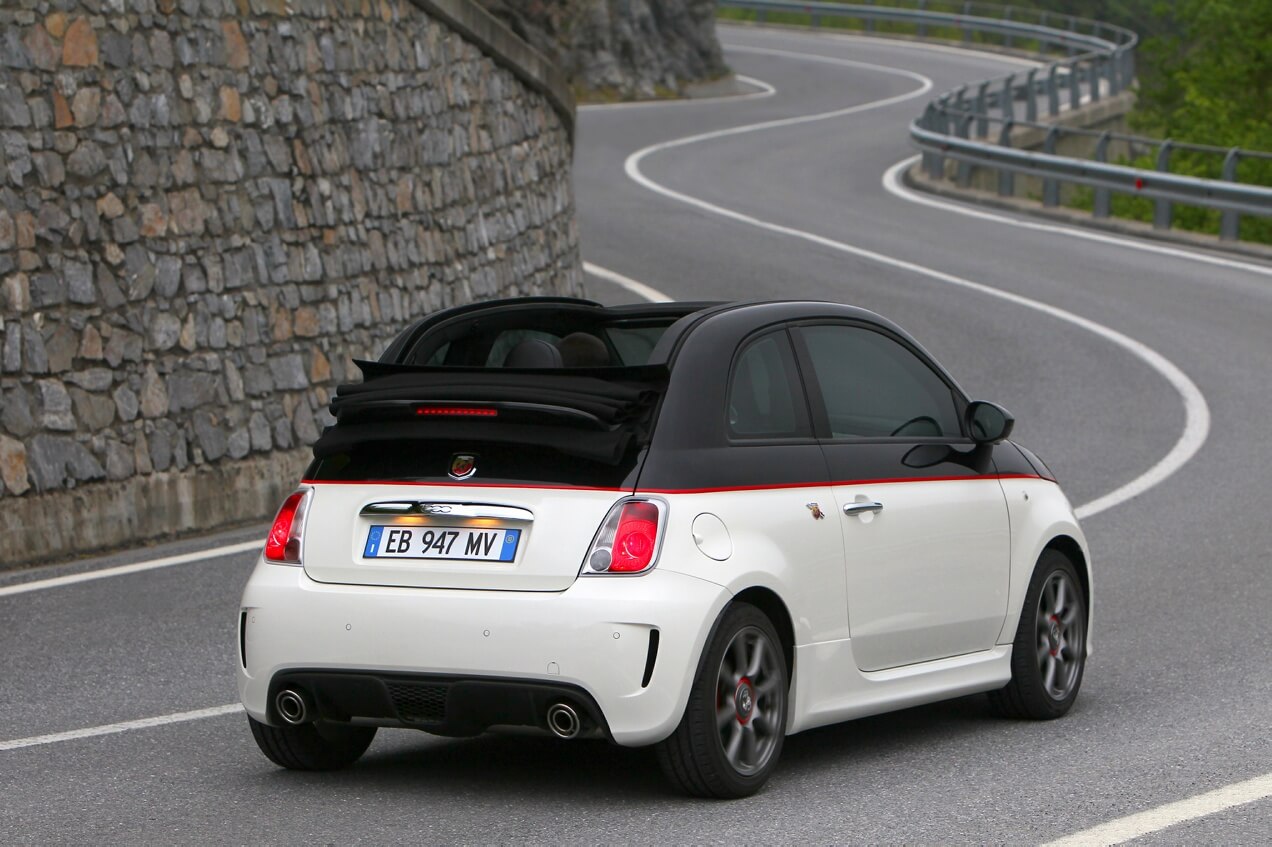
The Fiat 500C, with its large folding roof, had arrived in 2009, and the Abarth version followed in 2010. Compared with the regular Fiat 500, it has a deeper front bumper with extra cooling intakes, side skirts, a rear diffuser with twin exhaust outlets, lowered sports suspension and the scorpion badge. More about the parent brand is in the history of Fiat.
T-Jet turbo outputs from 500C to 695C
| Version | Years | Power | 0–100 km/h | Notes |
|---|---|---|---|---|
| Abarth 500C | 2010–2012 | 99 kW (135 PS) | about 8 s | 0–60 mph 7.9 s, 204 km/h |
| 595C | 2012–2024 | 107 kW (145 PS) | 7.8 s | Base model from the 595 renaming |
| 595C Trofeo | 2017 | 118 kW (160 PS) | - | Special version |
| 595C Turismo | 2012–2024 | 121 kW (165 PS) | 7.3 s | Leather, more comfort |
| 595C Competizione | 2012–2024 | 132 kW (180 PS) | 6.7 s | Stiffer suspension, "Record Monza" exhaust |
| 695C Rivale | 2018 | 132 kW (180 PS) | - | Special edition with Riva yachts |
The 1.4 T-Jet is a 1,368 cc four-cylinder with a single turbocharger. For the early 500C, evo's data sheet gave 99 kW at 5,000 rpm and 206 Nm (152 lb-ft) from 2,000 rpm. Abarth quoted 0–60 mph in 7.9 seconds and a top speed of 204 km/h (127 mph). The strongest 595C Competizione has 33 kW more than the original 500C, an increase of a third.

Buyers could choose a five-speed manual gearbox or an automated five-speed manual with paddles on the steering wheel. The automated gearbox shifts slowly and with a jerk in its sport setting unless the driver lifts off the throttle, so most enthusiasts prefer the manual. The Competizione could also be ordered with a limited-slip differential.
The folding fabric roof, cabin and 185-litre boot
The roof is a fabric panel that runs from the windscreen to the rear window and folds electrically in stages onto the boot lid. Because the side frames and pillars stay, the body keeps most of the hatchback's stiffness, but the folded roof blocks much of the view through the rear window. At speed, a partly open roof causes buffeting, so the car is quietest either fully open or fully closed.

Inside, the 500C keeps the retro dashboard of the Fiat 500 with sports seats, a small leather-trimmed steering wheel and aluminium pedals. Later cars got a 5-inch or 7-inch Uconnect touchscreen. The rear seats suit children or short trips. The boot holds 185 litres, rising to 550 litres with the rear seats folded, and the opening is narrow with a high lip.
What a 595C costs to run
The 595C with a manual gearbox was rated at 6.0 l/100 km (39 mpg US) and 139 g/km of CO2, and the automated version at 5.8 l/100 km and 134 g/km. Real-world use is higher, especially when the turbo is used hard. The 1cars fuel cost calculator turns these figures into a yearly cost.

Insurance and tyres cost more than for a regular 500, and the firm suspension wears bushes and top mounts on poor roads. The Fiat 500 has a weak reliability record in owner surveys, ranking 65th of 75 cars in one UK survey of 2018, so a full service history is important.
Euro NCAP stars and airbags
The Fiat 500 scored five stars in its 2009 Euro NCAP test, the first car in its class to reach the top rating, but only three stars in a 2017 re-test under stricter rules. The Abarth 500C shares the structure and has seven airbags, ABS and stability control as standard. Its active safety equipment is basic by the standards of newer superminis.

Mini, DS3 and Fiat 500C: rivals compared
| Model | Engine | Power (hp) | Boot (l) |
|---|---|---|---|
| Abarth 595C Competizione | 1.4 turbo | 178 | 185 |
| Mini Cooper S Convertible | 2.0 turbo | 189 | 160–215 |
| Citroën DS3 Cabrio THP 155 | 1.6 turbo | 153 | 245 |
| Fiat 500C | 0.9–1.4 petrol | 69–99 | 185 |
The Mini is the closest rival and the better all-rounder, with a more polished ride and a real convertible roof. The Abarth wins on character, sound and its compact size. The Mini Cooper hub covers the hatchback on which the convertible is based, and the comparison tool lines up the two in detail. For a sense of scale, the size comparison tool shows how small the 500C is next to other cars.


Rivals
Compare with…
Compare Abarth 500C with
- Mini Cooper quick spec comparison
-
In production
- Years
- 2001–present
- Body
- Hatchback
- Fuel
- Petrol, Diesel
- Power
- 55–225 kW (75–306 PS)
4 generations
- R50/R53
- R56
- F56
- F66

Abarth 500C in our rankings
- No. 2 of 15 · Most economical convertibles and roadsters (6.5 l/100 km)
- No. 122 of 297 · Most economical cars (6.5 l/100 km · top 44%)
- No. 55 of 81 · Most powerful convertibles and roadsters (132 kW · top 68%)
- No. 728 of 1011 · Most powerful cars (132 kW · top 73%)
- No. 124 of 146 · Most powerful Italian cars (132 kW · top 85%)
- No. 571 of 627 · Biggest engines: cars (1,400 cc · top 93%)
More economical than 86% of ranked convertibles and roadsters in the 1CARS catalog (No. 2 of 15).
Abarth 500C photos 15


FAQ
What engine does the Abarth 500C have?
Every Abarth 500C and 595C uses a 1.4-litre T-Jet turbocharged petrol engine. Outputs range from 99 kW (135 PS) in the 2010 car to 132 kW (180 PS) in the 595C Competizione and the 695C special editions.
Is the Abarth 500C a real convertible?
Not quite. It has a large electric fabric roof that folds back to the boot, while the side frames, pillars and windows stay in place. This keeps the body stiff, but it limits rear visibility when the roof is open.
What is the fuel consumption of the Abarth 500C?
The 595C was rated at about 6.0 l/100 km with a manual gearbox and 5.8 l/100 km with the automated gearbox, with CO2 emissions of 134–139 g/km. Real-world consumption is typically higher.
Is the Abarth 500C available with an automatic gearbox?
Yes. Besides the five-speed manual, Abarth offered an automated five-speed manual with steering-wheel paddles. It is cheaper to make than a dual-clutch gearbox, but its shifts are slower and less smooth.
What are the main rivals of the Abarth 500C?
The main rivals were the Mini Cooper S Convertible and the Citroën DS3 Cabrio. The Mini is more refined and roomier, while the Abarth offers more character, a louder exhaust and a smaller footprint for city parking.
Data sources
Data checked by an editor against the sources below.
- The text of this article (1cars archive)
- Wikipedia - Fiat 500 (2007)
- Co - Review


