
 Morgan 3 Wheeler
Specs, engines and history
Updated Published Sources (2) Report an error
By Felix Hartmann, Automotive Technology & EV Contributor Reviewed by Oleksandr Hnatiuk

- Built
- 2012–2021
- Used price today
- about €44,500–60,000 (AutoScout24, Nov 2026)
Which Morgan 3 Wheeler to choose
Our verdict · Felix Hartmann
- For driving feel: a 2014–2016 car, with the improved chassis and the stronger early engine output.
- For lower emissions and better economy: a 2017–2021 Euro 4 car, accepting less power and more weight.
- For collectors: a Gulf, Brooklands or P101 edition, with documented history.
- For everyday use: the Super 3, which has storage, a water-cooled engine and a modern chassis.
Whatever the year, buy from a Morgan dealer or a specialist who knows the bevel box and belt drive, and look for a full service record. The wider story of the company, from H.F.S. Morgan's first three-wheeler to the current range, is in the history of Morgan, and the current models are on the Morgan brand page.
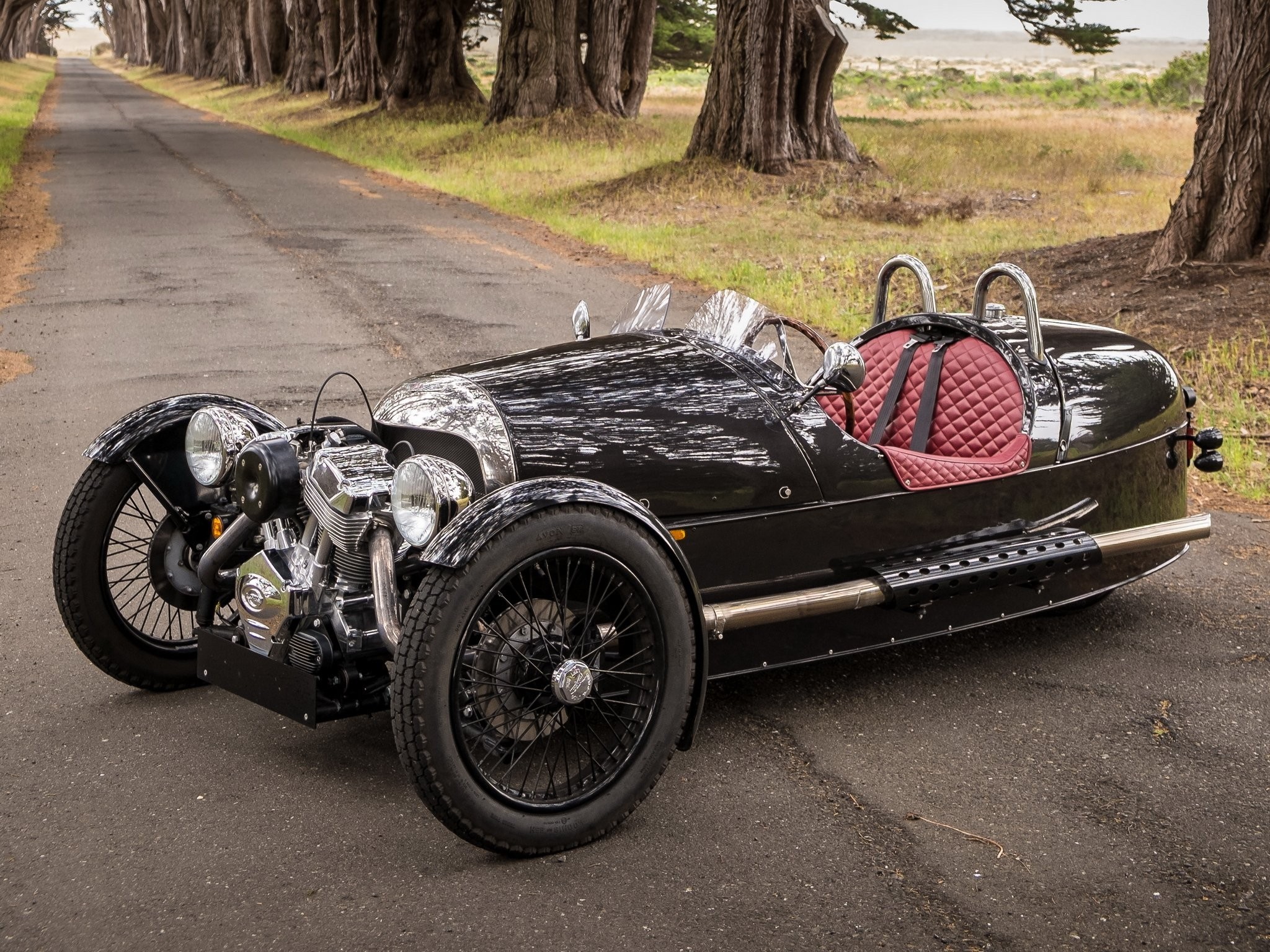
The Morgan 3 Wheeler is a two-seat, three-wheeled roadster built by hand in Malvern, England, from 2012 to 2021, after its debut at the 2011 Geneva Motor Show. A front-mounted 1,983 cc S&S V-twin with 61 kW (82 hp) drives the single rear wheel through a Mazda MX-5 five-speed gearbox and a toothed belt. The Super 3 replaced it in 2022.
In short
- Morgan took about 850 deposits after the 2011 announcement; European deliveries began in February 2012 and US deliveries in June 2012.
- Original figures: 525 kg, 0–100 km/h in about 6 seconds, 185 km/h (115 mph); Euro 4 cars from 2017 had 51 kW (68 hp) and weighed about 585 kg.
- Special editions included the Gulf (100 cars, 2012), Brooklands (2014), 110th Anniversary (2019) and the final P101 (2020–2021).
- Hand-built at Malvern Link, Worcestershire; in the United States it was homologated as a motorcycle.

Morgan 3 Wheeler at a glance
Morgan's first cars, from 1910 until the early 1950s, were three-wheelers with motorcycle V-twin engines. The 3 Wheeler of 2011 brought that layout back: two front wheels, one driven rear wheel and an exposed V-twin ahead of the radiator line. The idea came partly from the Liberty Ace, a modern Morgan-style three-wheeler built in small numbers in the United States by Pete Larsen. Morgan is reported to have acquired the design rights before developing its own car in Malvern Link, Worcestershire.

| Parameter | Metric | Imperial |
|---|---|---|
| Engine | 1,983 cc S&S V-twin, air- and oil-cooled, fuel-injected | 121 cu in |
| Power (Euro 3 / Euro 4) | 61 kW / 51 kW | 82 hp / 68 hp |
| Torque (Euro 3 / Euro 4) | 140 Nm / 129 Nm | 103 / 95 lb-ft |
| Gearbox | Mazda MX-5 five-speed manual, bevel box, toothed belt | |
| Weight (early / Euro 4) | 525 kg / about 585 kg | 1,157 / 1,290 lb |
| Length | 3,200 mm | 126 in |
| Wheelbase | 2,337 mm | 92 in |
| 0–100 km/h (early car) | about 6.0 s | 0–60 mph about 4.5 s claimed |
| Top speed | 185 km/h | 115 mph |
The old 1cars text gave a 1.8-litre engine with 136 hp. The production engine was the 2.0-litre S&S with 82 hp; Morgan's early talk of about 115 hp at the rear wheel referred to a Harley-Davidson Screaming Eagle engine that was not used.
The S&S V-twin and belt drive
The S&S V-twin is a pushrod, fuel-injected engine with a long stroke, built in the United States for custom motorcycles. In early form it gave 61 kW (82 hp) at 5,250 rpm and 140 Nm at 3,250 rpm. The power runs through a five-speed manual gearbox from the third-generation Mazda MX-5 and a propshaft. A bevel box then turns the drive through 90 degrees, and a toothed belt takes it to the rear wheel.

When Euro 3 cars could no longer be sold in Europe from January 2017, Morgan fitted new camshafts, a new engine management system and extra catalysts. The Euro 4 engine made 51 kW (68 hp) and 129 Nm at 2,500 rpm, the car became about 60 kg heavier and roughly a second slower to 100 km/h, but fuel economy improved.
With 525 kg and 61 kW, an early 3 Wheeler has about 116 kW per tonne, similar to a well-equipped hot hatchback; the power-to-weight calculator shows the sum for any other car.
Tubular frame, aluminium body and open cockpit
The structure is a tubular steel chassis with an aluminium body attached at twelve points. Front suspension uses wishbones and the rear wheel sits on a trailing arm, with Spax dampers. Narrow front tyres (about 10 cm wide, as the old article noted) and a wider rear tyre give light steering but limited grip, so the car rewards smooth driving.

The cockpit is simple: speedometer and rev counter, a large steering wheel, two narrow seats and a starter button under a flip-up cover, a detail inspired by fighter aircraft. There are no doors, no roof and no luggage space beyond a small area behind the seats and optional luggage on a rear rack. Weather protection is limited to small aero screens.
Model-year changes and special editions
| Year | Change or edition |
|---|---|
| 2011 | Debut at Geneva; launch price in the UK 32,500 pounds (about 37,000 EUR at 2011 rates) |
| 2012 | First deliveries (February in Europe, June in the US); Gulf edition, 100 cars |
| 2014 | Stiffer chassis, reduced bump-steer, improved centre drive, bevel box and cooling; Brooklands edition |
| 2015 | Steel rear belt sprocket replaces wear-prone aluminium item |
| 2017 | Euro 4 engine, about 50 mm more ride height |
| 2019 | 110th Anniversary edition |
| 2020–2021 | P101 run-out edition, 33 planned; production ends in summer 2021 |
By 2014 Morgan had sold about 1,000 cars, many to the United States. Morgan also built the EV3, an electric prototype with a 20 kWh battery, 101 bhp and an estimated 240 km range, between 2016 and 2018, but it cancelled production in late 2018. The EV3's story is told in the Morgan EV3 article.

Running costs and known problems
The 3 Wheeler is economical on fuel compared with most sports cars, and Euro 4 cars use less fuel than earlier ones. The costs come from the drivetrain, which needs regular attention. Points to check on a used car:
- bevel box: noise, oil leaks and wear; boxes bolted directly to the chassis are best left as they are;
- cush drive and belt: pre-2014 cush drives often failed, belts must be kept at the right tension, and a belt that jumps teeth bangs under load;
- rear sprocket: early aluminium sprockets wear fast, and steel is the better choice;
- engine: oil leaks at the rocker covers, head joints and oil tank welds, plus early pulley bolts;
- electrics: loose plug leads, voltage regulators and wiring faults;
- corrosion: paint bubbling on the aluminium body and rust on the tubular chassis and front mudguards.
The Mazda gearbox has a good reliability record, and on later cars the gear lever was moved forward for a better driving position. Cars with the 2014 chassis updates, or early cars fitted with Morgan's steering comfort kit, drive noticeably better.
Rivals: how the 3 Wheeler compares
| Model | Engine | Wheels driven | Character |
|---|---|---|---|
| Morgan 3 Wheeler | 2.0 V-twin, 61 kW | one rear wheel | vintage-style, light, open |
| Morgan Super 3 (2022–) | 1.5 three-cylinder Ford, about 87 kW | one rear wheel | modern successor, more practical |
| Polaris Slingshot | 2.0–2.4 four-cylinder | one rear wheel | heavier, side-by-side seats, US-built |
| Caterham Seven 270 | 1.6 four-cylinder | rear axle | four-wheeled, more grip, track-focused |
The 3 Wheeler is the most characterful of these: noisy, slow to warm up and very open, but fun at modest speeds. The Super 3 is easier to live with, and a Caterham is the better choice for track days. You can line up the 3 Wheeler against four-wheeled roadsters in the 1cars comparison tool, or see more open two-seaters among the British cars in the catalogue.

Morgan 3 Wheeler in our rankings
In production longer than 51% of ranked nameplates in the 1CARS catalog (No. 542 of 1177).
Morgan 3 Wheeler photos 15




Morgan 3 Wheeler videos 2

Video overview

Test drive
FAQ
What engine does the Morgan 3 Wheeler have?
It has a 1,983 cc S&S V-twin, air- and oil-cooled with fuel injection, mounted ahead of the front wheels. Early cars produce 61 kW (82 hp) and 140 Nm; the Euro 4 version from 2017 has 51 kW (68 hp).
How fast is the Morgan 3 Wheeler?
Morgan quoted a top speed of about 185 km/h (115 mph). Early cars reach 100 km/h in about 6 seconds, and Morgan claimed 4.5 seconds to 60 mph; Euro 4 cars are roughly one second slower because of lower power and more weight.
What gearbox does the Morgan 3 Wheeler use?
It uses the five-speed manual gearbox from the third-generation Mazda MX-5. A bevel box turns the drive through 90 degrees, and a toothed belt drives the single rear wheel, which is the part of the drivetrain that needs the most care.
What are the common problems of the Morgan 3 Wheeler?
Typical issues are bevel-box noise and leaks, worn cush drives on pre-2014 cars, belt tension and sprocket wear, oil leaks from the V-twin, electrical faults and paint bubbling on the aluminium body. Cars with the 2014 updates are better sorted.
What replaced the Morgan 3 Wheeler?
The Morgan Super 3 replaced it in 2022. It keeps the three-wheel layout and a Mazda gearbox but uses a water-cooled 1.5-litre Ford three-cylinder engine, a new monocoque and more storage space.
Data sources
Data checked by an editor against the sources below.
- Wikipedia - Morgan 3 Wheeler
- Pistonheads


