
 Iran Khodro Samand
Specs, engines and history
Updated Published Sources (1) Report an error
By Oleksandr Hnatiuk, Automotive Editor & Used Car Specialist Reviewed by Felix Hartmann
- Built
- 2001–2022
- Top power
- 84 kW (114 PS)
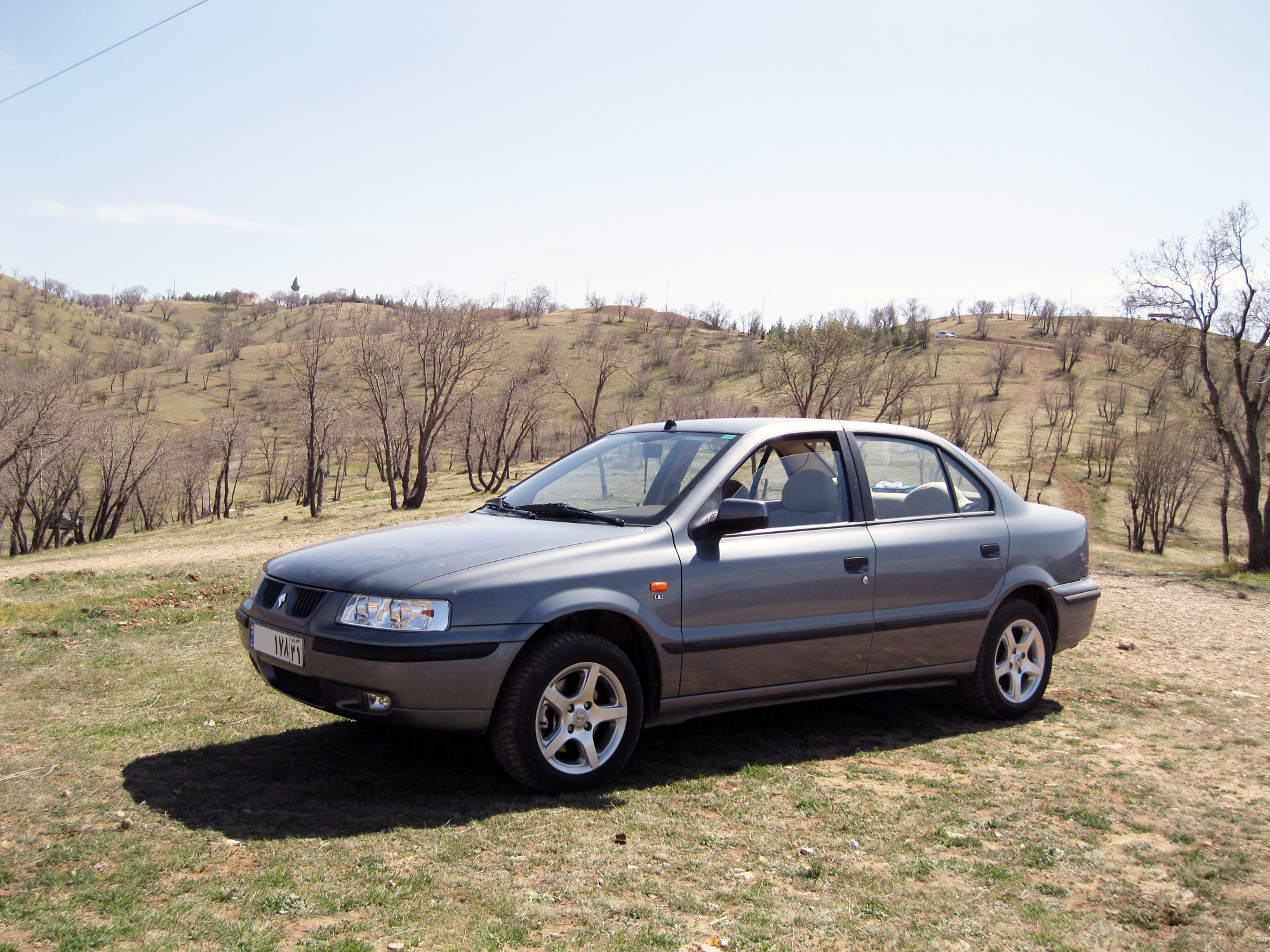
The Samand is a four-door family saloon built by Iran Khodro (IKCO) from 2001 to 2022 and regarded as Iran's national car. It is based on the Peugeot 405 platform but has an Iranian-designed body, and about 80% of its parts were made in Iran, including the EF7 engine, the country's first national engine. It replaced the long-running Paykan.
In short
- Production: 2001–2022 in Tehran; first car sold in 2001.
- Engines: Peugeot XU7 1.8 (100–110 hp), TU5 1.6 (110 hp) and IKCO's own EF7 1.7 (113 hp), which can run on petrol or compressed natural gas.
- Size: 4,502 mm long on a 2,671 mm wheelbase, 500-litre boot, five-speed manual gearbox.
- Built abroad in Azerbaijan, Belarus, Senegal, Syria and Venezuela under local names.
IKCO Samand at a glance
Iran Khodro was founded in 1962 and for decades built mainly the Paykan, sold from 1967 to 2005. According to the old 1cars text, Iran Khodro also builds trucks and buses under licence from Mercedes-Benz and produces up to about one million vehicles a year. The Samand was the company's first car designed largely in Iran and was meant to give the country a modern family saloon with mostly local parts. It uses the floorpan and much of the running gear of the Peugeot 405 (see the Peugeot catalogue), whose history is covered in the history of Peugeot. The Samand is listed in the Iran Khodro catalogue.

| Fact | Value |
|---|---|
| Maker | Iran Khodro (IKCO) |
| Production | 2001–2022 (model years 2002–2022) |
| Class | D-segment family saloon |
| Platform | Peugeot 405 |
| Engines | XU7 1.8, TU5 1.6, EF7 1.7 (petrol / CNG) |
| Gearbox | 5-speed manual |
| Local content | about 80% |
| Successor | IKCO Soren Plus |
Design and body
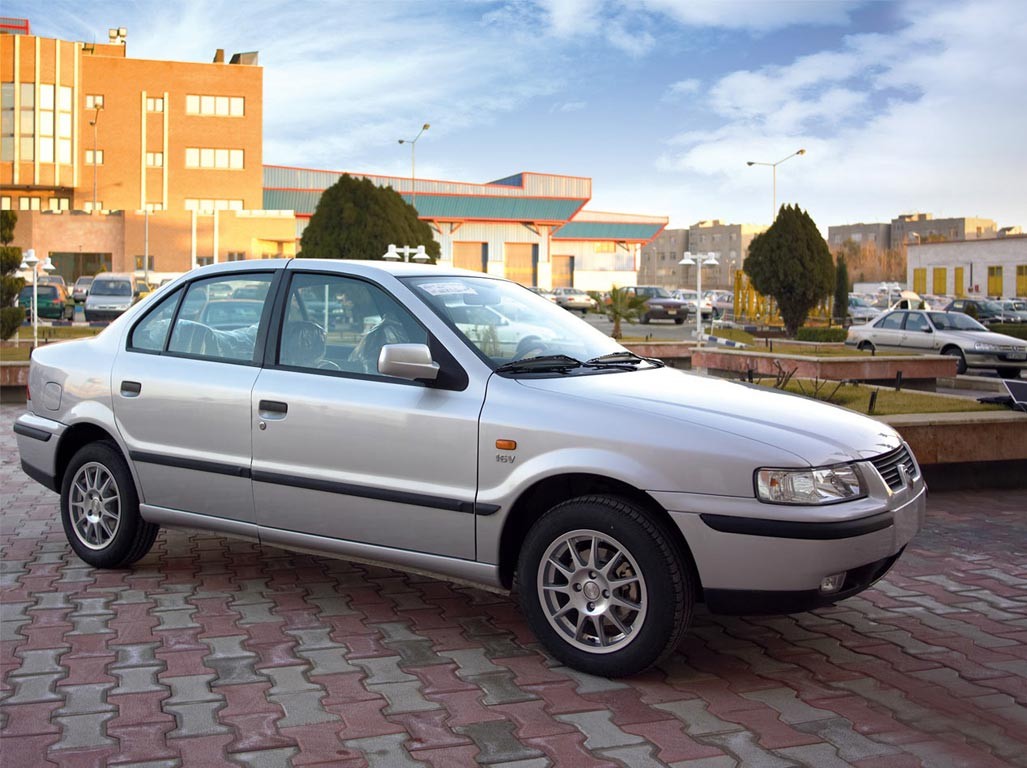
The Samand's body was designed in Iran on the Peugeot 405 base. It is a conventional four-door saloon with a high boot line and a generous cabin. According to the old 1cars text, the body is galvanised on both sides and the manufacturer gave a twelve-year warranty against corrosion. Fifteen-inch wheels and good ground clearance suit poor roads.

Engines and performance
| Engine | Type | Displacement | Power | 0–100 km/h | Kerb weight |
|---|---|---|---|---|---|
| XU7JP/L3 (PSA) | Petrol I4, 8 valves | 1.8 L | about 74 kW (100 hp) | 13.1 s (CNG 12.6 s) | 1,200 kg |
| XU7JP4/L4 (PSA) | Petrol I4, 16 valves | 1.8 L | about 81 kW (110 hp) | 9.8 s | 1,287 kg |
| TU5JP4 (PSA) | Petrol I4, 16 valves | 1.6 L | about 81 kW (110 hp) | 11.3 s | 1,220 kg |
| EF7 (IKCO) | Petrol / CNG I4 | 1.65 L (1,648 cc) | about 83 kW (113 hp) | 12.1 s (CNG 12.0 s) | 1,274–1,360 kg |
All engines drive the front wheels through a five-speed manual gearbox. The TU5 was chosen for export versions because it is economical, reasonably powerful and its parts are easy to find across Europe. The older XU7 engines are eight- and sixteen-valve versions of a long-established Peugeot design, and the 16-valve XU7JP4 gives the quickest Samand, reaching 100 km/h in under ten seconds.

The EF7 national engine
The EF7 was developed by IKCO as Iran's national engine. It is a 1.65-litre four-cylinder designed to run on both petrol and compressed natural gas, which is cheap and widely available in Iran. The bi-fuel Samand carries a large gas cylinder in addition to the petrol tank, which adds weight and reduces boot space; from mid-2010 IKCO also offered petrol-only EF7 engines without the CNG equipment. A diesel version, the EFD, was announced for 2010 but postponed because of testing needs and the lack of Euro IV diesel fuel.
Interior and practicality
The cabin is spacious, and even tall passengers fit in the back. The boot holds about 500 litres, and the fuel tank holds 70 litres; on CNG versions a gas cylinder of about 100 litres is added. Combined fuel consumption quoted in the old 1cars text is about 7 L/100 km. Critics and owners, however, have pointed to low-grade interior materials, fragile plastics, dashboards that crack or fade and trim that wears quickly, and domestic quality rankings placed the Samand near the bottom.

Dimensions

| Parameter | Metric | Imperial |
|---|---|---|
| Length | 4,502 mm | 177.2 in |
| Width (without mirrors) | 1,720 mm | 67.7 in |
| Height | 1,460 mm | 57.5 in |
| Wheelbase | 2,671 mm | 105.2 in |
| Kerb weight | 1,200–1,360 kg | 2,645–2,998 lb |
| Boot | about 500 L | about 17.7 cu ft |
| Fuel tank | 70 L | 18.5 US gal |
Safety
The Samand offers basic passive safety equipment, including airbags on many versions. Safety has been a subject of public debate in Iran: several serious multi-vehicle collisions involved Iranian-built cars, including Samands, whose airbags reportedly did not deploy, which led to calls for investigations.

Production abroad
| Country | Local name | Assembler | Years |
|---|---|---|---|
| Azerbaijan | AzSamand Aziz / Khazar LX | AzSamand | – |
| Belarus | Samand | Unison | 2006–2013 |
| Senegal | SenIran Samand Mandori | SenIran Auto | – |
| Syria | Siamco Sham | Siamco | 2006–2012 |
| Venezuela | Venirauto Centauro | Venirauto | from 2006 |
The foreign plants show how widely IKCO tried to export the Samand. In Belarus, Unison assembled it in Minsk from 2006 to 2013 alongside Lublin vans, and it signed a new agreement with IKCO in 2018 for other models. In Syria, Siamco built the car in Damascus as the Sham from 2006 to 2012. Venirauto in Maracay, Venezuela, sold it as the Centauro from 2006, SenIran Auto assembled it in Dakar, Senegal, and AzSamand built it in Shamakhi, Azerbaijan.

Versions and successors
The Samand was produced in several equipment levels and was the base for related models such as the closely related Soren and the Soren Plus, which succeeded it. It is also related to the Peugeot Pars, another Iranian development of the Peugeot 405. Production of the Samand ended in 2022 after more than two decades.

Rivals: how the Samand compares
In its home market the Samand competed with the Peugeot Pars and 405 and later with Chinese and Korean saloons such as the Geely Emgrand EC7. Abroad, its rivals were affordable family saloons such as the Renault Logan. Its strengths are space, a large boot, a simple and familiar Peugeot-based chassis and the CNG option; its weaknesses are dated design, poor interior quality and criticism of its safety.


Rivals
Compare with…
Compare Iran Khodro Samand with
- Renault Logan quick spec comparison
- Lada VAZ-2110 quick spec comparison
- Geely Emgrand EC7 quick spec comparison
-
Ended 2020
- Years
- 2012–2020
- Body
- Sedan
- Fuel
- Petrol, Diesel
- Power
- 55–75 kW (75–102 PS)
-
Ended 2007
- Years
- 1995–2007
- Body
- Sedan
- Fuel
- Petrol
- Power
- 52–67 kW (71–91 PS)
-
Ended 2016
- Years
- 2009–2016
- Body
- Sedan, Hatchback
- Fuel
- Petrol
- Power
- 72–93 kW (98–126 PS)


Iran Khodro Samand in our rankings
- No. 181 of 1195 · Longest-running car nameplates (21 years · top 16%)
- No. 163 of 214 · Most powerful sedans (84 kW · top 77%)
- No. 1005 of 1134 · Most powerful cars (84 kW · top 89%)
In production longer than 84% of ranked nameplates in the 1CARS catalog (No. 181 of 1195).
Iran Khodro Samand photos 11

FAQ
What is the IKCO Samand based on?
The Samand uses the platform and much of the running gear of the Peugeot 405, with an Iranian-designed body. About 80% of its parts were made in Iran, including the EF7 engine.
What engines does the Samand have?
It was offered with Peugeot's XU7 1.8 (100–110 hp) and TU5 1.6 (110 hp) petrol engines and IKCO's own EF7 1.65-litre engine with about 113 hp, which can run on petrol or natural gas.
When was the Samand produced?
Iran Khodro built the Samand from 2001, when the first car was sold, until 2022. It replaced the Paykan as Iran's national car, and the Soren Plus succeeded it.
Where else was the Samand built?
Local assembly took place in Azerbaijan, Belarus, Senegal, Syria and Venezuela, where the car was sold under names such as AzSamand Aziz, Siamco Sham and Venirauto Centauro.
How big is the Samand's boot?
The boot holds about 500 litres. On bi-fuel CNG versions, the gas cylinder reduces the usable space, while petrol-only versions keep the full luggage area.
Data sources
Data checked by an editor against the sources below.
- Wikipedia - IKCO Samand


