 Iveco Daily
Specs, engines and history
Updated Published Sources (1) Report an error
By Felix Hartmann, Automotive Technology & EV Contributor Reviewed by Oleksandr Hnatiuk
Which Iveco Daily to buy: verdict
Our verdict · Felix Hartmann
Choose a Daily if you need heavy payloads, towing or a strong base for a body: tippers, recovery trucks, motorhomes and minibuses suit it best. The 2014-on model with the Hi-Matic gearbox is the most refined choice, the 3.0 twin-turbo is best for heavy work, and the 2.3 is enough for lighter vans. For city deliveries with a short range, the eDaily is worth a look.
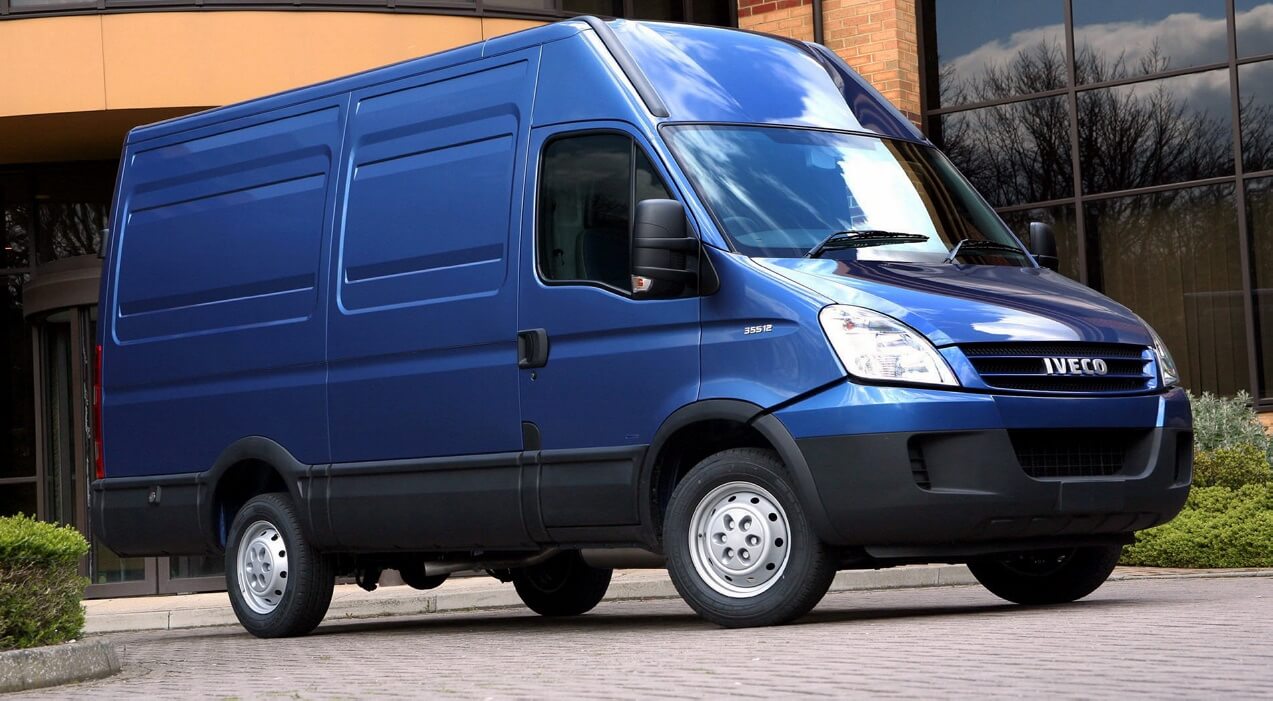
The Iveco Daily is a light commercial vehicle built since 1978, first by Fiat and then by Iveco, mainly at Suzzara in Italy. Unlike most vans, it sits on a separate ladder frame with rear-wheel drive, which lets it carry heavy loads: versions range from 3.5 to 7 tonnes gross. More than three million have been sold in over 40 years.
In short
- Generations: launched in 1978, new series in 1990, 1999–2000 and 2006, a facelift in 2011 and a fully revised model in July 2014, updated in 2019.
- Engines of the current model: 2.3- and 3.0-litre four-cylinder diesels, plus 3.0 CNG, with outputs of up to about 150 kW in the 2015 range.
- Gearboxes: six-speed manual or the ZF-based eight-speed Hi-Matic automatic; rear-wheel drive, with a 4×4 version.
- Bodies: panel van, chassis cab, double cab, minibus and the electric eDaily.

The Daily at a glance: segment, bodies and plants
The Daily covers more ground than most vans: from a 3.5-tonne panel van to a 7-tonne chassis cab that carries tipper, box or motorhome bodies. Its ladder frame, independent front suspension and rear-wheel drive have stayed the same since 1978. The main plant is at Suzzara, near Mantua, and the Daily is sold in about 110 markets. In China, Naveco has built licensed versions since 1991. The company's story is in the history of Iveco, and the brand's models are in the Iveco catalogue.

| Fact | Value |
|---|---|
| Maker | Iveco; launched in 1978 as the Fiat Daily |
| Production | 1978 to date |
| Main plant | Suzzara, Italy |
| Construction | Separate ladder frame, rear-wheel drive (4×4 available) |
| Gross vehicle weight | 3.5–7.0 t, depending on version |
| Bodies | Van, chassis cab, double cab, minibus, camper base |
| Sales | more than 3 million in over 40 years |
Iveco Daily generations since 1978
| Generation | Code | Years | Body styles | Engines | Power (hp / kW) |
|---|---|---|---|---|---|
| First | 30F8 / 35F8 / 40F8 | 1978–1990 | Van, chassis cab, double cab, minibus | 2.5 and 2.8 diesel and turbodiesel | 56–91 kW (75–122 hp) |
| Second | – | 1990–1999 | Same, plus 4×4 | Sofim 2.5 and 2.8 diesels | – |
| Third | – | 1999–2006 | Van, chassis cab, minibus, CNG | 2.8, 2.3 F1A and 3.0 F1C common-rail diesels | 74–122 kW (99–164 hp) |
| Fourth | – | 2006–2011 | Van, chassis cab, combi, minibus, CNG, 4×4 | 2.3 and 3.0 diesels, 3.0 CNG | – |
| Fifth (facelift) | – | 2011–2014 | Same range, Euro 5 and EEV | 2.3 and 3.0 diesels, 3.0 CNG | 78–151 kW (106–205 PS) |
| Current | – | 2014– | Van, chassis cab, double cab, minibus, eDaily | 2.3 and 3.0 diesels, 3.0 CNG, electric | 93–150 kW (126–204 PS) |
Counting the generations is not straightforward: Iveco itself called the 2014 model the third generation, while European magazines count each new series since 1978. The 2014 Daily brought about 80 % new body parts, a load floor 55 mm lower and shorter overhangs, and the 2019 update added full-LED headlamps and more driver assistance.
From TurboDaily to the twin-turbo 3.0
The first Daily used 2.5- and 2.8-litre diesels from 56 kW (75 hp), with turbodiesels from 1985 under the TurboDaily name. From 1999–2000 common-rail "Unijet" diesels took over, followed by the 2.3-litre F1A in 2003 and the 3.0-litre F1C in 2004. The 2011 facelift offered three 2.3 versions of 106, 126 and 146 PS, and 3.0 engines of 146, 170 and 205 PS, the strongest with a twin turbocharger.

| Engine (2015 range, Australia) | Power | Torque |
|---|---|---|
| 2.3 turbo-diesel, four-cylinder | 93 kW at 3,000–3,600 rpm | 320 Nm |
| 3.0 turbo-diesel, single turbo | 125 kW at 2,900–3,500 rpm | 430 Nm |
| 3.0 turbo-diesel, twin turbo | 150 kW at 3,100–3,500 rpm | 470 Nm |
| 3.0 CNG (Natural Power) | 100 kW (136 PS) | – |
A six-speed manual is standard on most versions. The ZF-sourced eight-speed Hi-Matic automatic with Eco and Power modes joined the range on the 2014 model, which also offers eight rear-axle ratios and an optional rear differential lock. Earlier Dailies offered the Agile automated manual. The 4×4 version, developed with SCAM from 2007, has a transfer case and locking differentials.
Weights, wheelbases and load space
The Daily is sold in two main families: the S models with single rear wheels and the heavier C models with twin rear wheels. Gross weights range from 3.5 to 7.0 tonnes; in the 2015 range, wheelbases ran from 3,520 to 4,750 mm, and chassis-cab versions took bodies up to 6,190 mm long.

| Parameter | Metric | Imperial |
|---|---|---|
| Gross vehicle weight | 3,500–7,000 kg | 7,716–15,432 lb |
| Wheelbase | 3,520–4,750 mm | 138.6–187.0 in |
| Maximum body length (chassis cab) | 6,190 mm | 243.7 in |
| Load floor (2014 van) | 55 mm lower than before | 2.2 in lower |
| Service interval | 40,000 km | 24,855 miles |
If you plan a high-roof van, check the height against your garage or depot entrance with the garage fit tool.
Fuel savings, CNG and service intervals
Iveco claimed a 4.1 % fuel saving for the 2014 Daily over its predecessor, helped by better aerodynamics and new gearing. The CNG Natural Power version cuts running costs and emissions where gas is cheap, and long service intervals of 40,000 km reduce workshop time. To estimate the cost of a daily route, enter your consumption in the fuel cost calculator.

Electric and alternative-fuel versions
Iveco first showed an electric Daily in August 2010, with a 30 kW motor (60 kW peak) and a 21.2 kWh battery. The 2014 model offered electric drive with 60 or 80 kW motors and a range of up to 280 km. A hydrogen fuel-cell eDaily followed in September 2022, with a 140 kW motor and a 90 kW fuel-cell system for a range of up to 350 km. In 2023 a 3.5-tonne eDaily set a Guinness World Record for the heaviest load towed by an electric van.

Trims, equipment and safety
The 2015 Daily came with stability and traction control, trailer-sway mitigation, rollover mitigation, ABS with brake-force distribution, front and curtain airbags, hill-start assist and disc brakes front and rear. Lane-departure warning and a reversing camera were optional, and pneumatic rear suspension was available. In ANCAP's 2022 commercial-van grading, which uses medals rather than stars, the Daily scored 41 % overall for a Silver rating.

Frame, clutch and DPF: used-van checks
The ladder frame and simple diesel engines give the Daily a long working life, and its two awards as Van of the Year, for 2000 and 2015, reflect strong designs. On a used vehicle, check the frame for corrosion and cracks, especially on tippers and campers. Then look at the clutch and gearbox on manual vans, the diesel particulate filter on Euro 5 and later engines, and the rear springs.

Rivals: how the Daily compares
| Model | Construction | Drive | Heaviest version |
|---|---|---|---|
| Iveco Daily | Separate ladder frame | Rear, 4×4 optional | 7.0 t |
| Mercedes-Benz Sprinter | Unitary body | Front, rear or 4×4 | about 5.5 t |
| Ford Transit | Unitary body | Front, rear or AWD | about 4.7 t |
| Renault Master | Unitary body | Front or rear | about 4.5 t |
Compared with the Mercedes-Benz Sprinter, Ford Transit and Renault Master, the Daily carries more weight in its top versions because of its truck-style frame: by our count, its 7-tonne chassis cab is rated for about 2,500 kg more gross weight than the heaviest Master. The trade-off is a higher load floor on some versions and a firmer ride when empty.

Rivals
Compare with…
Compare Iveco Daily with
- Mercedes-Benz Sprinter quick spec comparison
- Ford Transit quick spec comparison
-
EV version
Ended 2018
- Years
- 1995–2018
- Body
- Pickup, Van
- Fuel
- Petrol, Diesel
- Power
- 58–190 kW (79–258 PS)
2 generations
- T1N
- NCV3
-
EV version
In production
- Years
- 1965–present
- Body
- Pickup, Van
- Fuel
- Petrol, Diesel, Electric
4 generations
- Mk1/Mk2
- VE6
- V184
- IV


Iveco Daily photos 12


Iveco Daily videos 2

Test drive

Iveco Daily video 2
FAQ
How many generations of the Iveco Daily are there?
Sources count differently. The Daily was launched in 1978, renewed in 1990, 1999–2000 and 2006, facelifted in 2011 and fully revised in July 2014. Iveco calls the 2014 model the third generation; magazines usually count five or six series.
What engines does the Iveco Daily use?
Current versions use 2.3- and 3.0-litre four-cylinder diesels, a 3.0-litre CNG engine and electric drive. In the 2015 range the diesels gave 93 to 150 kW, with a six-speed manual or the eight-speed Hi-Matic automatic.
What is the maximum weight of the Iveco Daily?
Gross vehicle weights range from 3.5 to 7.0 tonnes. The heavier C models with twin rear wheels and the ladder frame allow far higher payloads than most vans of the same size.
Is the Iveco Daily available with four-wheel drive or electric power?
Yes. A 4×4 version has been offered since the 1980s, with a modern version developed with SCAM from 2007. The electric eDaily has been available since the 2010s, and a fuel-cell version was shown in 2022.
What are the main rivals of the Iveco Daily?
Its main rivals are the Mercedes-Benz Sprinter, Ford Transit, Renault Master and Fiat Ducato. The Daily stands out with its separate ladder frame, rear-wheel drive and gross weights of up to 7 tonnes.
Data sources
Data checked by an editor against the sources below.