 Asia Motors Asia Hi-Topic
Specs, engines and history
Updated Published Sources (2) Report an error
By Sarah Whitmore, Senior Automotive Writer Reviewed by Oleksandr Hnatiuk

- Built
- 1987–1999
- Top power
- 55 kW (75 PS)
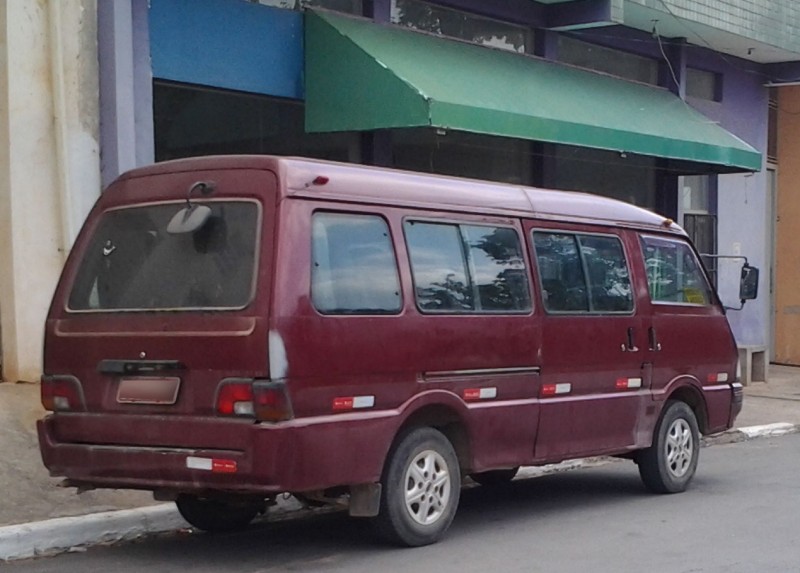
The Asia Hi-Topic (AM725) is a light commercial vehicle built by the South Korean manufacturer Asia Motors from 1987 to 1999. Offered as a panel van, a six-seat crew van, a 15-seat minibus, a refrigerated van and a pickup, it belongs to the Topic family related to the Mazda Bongo and Kia Bongo. Its 2.7-litre diesel and petrol engines produce about 55 kW (75 hp).
In short
- Maker: Asia Motors, founded in 1965 in Gwangju, owned by Kia from 1976; the Asia brand ended in 1999.
- Production: 1987–1999 according to specification databases; also on sale in export markets in the 1990s.
- Engines: 2.7-litre diesel and 2.7-litre petrol, both about 55 kW (75 hp).
- Chassis: independent front suspension with wishbones, rigid rear axle on leaf springs, rear-wheel drive.
Specs by version
Verified Manufacturer and type-approval data from our catalog · Sources and methodology
Asia Hi-Topic at a glance
The Hi-Topic is a simple, robust workhorse designed to carry passengers or goods in towns and on poor roads. It has no luxuries, but its simple design makes it reliable and easy to repair. In the 1990s the 15-seat version was widely used as a minibus for shuttle and shared-taxi services in several countries. Asia Motors' story is told in the history of Asia, and the brand's models are in the Asia Motors catalogue.

| Fact | Value |
|---|---|
| Maker | Asia Motors, Gwangju (South Korea) |
| Model code | AM725 |
| Production | 1987–1999 |
| Body styles | Van, crew van (6 seats), minibus (15 seats), refrigerated van, pickup |
| Engines | 2.7 L diesel, 2.7 L petrol |
| Power | about 55 kW (75 hp) |
| Drive | Rear-wheel drive |
| Related models | Asia Topic, Kia Bongo, Mazda Bongo |
Asia Motors and the Topic family
Asia Motors was founded in Gwangju in 1965, financed by the entrepreneur Lee Mun-hwan, after a 1962 tax exemption encouraged local assembly of imported parts. It first built military vehicles, trucks and buses, and from 1970 it assembled the Fiat 124 under an agreement with Fiat. Dongkuk Steel took over the company in 1969, and in 1976 Kia bought it after Asia lost its car-assembly permits. A 1978 agreement with Hino Motors helped Asia build larger trucks and buses.

Asia's light commercial range included the Asia Topic, related to the Mazda Bongo and the first Kia Bongo, the Asia Towner, a version of the Daihatsu Hijet also sold as the Kia Towner, and the Asia Combi minibus, based on the Mazda Parkway and closely related to the Kia Combi. The Hi-Topic extended the Topic idea to a larger van and minibus, so that together with the small Towner and the large Combi, Asia covered the whole light commercial range. Asia also built the Rocsta off-roader, later replaced by the Retona. After Hyundai acquired Kia, the Asia brand was discontinued in 1999, and models such as the Retona continued under the Kia name.
Body styles and interior
The Hi-Topic's appearance is plain and functional, with a flat cab-over front and a tall body. The range covers several body styles:
| Version | Seats | Use |
|---|---|---|
| Panel van | – | Goods delivery |
| Crew van | 6 | Passengers and cargo |
| Minibus | 15 | Passenger transport |
| Isothermal van | – | Food delivery; refrigeration unit optional |
| Pickup | 2 or 5 (double cab) | Building and farm work |

The cabin is not especially roomy, but it is adequate for the driver and passengers. The 15-seat minibus has rows of seats behind the cab, while the six-seat crew van combines a second row with a cargo area. Equipment is basic, and power steering was an option.
Engines and transmission
| Engine | Displacement | Power | Notes |
|---|---|---|---|
| Diesel | 2.7 L | about 55 kW (75 hp) | Naturally aspirated |
| Petrol | 2.7 L | about 55 kW (75 hp) | Base engine in many markets |
The engines drive the rear wheels through a five-speed manual gearbox or, on some versions, an automatic with three gears plus overdrive. The modest output of 75 hp is enough for steady acceleration in town traffic, but performance is limited when the vehicle is fully loaded.

Chassis
The front suspension is independent with transverse wishbones, while the rear uses a rigid one-piece axle on leaf springs. The optional hydraulic power steering makes the van easier to manoeuvre in town. The simple construction means that the Hi-Topic can be repaired almost anywhere, and spare parts have been easy to find.

The bigger brother: Asia Combi
Above the Hi-Topic, Asia offered the Combi, a 24-seat minibus launched in October 1983 and based on the second-generation Mazda Parkway. Most versions used a 4.05-litre Mazda six-cylinder diesel with 74 kW (100 PS), and from 1996 Hyundai turbo-diesels with 3.3 and 3.9 litres and 88–103 kW (120–140 PS) were added. The original twin-headlight AM805/807 was followed by the AM815 with single headlights, the AM815 Hi-Combi in 1994 and the updated AM825 for 1996. After the Asia brand disappeared, the minibus continued as the Kia Combi until October 2002. Together, the Hi-Topic and Combi covered the light and medium passenger-transport market for Asia Motors. Other light commercial models can be found in the vans section.

The Hi-Topic in service
The Hi-Topic earned a reputation as a very tough vehicle. Owners noted that it reliably carries passengers or cargo day after day, even on poor roads, and copes with its transport tasks without complaint. It is not comfortable by modern standards, but owners valued its ability to keep working with minimal maintenance. As the Asia brand ended in 1999, new vehicles stopped arriving in export markets, and today the Hi-Topic is found mainly on the used market. Asia Motors also tried to expand in South America, founding Asia Motors do Brasil in 1994, but a planned plant at Camaçari was never completed.

Rivals: how the Hi-Topic compares
The Hi-Topic competed with light vans and minibuses such as the Toyota HiAce, Mitsubishi L300, Hyundai H-100 and its relative, the Kia Bongo. Its strengths are a simple and durable design that tolerates hard work, several body styles, a 15-seat minibus version and easy repair; its weaknesses are low power, basic comfort and equipment, and limited safety by today's standards. For later Korean vans and cars, see the history of Kia and other Korean cars.

Asia Motors Asia Hi-Topic photos 15


Asia Motors Asia Hi-Topic videos 2

Asia Motors Asia Hi-Topic video 1

Asia Motors Asia Hi-Topic video 2
FAQ
Who made the Asia Hi-Topic?
The Hi-Topic was made by Asia Motors of Gwangju, South Korea, which had belonged to Kia since 1976. The Asia brand was discontinued in 1999 after Hyundai acquired Kia.
What engine does the Asia Hi-Topic have?
It uses a 2.7-litre diesel or a 2.7-litre petrol engine, both producing about 55 kW (75 hp), with a five-speed manual gearbox or an automatic with three gears plus overdrive.
How many seats does the Asia Hi-Topic have?
The minibus version seats 15 people and the crew van six, while the panel van has a front cab and a large load area. Pickups with two-seat and five-seat cabs were also built for some markets.
When was the Asia Hi-Topic produced?
Specification databases list production of the Hi-Topic AM725 from 1987 to 1999. The Asia brand, and with it the Hi-Topic name, disappeared in 1999 after Hyundai took over Kia and its subsidiaries.
Is the Asia Hi-Topic related to the Kia Bongo?
Yes. The Hi-Topic belongs to Asia's Topic family, which is related to the Mazda Bongo and the first-generation Kia Bongo, both light vans built with Mazda technology.
Data sources
Data checked by an editor against the sources below.
- The text of this article (1cars archive)
- Auto-data - Asia Hi Topic Am 725 2.7 D 75hp 2871