
LuAZ-969
Specs, engines and history
Updated Published Sources (2) Report an error
By Oleksandr Hnatiuk, Automotive Editor & Used Car Specialist Reviewed by Felix Hartmann

- Built
- 1971–1975
- Top power
- 30 kW (41 PS)
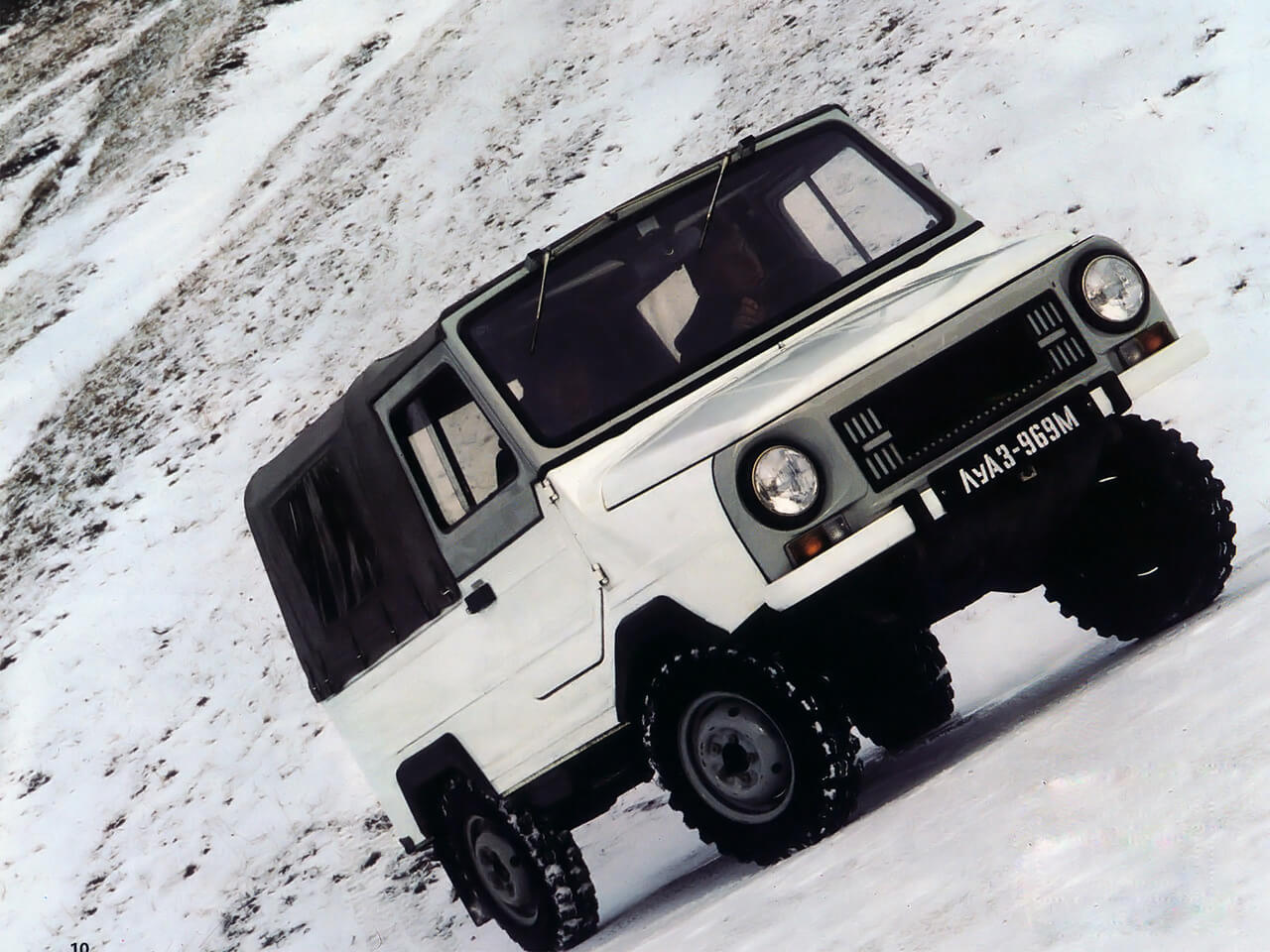
The LuAZ-969 is a small cargo-and-passenger 4x4 built by the Lutsk Automobile Plant (LuAZ) in Ukraine, then part of the Soviet Union. It grew out of the military LuAZ-967 front-line transporter, entered production in 1971 with switchable four-wheel drive and, as the 969M Volyn from 1979, used a 1,197 cc air-cooled V4 rated at 29 kW (40 PS).
In short
- A light open 4x4 for rural work, derived from the amphibious LuAZ-967 and developed with NAMI and the Zaporizhzhia plant (ZAZ).
- The family runs ZAZ-969V (front-wheel drive, late 1960s) → LuAZ-969 (1971) → LuAZ-969A (1975) → LuAZ-969M Volyn (1979) → LuAZ-1302.
- Front-mounted air-cooled V4 from the Zaporozhets line: 887 cc and 22 kW (30 PS) at first, later 1,197 cc and 29 kW (40 PS).
- About 230,000 were built across all versions, by German-language production counts.

Size at a glance
GAZ-69
The LuAZ-969 is 460 mm shorter, 140 mm narrower and 170 mm lower than the GAZ-69.
| Dimensions | LuAZ-969 | GAZ-69 | Difference |
|---|---|---|---|
| Length | 3,390 mm133.5 in | 3,850 mm151.6 in | −460 mm−18.1 in |
| Width | 1,610 mm63.4 in | 1,750 mm68.9 in | −140 mm−5.5 in |
| Height | 1,780 mm70.1 in | 1,950 mm76.8 in | −170 mm−6.7 in |
| Wheelbase | 1,800 mm70.9 in | 2,300 mm90.6 in | −500 mm−19.7 in |
Running cost
Fuel · LuAZ-969 1.2 SUV
about 3,950 EUR fuel a year at 15,000 km
15.0 l/100 km · petrol at 1.75 EUR/l · change mileage, fuel price or version
Specs by version
Engines
Performance
Show all 1 versions
| Version | Top speed | Fuel consumption |
|---|---|---|
| 1.2 SUV | 90 km/h56 mph | 15.0 l/100 km15.7 mpg US · 18.8 mpg UK |
Dimensions and weight
Verified Manufacturer and type-approval data from our catalog · Sources and methodology
Development and production history
The LuAZ-969 took more than a decade to reach its final form: the first prototype ran in 1958, the four-wheel-drive production model arrived in 1971 and the definitive 969M followed in 1979. The starting point was a NAMI project of the late 1950s for a small off-road vehicle that could carry around 300 kg (661 lb) on farm tracks. German sources name the Steyr-Puch Haflinger as one of the vehicles the engineers studied.

The NAMI-049 of 1958 had a fibreglass body, independent torsion-bar suspension, permanent four-wheel drive and a motorcycle engine of 16 kW (22 PS). English sources call that engine the MD-65, while the German account describes a two-cylinder boxer of motorcycle origin. Whatever its name, it was too weak, and the plastic body proved fragile.
The second prototype, NAMI-049A, switched to a steel body and an air-cooled V4 related to the engine of the ZAZ-965A small car. It also introduced the layout the production car kept: front-wheel drive with a rear axle that the driver could engage. In parallel, the same engineering base produced the military LuAZ-967, an amphibious transporter with a watertight steel body that moved through water at about 3 km/h (2 mph) and went into production from 1961.
From ZAZ-969V to LuAZ-969
Civilian production was authorised in 1966, but the first version, the ZAZ-969V, came without driven rear wheels. Rear axles were in short supply, and the supplier gave priority to the military 967. The ZAZ-969V was built from 1967 to 1971 (some sources start it in 1966) after a pre-production batch of fifty cars. On 11 December 1966 the Lutsk works, until then a general engineering plant, was renamed the Lutsk Automobile Plant; its wider story is told in our history of the Lutsk Automobile Plant.
In 1971 LuAZ took full charge of the model. The LuAZ-969 now had four-wheel drive as standard, with a switchable rear axle and an added crawler gear. In 1975 the plant joined the AvtoZAZ group, and the LuAZ-969A arrived with the larger 1,197 cc engine and a rear differential lock. Development of the 969M began in 1974, and the car was shown at Turin in 1978, where the plant reports it was named among the top ten exhibits. Series production of the 969M started in 1979.
| Year | Event |
|---|---|
| 1958 | NAMI-049 prototype with fibreglass body and motorcycle engine |
| 1961 | Production of the military LuAZ-967 begins |
| 1966 | Civilian ZAZ-969V authorised; plant renamed LuAZ on 11 December |
| 1967 | ZAZ-969V series production, front-wheel drive only |
| 1971 | LuAZ-969 with four-wheel drive as standard |
| 1975 | LuAZ-969A with 1,197 cc V4; plant joins AvtoZAZ |
| 1977 | LuAZ-969F hard-top panel van |
| 1978 | 969M shown at Turin |
| 1979 | LuAZ-969M Volyn enters production |
| 1982 | 100,000th LuAZ vehicle built |
| 1990 | Plant record of 16,500 vehicles in a year |
| Early 1990s | LuAZ-1302 takes over from the 969M |
Design and engineering
The LuAZ-969 is a front-engined, front-wheel-drive vehicle with an engageable rear axle, portal axles and independent suspension on all four wheels. That combination explains its reputation off road. The portal axles use reduction gears at the wheel hubs, which lift the axle housings and give 280 mm (11.0 in) of ground clearance on the 969A and 969M; the front-drive ZAZ-969V had 300 mm (11.8 in).

Each wheel is located by trailing arms with torsion bars and hydraulic dampers, a layout inherited from the NAMI prototypes. The wheelbase stayed at 1,800 mm (70.9 in) for every version, and the 969M is about 3.4 m (11.1 ft) long, roughly 1.6 m (5.2 ft) wide and 1.8 m (5.9 ft) high with the top up. The body is an open steel structure with a fabric tilt.
The short wheelbase, the high clearance and a kerb mass of 960 kg (2,116 lb) for the 969M are the real reasons the car crosses mud and snow well. The same light, narrow package keeps the car usable on forest tracks and field edges, which is exactly the work NAMI had in mind.
What the 969M changed
The 969M of 1979 was the most thorough update of the family. It received a dual-circuit hydraulic brake system with a vacuum servo, doors that could be locked, a folding windscreen and a new interior. English-language sources describe front disc brakes on the 969M, while the German account lists drums on all four wheels, so the brake hardware on a given car is worth checking. A fuel-burning cabin heater was fitted, since the air-cooled engine gives no hot coolant to heat the interior.
Engine and drivetrain
Every production LuAZ-969 used an air-cooled petrol V4 from the Zaporozhets family, mounted at the front and driving the front wheels. The ZAZ-969V had the 887 cc (54.1 cu in) unit of the early ZAZ-966 with 22 kW (30 PS). From the 969A onwards the engine was the MeMZ-969A, a 1,197 cc (73.0 cu in) air-cooled V4 with about 29 kW (40 PS), closely related to the engines of the ZAZ-966 and ZAZ-968.

Power goes through a four-speed manual gearbox and a reduction stage that works as a crawler gear for steep or soft ground. The driver engages the rear axle when needed; on hard roads the car runs in front-wheel drive. The 969A and later cars also have a lockable rear differential.
With 29 kW (40 PS) moving close to a tonne, the 969M is slow on the road, and the air-cooled V4 is loud in an open body. Its strengths are low-speed traction and simple maintenance rather than pace. An Italian importer is reported to have offered the car with a 1.1-litre Ford engine of 37 kW, but these were export conversions, not factory versions.
LuAZ-969M specifications
The table covers the LuAZ-969M Volyn, the most numerous version. Figures marked "about" come from a single reference table; top speed and torque are left out because sources disagree. For catalogue data on one version, see the 1.2 SUV version specs.

| Parameter | Metric | Imperial |
|---|---|---|
| Production | 1979 – early 1990s | 1979 – early 1990s |
| Body | Open 4x4 with fabric tilt | Open 4x4 with fabric tilt |
| Engine | MeMZ-969A air-cooled petrol V4 | MeMZ-969A air-cooled petrol V4 |
| Displacement | 1,197 cc | 73.0 cu in |
| Maximum power | 29 kW (40 PS) | 29 kW (40 PS) |
| Gearbox | 4-speed manual with crawler gear | 4-speed manual with crawler gear |
| Drive | Front-wheel drive, engageable rear axle (4x4) | Front-wheel drive, engageable rear axle (4x4) |
| Wheelbase | 1,800 mm | 70.9 in |
| Ground clearance | 280 mm | 11.0 in |
| Kerb mass | 960 kg | 2,116 lb |
| Gross mass | about 1,360 kg | about 2,998 lb |
| Payload | 400 kg | 882 lb |
| Fuel tank | 34 L | 9.0 US gal |
| Fuel consumption (control figure at 60 km/h) | 10 L/100 km | 23.5 mpg US |
The consumption figure is a factory-style control value at a steady 60 km/h (37 mph), not an average for off-road use. Some references give the gross mass with a soft top as 1,340 kg (2,954 lb).
Variants and derivatives
The 969 family consists of four main production versions plus a panel van, and it led directly to the LuAZ-1302.
| Variant | Years | Body / purpose | Engine | Notes |
|---|---|---|---|---|
| ZAZ-969V | 1967–1971 | Open utility vehicle | 887 cc V4, 22 kW (30 PS) | Front-wheel drive only; about 7,400 built |
| LuAZ-969 | 1971–1975 | Open 4x4 | Air-cooled V4 | Switchable rear axle, crawler gear; 16,210 built |
| LuAZ-969A | 1975–1979 | Open 4x4 | 1,197 cc V4, 29 kW (40 PS) | Rear differential lock; output figures differ |
| LuAZ-969F | from 1977 | Hard-top panel van | Air-cooled V4 | 400 kg payload, small numbers |
| LuAZ-969M Volyn | 1979 – early 1990s | Open 4x4 | MeMZ-969A, 29 kW (40 PS) | Servo brakes, new interior; 170,683 built |
| LuAZ-1302 / 13021 | early 1990s – early 2000s | 4x4 and pickup | 1.1-litre Tavria-type engine | Successor; 13021 is the pickup |
The name Volyn (also Volynianka), taken from the Volyn region around Lutsk, belongs to the 969M, but it is widely used for the whole family. The military LuAZ-967 is a parent rather than a variant. The plant also built related vehicles on its own base, such as the LuAZ-970 six-wheel amphibian, the LuAZ-13019 six-wheeled pickup of 1990 and the LuAZ-1901 Geolog 6x6 of 1999; none of them is a 969 version. The successor, the LuAZ-1302, was developed from the 969M and switched to a 1.1-litre engine of the Tavria type.
In service: operation, reliability and legacy
The LuAZ-969 served as a rural workhorse of the Soviet Union (USSR), used by assembly crews, agriculture, forestry services, the army, and postal and medical services. Its design suited places where a larger 4x4 was too heavy or too expensive to run. By German-language counts about 7,400 ZAZ-969V, 16,210 LuAZ-969, tens of thousands of 969A and 170,683 969M were built, about 230,000 in total.

The 969M was also the plant's international calling card. After Turin it was presented in Brussels in January 1979, and in July 1979 it won a gold medal at a trade fair in Czechoslovakia.
There are no reliable published figures for engine life or failure rates, so claims of a fixed engine lifespan in older reviews should be ignored. What can be said is that the air-cooled V4 is a shared Zaporozhets design, and that the open body leaves the car and its occupants exposed to the weather. After the Soviet era the Lutsk plant was privatised, became part of the Bogdan group in 2005, went bankrupt in July 2020 and saw the brand revived in 2022.
Preservation and collecting today
A LuAZ-969M is now a collectable small 4x4, and occasional examples have been imported to the United States under the 25-year rule. Parts supply abroad is the main worry for owners outside the former Soviet Union, although repair videos are available online.

When looking at a car, check:
- The version: front-drive ZAZ-969V, 969 or 969A, or the later 969M with locking doors and the revised interior.
- The body, floor and frame members for corrosion.
- The portal axle hubs and the rear axle engagement.
- The brake system: dual circuit with servo on the 969M, and whether the front brakes are discs or drums.
- The engine: an original MeMZ V4 or a later conversion, which matters for originality.
For the rest of the range from the same plant, browse all LuAZ models, other Ukrainian cars and more classic cars of the 1970s.
Rivals
Compare with…
Compare LuAZ-969 with
- GAZ-69 quick spec comparison

Popular comparisons
LuAZ-969 in our rankings
- No. 1 of 198 · Smallest SUVs and crossovers (3,390 mm)
- No. 1 of 145 · Lightest SUVs and crossovers (960 kg)
- No. 2 of 558 · Smallest cars (3,390 mm)
- No. 29 of 418 · Lightest cars (960 kg · top 7%)
- No. 883 of 1142 · Longest-running car nameplates (4 years · top 83%)
- No. 283 of 316 · Most economical cars (15.0 l/100 km · top 91%)
Shorter than 99% of ranked SUVs and crossovers in the 1CARS catalog (No. 1 of 198).
LuAZ-969 photos 23




LuAZ-969 videos 4

LuAZ-969 video 1

LuAZ-969 video 2

LuAZ-969 video 3

LuAZ-969 video 4
FAQ
When was the LuAZ-969 produced, and where?
It was built in Lutsk, Ukraine. The front-drive ZAZ-969V ran from 1967 to 1971, the four-wheel-drive LuAZ-969 from 1971, the 969A from 1975 and the 969M Volyn from 1979 into the early 1990s, when the LuAZ-1302 replaced it.
How many LuAZ-969 were built?
About 230,000 across all versions, according to German-language counts: roughly 7,400 ZAZ-969V, 16,210 LuAZ-969, tens of thousands of 969A and 170,683 969M. Totals for the 969A differ between sources, so the overall figure is approximate.
What engine does the LuAZ-969 have?
An air-cooled petrol V4 from the Zaporozhets family, mounted at the front. The early ZAZ-969V used an 887 cc engine with 22 kW (30 PS); the 969A and 969M use the 1,197 cc MeMZ-969A with about 29 kW (40 PS).
Is the LuAZ-969 the same as the Volyn?
Yes. Volyn, or Volynianka, is the name of the LuAZ-969M, taken from the region around Lutsk. In everyday use the name covers the whole 969 family and sometimes the successor LuAZ-1302 as well.
Is the LuAZ-969 collectable, and what should buyers check?
Yes, especially the 969M. Check the body, floor and frame for rust, the portal axle hubs, the rear axle engagement, the brake system and whether the original air-cooled V4 is fitted. Outside the former Soviet Union, parts supply needs planning.
Data sources
Data checked by an editor against the sources below.
- The text of this article (1cars archive)
- Wikipedia - LuAZ 969


